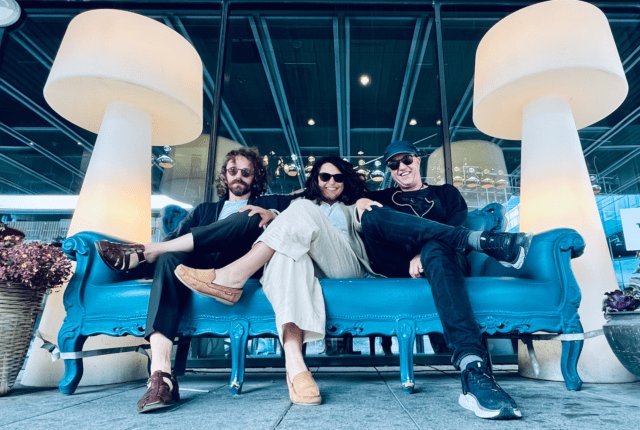
Team Mirage: Egil Håskjold Larsen, Racha Helen Larsen and Martijn te Pas
“This year we are simply expanding and building on what we did in 2021 by creating an international oasis where even more artists, filmmakers and producers, but also editors, sound designers and cinematographers meet, see and present films, discuss them and create new exciting alliances,” explain founders Racha Helen Larsen and Egil Håskjold Larsen on the eve of the second Mirage festival, running October 12-16 in Oslo.
Theirs is an “art of the real” festival, they underline, that foregrounds art but which sets out to question and challenge “the traditional conceptions of what documentary film actually is,” or indeed how it should be experienced.
Film therefore rubs shoulders with performance, such as with cosmic rave guru Timo Kaukolampi’s live musical accompaniment of Burial by Emilija Skarnulyte, about the shutdown and burial of a nuclear power plant.
Doc also fuses with art in the form of Tonje Bøe Birkeland’s exhibition in which she stages and photographs herself as a series of female explorers in unknown terrain. This is programmed to complement C. S. Nicholson’s experimental doc The Discoverer of the Discoverers in which a family in the West African Republic of Benin re-tell their version of their ancestors’ first encounter with Europeans.
“This year we also give more room to films from all over the world for which the word ‘documentary’ hardly applies,” Racha and Egil agree. “Like for example 107 Mothers, Dry Ground Burning and Days, and we will screen some groundbreaking classics.” These include Mikhail Kaufman’s recently rediscovered silent film In Spring, presented in collaboration with the Tromsø International Film Festival and with a live music score performed by Ukrainians Roksana Smirnova & Misha Kalinin; Agnès Varda’s “timeless and trailblazing” The Gleaners and I, and the “seminal classic” Koyaanisqatsi.
“We are also proud to screen work from the experimental Sensory Ethnography Lab filmmakers Verena Paravel & Lucien Castaing-Taylor, including their latest spectacular Cannes 2022 film De Humani Corporis Fabrica,” the Mirage founders add. “Last but not least we also added two very exciting short film programs, a Norwegian one and an international program curated by Flatpack and Nordisk Panorama programmer Sam Groves – that we also show in a sauna.”
Four craft awards will be handed out this year for directing, editing, cinematography and sound. “We want to stress though that Mirage is not aiming to have competitions with strict premiere requirements but we do simply want to honor highly artistic crew achievements in a setting that is not competitive but generous and collaborative. Highly creative contributions of dedicated film crews are often invisible and underrated and Mirage is probably unique in putting them on a pedestal.”
In terms of Industry Programme talks and masterclasses, Mirage will stage a conversation between Annie Fee, a feminist film historian and Teresa Pepe, an associate professor in literature who will examine the different ways film and literature relate to non-fiction.
With her award-winning essay documentary The Eclipse (2022) as a case study, filmmaker Nataša Urban will introduce the industry attendees to analogue film, Super 8 filming, and ecological film development. The film’s “visual soundscapes” will be addressed in the Craft of Cinema roundtable discussion on sound design moderated by Heikki Kossi – foley artist and sound designer.
“And we are extremely proud that Sir Roger Deakins will not only give a Masterclass in Cinematography but also have a conversation about the differences and similarities between cinematography and photography while talking about ‘Byways,’ his first and brand new book of photographs.”
Should we turn to artists at times of crisis, such as what much of the world in experiencing right now, I ask Racha and Egil. What can, or should, we demand of artists and docmakers? Leave them be, is their response.
“Even in dark times like this we would never tell artists what to expect from them. Surely good films or other art forms often offer at least some salvation, hope, information, relief, emotion or simply provide us with a new and surprising perspective,” they underline. “What we feel is important is that we can see, understand and experience the world with multiple eyes and ears so we can sharpen our critical thinking and views so we ultimately grow into open, tolerant and engaging people who can be amazed, angered and touched too. Preferably together during Mirage, as we are social animals too.”