

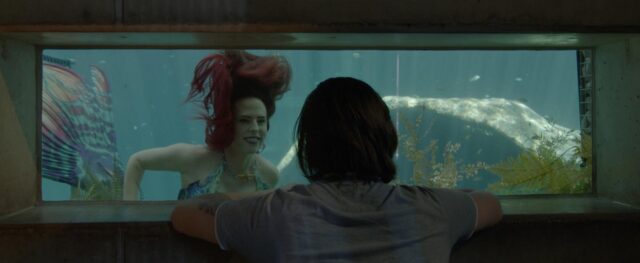
Anne is a very strong swimmer who can hold her breath for three minutes and 40 seconds. When she is underwater, she feels happy and in control of her environment. But Anne also has Asperger’s Syndrome, and in everyday life, noise and commotion upset and distract her. She is the subject of Under The Surface, the feature work-in-progress by Guido Verelst. Anne is also the director’s cousin.
What appealed to him initially was the paradox about Anne. In normal life, she struggles but “under water, she is happy and free.” She is like a real-life mermaid. “We’ve almost completed shooting – and I started three years ago,” Verelst says of his film (produced through Storyhouse).
Eight years ago, the family discovered that Anne’s premature birth was due to medicine which her grandmother had taken years before. “This is not really the subject of the documentary,” the director reflects on the troubling medical background to the story. He knew, though, that this was one element he couldn’t ignore.
Working with close relatives was a challenge. “I am very close to Anne and her parents. That was both an advantage and a disadvantage. The advantage was that I had access to all the crucial moments [in her life] and they trust me.” The challenge, though, was not to let the family down and to make sure he wasn’t exploitative of his subject. Verelst was determined to make a respectful and honest portrait of Anne.
The director filmed with two crews. One dealt with the underwater scenes. The other shot the scenes above the surface.
During the time that Verelst was shooting, Anne found a boyfriend. The director was a little thrown by this at first. The boyfriend wasn’t part of the original plans for the film. “But of course, I am not making fiction, I am making documentary, so I have to adapt. I had to gain his trust of course. I had to ask him if he wanted to be in the documentary. He even signed a paper that he agreed!”
Slowly but surely, the director won the boy’s confidence. “He’s a quiet person, quite shy.” With his presence, the dynamic shifted. He took on some of the responsibilities for Anne previously held by her parents. “Will he be able to take care of her as her parents did? We don’t know that yet. That’s a bit of an open question. At this moment, I don’t have a crystal ball.”
“I had a very interesting talk with [him]. I recorded his voice and I asked him about the future and whether he can take care of her [Anne]. He was quite open and honest about it. You could also hear his fears. He’s a bit insecure but he is giving it [the relationship] a chance. He loves her a lot.”
Verelst has known Anne since her birth. Before the documentary, they weren’t especially close. She kept to herself. However, when he told her he was fascinated by her mermaid-like feats underwater, she immediately agreed to allow him to film her. “We really became…friends! I must say the documentary opened up everything, also with the parents.”
The director is still planning to shoot some more footage – but not until early next year. “Once we start editing, I can really see what is missing.” He already knows, though, he needs more material focusing on Anne’s father. “He is someone who reacts in his own way. He isolates himself and goes on walks in the woods,” Verelst reflects on how the father deals with his daughter’s autism. “I want to give him his chance to show their reaction to the whole thing.”
Verelst also wants more footage of Anne and her boyfriend (who looks like Prince Eric from Disney’s The Little Mermaid).
A few weeks ago, Verelst and his two film crews travelled to Greece with Anne and her family, filming them extensively. “But I really don’t want an on screen interview,” he says of how the documentary will be structured. The family’s voices will be heard, but on the soundtrack – not as talking heads.
Anne can be temperamental. She gets tired and fractious. She is short-sighted. She becomes frustrated. During the pandemic, when normal life stopped, she was calm and contented. “Everything was peaceful. Everybody was at home. She didn’t have the fear of missing out.”
“Many films have been made about autistic people,” the director acknowledges but hopes his documentary has a new perspective. He brings layers of complexity to the subject matter – for example, how the parents and grandparents as well as the boyfriend relate to Anne.
Under The Surface is produced by Maarten Schmidt. “He [Schmidt] knows it is not an ordinary documentary. The main character, she is a person with issues. She is not always easygoing. I think Maarten understands that perfectly. He gives me a lot of advice on how to approach [the film].”
Sometimes, when Verelst is there with his camera, he thinks Anne is trying to hide from him. “I can’t always capture her like she really is. She quickly puts on a mask, a facade. I talk a lot with Maarten about how I can film her being her true self…when there is a crew she can behave a bit differently.” One solution has been ask to ask Anne to keep her own video diary on her phone. “When she is alone, she shows her true self.”
Then, of course, there is the water which becomes her special fantasy world. “She was fascinated by water since childhood. She was always in the bath, the swimming pool,” Verelst notes.
Anne also likes to dress up. That’s why, for her, pretending to be a mermaid is the “summit of happiness.” When she is under the surface, she doesn’t feel like Anne any more but like a fictional character with her own special powers.





