The annual documentary forum DocedgeKolkata, which describes itself as an “incubation-cum-pitching” event for Indian and Asian filmmakers, is on an extraordinary run of success. One of the projects that the annual Indian event (which will be held virtually this year in March-May 2022) helped along the way in 2017, Writing With Fire from directors Rintu Thomas and Sushmit Ghosh, has been nominated for an Oscar. Another, Shaunak Sen’s All That Breathes, which was at Docedge in 2020, won the Sundance Festival Grand Jury Prize earlier this year. Meanwhile, Diem Ha Le’s Children of the Mist won the Best Directing Award at IDFA.
Nilotpal Majumdar is the founder-president of the Documentary Resource Initiative (DRI), Kolkata. He is the one who launched DocedgeKolkata around 20 years ago. In that time, he has overseen a quiet revolution in documentary making in India. A form of filmmaking that used to be consigned to the margins is now moving closer to the mainstream – and an Oscar win for Writing With Fire is bound to increase Indian public engagement with documentary yet further.
The story of DocedgeKolkata dates back to 2000 when Majumdar attended Cinéma Du Réel at the Pompidou Centre in Paris with a film he had shot and edited. “I started looking at how things were working,” Majumdar says of the Paris event. This was the kind of documentary bazaar which India, in this period, simply didn’t have.
When Majumdar had been a student at the Film & Television Institute of India, documentary was hardly even acknowledged. “It was totally fiction…The understanding and perception of documentary was absolutely not available,” he remembers. “Academic critical discussion was not available.”
Attitudes toward documentary in India were still strongly influenced by the period of British colonial rule – and by the British documentary movement spearheaded by John Grierson. “We were more or less blindly following the [British] model.”
India had a huge TV system but there were few, if any slots, available for docs on either the private or public channels. The idea that documentary could be artistic or that anyone could make a living through working in the field wasn’t even entertained. Indian filmmakers who made documentaries were “on their own.”
This is why Majumdar created Docedge in 2003/2004 as “a creative and cultural exchange.” The idea was to give local documentary makers the mentoring and networking opportunities (“the handholding and investment”) that were available at European events like Cinéma Du Réel.
One of Majumdar’s most important early supporters was Danish consultant and critic, Tue Steen Müller, who was director of EDN (European Documentary Network). “Initially, we started in a really small way. The objective really was to give confidence to the filmmakers,” the Docedge founder recalls the event’s modest beginnings. He talks of the “appetite” for documentary that slowly began to build.
Although there had been small and scattered local support, Majumdar also acknowledges the backing he was given early on by Ally Derks, the founder and former director of IDFA, and Cara Mertes, the then Sundance Documentary Programme Director.
In those early days, resources were limited. “Monetary and creative engagement, the kind of physical time that you should invest in the film – that was not happening.” No public institutions got behind the initiative. However, young would-be documentary makers already had “passion” and showed perseverance.
He believes DocedgeKolkata has evolved quickly because of the “constant innovation in our incubation model.” In the early days, Majumdar and his colleagues looked to the Balkans and eastern European tradition of documentary making for inspiration. They also borrowed from the French and North American doc traditions, “Direct Cinema and all these things.”
Gradually, the event was able to secure more financial resources. Organisations such as The Ford Foundation and the Whickers have supported DocedgeKolkata. The current exchange award partners are: IDFA, DMZ Docs, Sunny Side of the Doc, Tokyo Docs, The Whickers, GFMI, Baltic Sea Docs, Global Media Makers, Dhaka Doc Lab, Green Hub and the Griffith Film School. This year Docedge has also introduced the Round Glass Sustain Award for climate change/ environment/wildlife category.
“It is for them kind of a happy investment. It is for them a brand building,” Majumdar suggests. “Slowly, slowly, there is a tremendous interest.”
DocedgeKolkata prides itself on the mentoring it provides to documentary makers. The programme is intense, and demands full commitment. “It’s a multi-layered effort,” the founder says. By the time the filmmakers are ready to pitch, they’re expected to have something “really, really good, provocative, stimulating and inspiring.”
International partners haven’t been supporting Majumdar and his team just for the sake of it. They now realise that this is an event which can help them discover some of the most talented new documentary filmmakers in India, Asia and the global south.
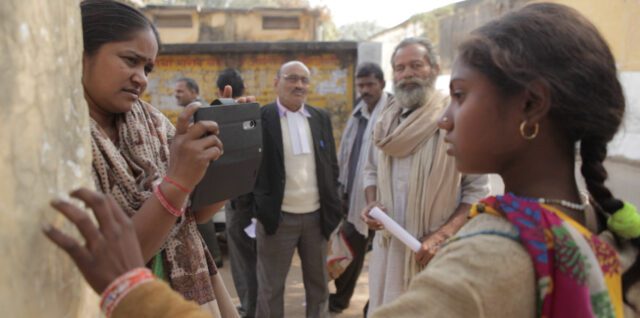
Writing With Fire is one project which passed through DocedgeKolkata at an early stage (“it was the film everybody was talking about’). It has gone on to screen at festivals all over the world. Majumdar remembers that when the project, which won a Best Pitch award, was presented by its directors Rintu Thomas and Sushmit Ghosh, he was immediately fascinated by the three main protagonists in the documentary, female journalist Meera, Chief Reporter at digital news agency Khabar Lahariya (KL0), and reporters Suneeta and Shyamkali. They all come from the Dalit community, the caste regarded as “untouchable.”
After DocedgeKolkata, the Writing With Fire filmmakers attended the Sheffield Doc Fest. There, they began to put the project together – to find co-production partners through Sheffield’s MeetMarket. Majumdar was in Sheffield and the IDFA Forum too and saw how the momentum behind the documentary (sold by Autlook) grew.
In recent years, Majumdar has also been working at Manipur State Film and Television Institute (in Imphal), trying to “build up the first PG [professional grade] level exclusive documentary school.” He is an editor, cinematographer, director and writer – and describes writing prose in Bangla as his “most cathartic engagement.” This creative background has helped him to work with filmmakers and to shape DocedgeKolkata.
Now, like everyone else in the Indian documentary field, Majumdar is looking forward to the Oscars and celebrating the success of a new wave of documentary makers. “It is a huge paradigm shift,” he says of Writing With Fire, All That Breathes and all the other Indian docs that have been breaking through at festivals and awards events. “That is something incredibly great. Indian filmmakers are really buzzing with joy!”