

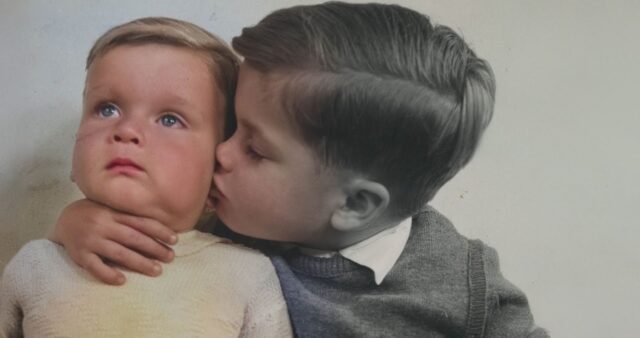
Ten years after Tom Fassaert opened IDFA with A Family Affair, his film about the vexed relationship between his grandmother and his father, he is back with an equally personal and harrowing new feature documentary. Between Brothers (screening at NLWave25) looks at the troubled inner world of his father, Rob, and Rob’s older brother, Rene. Both suffered hugely as a result of the breakdown of their parents’ marriage. They’ve since led very different lives. Rob is a retired therapist. Rene is a misfit, living in solitude and chaos.
A Family Affair focused on the filmmaker’s grandmother, a glamorous, headstrong, narcissistic woman who had put her boys in an orphanage while she built herself a new life in South Africa.
“Finishing A Family Affair, I was really done with filming my family. Emotionally, physically, cinematically, I was done!” Fassaert says of the emotional toll the first film took. “I was happy I survived that venture and I wanted to get on with my own life before starting a new project – and I didn’t think I was going to focus on my family again.”
Nonetheless, he also admits to being deeply intrigued by his uncle’s story.
There was a strange moment when Fassaert’s wife was pregnant with their first child. He told his father the news. “His reaction to that was not being super-enthusiastic, but focusing on everything that can go wrong in a pregnancy. He wasn’t really reacting in the euphoric way I hoped he would react.”
At around the same time, the father told Tom that he was going to try to help Rene again. Tom learned that his uncle was “suffocating in his own chaos,” facing eviction from his home.
“There was this thing that happens in your head when you feel there is something there,” Fassaert says of the sudden feeling he experienced that there might be material for a new documentary. “It’s like when you feel there is a story here and that you need to go and investigate….it was at that moment I heard this little bell ringing and I went and saw them, without having my camera with me.”
Fassaert’s father was beginning to intervene again in Uncle Rene’s life. Their mother had recently died and with her passing, the siblings were coming closer together again. Watching them, Fassaert couldn’t help but sometimes laugh. They were almost like an old married couple. I felt there was a huge absurdity in the dialogue they had together.”
The director began to see the physical chaos in Rene’s life – his wildly untidy apartment and the possessions he had been hoarding for many years – as a “metaphor for something bigger, something more universal.”
As a child, Fassaert had hardly known his uncle. “I wasn’t close at all and he was someone who really frightened me in a way.”
He remembers occasional visits to Rene as being awkward and uncomfortable. “I didn’t know what was wrong with Rene, but obviously there was something not normal.” There were “myths around Rene” but Fassaert had never been told the true details about his life. However, a bond quickly developed between the duo once filming on the documentary began.
Rene, it turned out, had been diagnosed as schizophrenic and taken into care when he was younger. “But my father, who is a psychologist, already from the start, he was very critical toward that labelling.” Rob felt it was far more likely that Rene had Asperger’s syndrome. He was clearly smart but was awkward socially, and had led an isolated life.
The longer Fassaert spent with the brothers, the more similarities he saw between them. “It seems like they are two opposites. My father is the rational psychologist with a successful life and a tidy home. My uncle is the opposite of that. And yet, throughout the film, I hope the audience will feel that these people on the inside are very much the same.”
There is a poignant moment late on in the documentary where the brothers track down the cemetery in Belgium where their own father, Richard, was buried. He has no gravestone and appears to have died in near anonymous poverty. In scenes that are both poignant and a little absurd, the brothers roam tramp grass and roam through the flowerbeds looking for their missing father who, after all, had been absent throughout almost all of their lives.
“We all knew that we wouldn’t find him alive. What I didn’t expect was that diving into that life…going to that house [where Richard lived late in his life] was much more emotional for me. I actually started crying when I was in that house. I went there with them [the brothers] and I also went there alone, to film travelling shoots through the hallways and empty rooms – and that is when I really felt a connection with my grandfather.”
What emerges most strongly from the film is the dogged loyalty father Rob shows his older brother. He made sure that Rene wasn’t institutionalised but was able to live as close to a normal life as possible.
“They can’t live without each other and yet when they’re together….” Fassaert sighs as he reflects on the odd couple dynamic between the brothers. “The bittersweet taste – that is what made me make this film.”
As he contemplates the upheavals in the lives of his parents and grandparents, Fassaert acknowledges his concern about the “ripple effect…the here and now, my own family.” There is the nagging fear history might repeat itself. He shares certain traits with Rob and René. Like his father, he documents his life obsessively on film. Like Rene, he is a bit of a hoarder (although he says his wife keeps him in order).
Fassaert made A Family Affair with Conijn Film but worked with a different Dutch production company, Een van de jongens (Dutch for ‘one of the guys’) on Between Brothers.
“With A Family Affair, it was such a heavy process….I felt I needed to change something and I needed a fresh start. That’s why I decided to change producers, also to have fresh eyes toward the film,” the director explains. He didn’t want to “make the same film” again, and he therefore also collaborated with a different editor and worked in a different mixing studio. Fassaert filmed himself; recorded the sound, wrote and partly edited it, and says he “needs other people really to take me out of my tunnel vision.”
Both films, though, have the same Belgian co-producer, Hanne Phlypo of Clin d’oeil films, whom he regards as one of his most loyal supporters.
Fassaert and his team are in Utrecht this week looking for sales and broadcaster support. They also hope to secure a festival berth for the film. Dutch distribution has already been secured, through Wiepko Oosterhuis’ Bantam Film.
“Wiepko had been a fan of my films from the start. He was shown a 30-minute pilot of Between Brothers maybe three years ago, He saw scenes and was very enthusiastic, He said yes please…give me a chance to distribute this film!”
The Dutch director also has another project in Utrecht, In Your Shadow, which he has co-directed with Thabi Mooj, and is being pitched as a work in progress. In the film, Mooi accompanies her father as he confronts trauma from his past as an armed freedom fighter in South Africa.
Between Brothers screens at NLWave on Sept 25.





