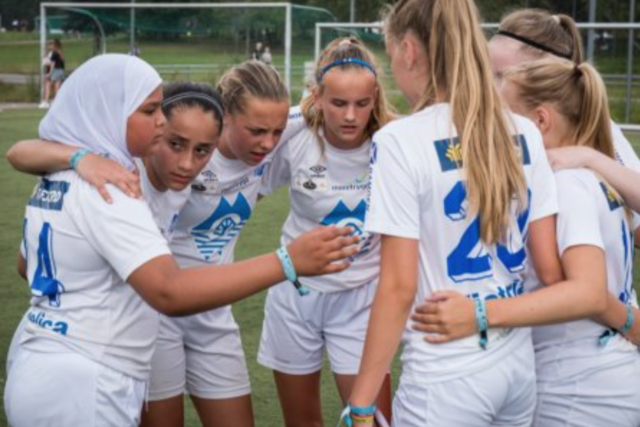
For six days every year, 30,000 young footballers from all corners of the globe, girls and boys aged 11-19, descend on the Norwegian capital of Oslo to play in the world’s biggest club tournament for kids.
Kids Cup, directed by Line Hatland and produced by Ingvil Giske and Mari Monrad Vistven of Medieoperatørene, follows five of these youngsters, three girls and two boys, all of whom have their eyes on the prize.
The Norwegian Anna (team: Herd) is a box-to-box midfielder with a demon left foot, and the daughter of the team coach (with all the attendant pressures and comforts that entails). Khalidi (team: Magnet) is from Philadelphia, the son of a hardline Tanzanian father who invests much in his son’s potential as a footballer. “You can’t have a dream without practice,” Khalidi is told.
Yu comes from Chengdu in China and is captain of Panda Girls. She is still grieving the recent death of her father but has become used to keeping her tears in check, especially during emotional moments during the tournament. Palestinian Afnan (Jerusalem Girls) also possesses a subtle left foot, practises in her front room with her sister but is fearful of the continual violence on the streets of her home city and, as we hear in news reports, the arrest of increasingly younger kids. “I feel like a girl going into battle,” she says, as she leaves home for the tournament, belying her gentle nature.
Fred is from Brazil and is something of a Neymar, especially as he has somewhat of an eye for the girls. What’s more, the Norwegian girls seem to be just as interested in him, even if he finds it difficult to get a starting pace in his team (Trops).
We follow the players and their teams as they set off and arrive at the tournament, and then throughout each day as the Finals approach. We see victories and defeats, highs and lows, triumph and despair, as little by little the pool of teams left in the competition diminishes. We see the kids having fun, confiding to one another, offering bucketloads of encouragement, complaining about the strange Norwegian food, sneaking out of the dorm, and flirting…a lot.
And of course, there is the penalty shoot-out which, as we all know, is the most difficult thing in the world to watch. And the one we see in Kids Cup is about as painful as it gets.
Producer Giske tells how, although 90% of the film was shot during the tournament, the process of casting and test shooting commenced over a year before. It seems like an obvious subject for a documentary, but the logistics of covering such a vast event had to be managed like a military campaign. Giske credits line producer Johanna Raita for doing “a fantastic job” as well as the army of cinematographers who were tasked with covering the action in real time. “When we started working on it, we understood why nobody had done it before,” says Giske.
The film is, in essence, about how to manage loss and defeat, Giske concedes, not that she will use this is a tag line to entice the youth audience, all of whom have, so far, reacted rapturously to the film, she says.
It is also about parenting, examples of which in the film can be heart-warming and life-affirming. There are also parenting styles that make you cringe, and which, one feels, must leave psychological scars on some of the children.
The producer also points out how this film can serve to widen the audience for documentary, such as the 13-14 year adolescent boys at school screenings who identify as much with the trials and tribulations of the girls as with the romantic inclinations of Brazilian Fred, maybe more so. “I think this is quite beautiful,” says Giske, who has a 14-year old herself on whom she tests all her new films. “I think making documentaries for youngsters is a way to enhance or make the audience larger in the future for documentary. I think it’s so important that we do it.”
Norway has become somewhat of a documentary powerhouse in recent years. Two Norwegian docs were shortlisted for the 2021 Best Feature Documentary Academy Award. These were Victor Kossakovsky’s Gunda and Benjamin Ree’s The Painter and the Thief, the latter produced by Giske (who also produced the heart-warming kids doc Tonguecutters in 2017).
To what does she attribute this amazing recent success? “We have, and have had, good commissioning editors at the Film Institute and they were very supportive,” she answers. “We never like to applaud a financing system, do we? But I mean, it is a good financing system. Even if it’s never enough, it’s probably one of the best for documentaries in the world.”
She also points to a landscape of healthy competition. “When your colleagues become better, it’s easier for you to become better as well… and it helps that the cinemas show documentaries in Norway. Audiences watch them. We had 30,000 the admissions for The Painter and the Thief and that was during the pandemic. And we are a country of 5 million people.”
“So I think that’s pretty good. It’s one of the best countries in the world [for funding] and we have an audience that likes documentary. But all that puts even greater pressure on us to continue making documentaries [of high quality] that the audiences want to watch.”