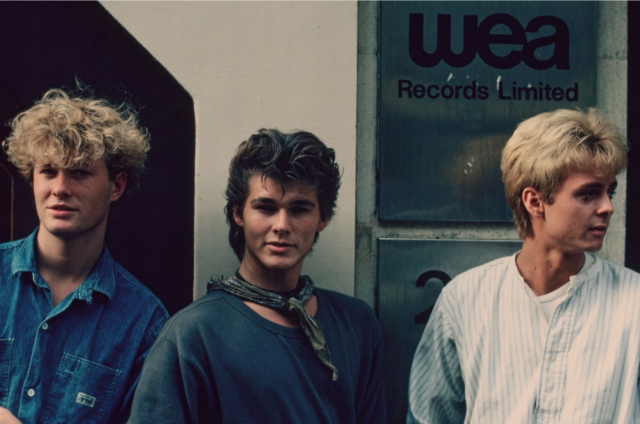
Before A-ha came along, Norway’s biggest cultural export was Ibsen, says co-director Thomas Robsahm. But the 1984 song ‘Take On Me’ changed all that with its memorable synth riff, Morten Harket’s falsetto posturing and that ground-breaking rotoscope video, driving the song to number one across the world, eventually generating more than one billion YouTube views.
The film, co-directed by Aslaug Holm, was four years in the making and follows the three band members, Morten Harket, Magne Furuholmen, and Paul Waaktaar-Savoy, as they tour and pursue their own projects, but steadfastly refuse to record together again. “In the end, we’d bash one another’s brains out,” says keyboardist Magne.
The band started out as a twosome consisting of Magne and Paul. The pair had previously been in a four-piece combo called Bridges, but their musical ambitions were greater than those of the other two, and so they set off for a post-punk London of the early 1980s where the likes of Soft Cell were topping the charts.
But they soon realized that if New Romanticism offered nothing else, it certainly served up a bucketload of glam, which is what the band lacked.
Which is where soon-to-be lead singer Morten Harket comes in, a beautiful “poser” with the voice of an angel, and possessing of an extraordinary vocal range. As Harket says in the film: “I had to wait for them to discover me.”
To cut a long story (as pop rivals Spandau Ballet once sang), Morten joined them in London where they cut a deal with Warner Bros. Producer Alan Tarney re-mixed their ‘Take On Me’, a song whose riff had previously been written for ‘The Juicy Fruit Song’, previously recorded by Bridges. After British director Steve Barron made the legendary half animation video, the band, as they say, hit pay dirt.
More hits followed, such as ‘The Sun Only Shine on TV’ and later the theme for the Bond film The Living Daylights, but little by little cracks appeared in the perfect veneer as creative differences emerged, and there was always the thorny question of copyright and royalties.
Nearly thirty years on, the band is still touring, but they have their own diverse interests and, as we see in the film, at the end of their gigs, each climbs into a separate limo.
“I’m definitely a fan. I mean, everyone in Norway is a fan in some way, or at least have followed them,” says co-director Robsahm of the decision to profile the band on celluloid, a desire he had harboured since 2009. “For our generation, you know, Norway was not on the map. We were kind of like a third world country, culturally. So of course A-ha changed everything. It made everyone believe that things were possible, that we thought previously were not possible.”
In the early days Paul was the de facto leader of the band, being the eldest, arguably the most talented and probably the most driven.
“But when they came back together in 2000, the other two decided to take much more of a lead in the band and of course [there were] the conflicts that have been there from the beginning,” says Robsahm, most notably that Paul retained songwriting credits on many of the band’s early works. “Paul has continued, you know, wanting to be the band leader, but the other two won’t let him, so then I guess all the albums, since they came back together, have been compromises and they are not happy with any of them.”
It would have been nigh on impossible to tell the story without referencing Steve Barron’s ‘Take On Me’ video, and therefore the early life of the three are in-part told in rotoscope, even though Robsahm initially feared it may be a bit too “obvious”. He even contemplated a series of idealized and contemporary dream sequences of all three, but availability would always be a problem, especially as Paul lives in the States.
Co-director Aslaug Holm believes that one of the key psychological threads in the film is the age old struggle between a regular person and an artist. “It’s about being immortal. It’s a classic story about strong individuals creating something together, and what is building up is also what is destroying you. I thought that was really fascinating when we were making it. This is a great story about human beings”
The film has been very well received both by critics and the Norwegian public, 90% of whom (according to Robsahm) say they feel genuine empathy for the characters. “Thomas and I have managed to come inside their comfort zone,” says Holm of the band members. “You know, the loneliness of being in a band in this successful story, I think that’s what maybe touches us when we see the film. I think we feel we know the guys. I’m really glad that most of the people like all three of them. Even if they are fighting against each other, they [the band members] also love each other in this deeper level.”
Robsahm offers up the curious fact that two of the band members love the film, but the third doesn’t, but he refuses to say who. “You’ll just have to guess, but it’s kind of like what we expected and what was said to us from the beginning, it’s impossible to tell the story of A-ha in a way where all three will be happy because that story doesn’t exist, because they continue not to agree on most things,” he says.
“It’s a sad thing, but that’s how it is…Without those three there would be no A-ha. You just have to accept how them they are, you know, warts and all,” Robsahm signs off.
Sales for A-ha – The Movie are handles by First Hand Films.