Depending on how you assess him, or who you speak to, Thorbjörn Steingrímsson is a car farmer, an inveterate horder or a spare parts man. For Helga Rakel Rafnsdóttir, he is a ‘good shepherd,’ which is the Icelandic title of her film. What is beyond question is that ‘Bjössi’ has a passion for wrecked cars, hundreds of which are arranged on his small holding in the north west of Iceland.
The director herself grew up on a farm “a few fjords” away and would often drive past Bjössi’s place, which was something of a tourist attraction, even though only 5% of visitors to Iceland make it as far across the island, Rafnsdóttir estimates. (If you imagine Iceland to be a sheep facing west, then the Westfjords region, where the film is set, would be its head, she further suggests.)
“I just liked the place. It’s very colorful and kind of aesthetically charming and inspirational in a way,” says the director. “I grew up a lot with my grandfather. He also had a couple of car wrecks that were resting in the fields. So I’m used to it somehow from childhood. I like the smell of the oils and the things that are weathering.”
The film is relaxed about specifying its other characters, but the woman who tends the plants (placed in old tyres) and maintains a spotless and brightly coloured house is his mum, while the younger woman who turns up exactly halfway through may just be a love interest, which is confirmed by Bjössi arranging for a mobile home to be craned in to rest right beside the farmstead.
All sorts of people show up for help with their old and smoky engines, and one number plate enthusiast is delighted with some of the plates he can purchase. Later in the film the island’s youth congregate to celebrate a yearly festival, at which point we meet Bjössi’s late teenage son.
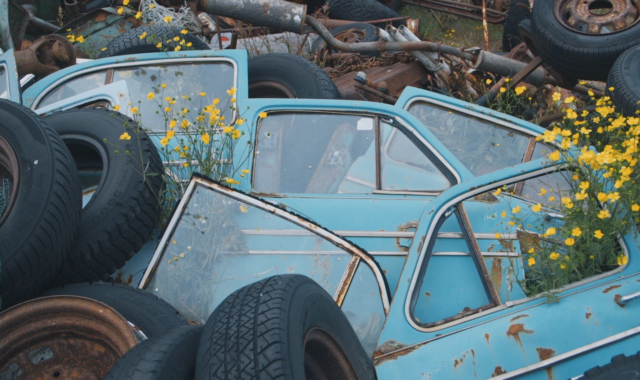
In a film almost devoid of dialogue, and whose pacing is measured and highly satisfying, Bjössi may be the understated star, but the cars steal the show, presented at times almost as installation art and arranged like a military phalanx within the field.
Rafnsdóttir sees it slightly differently. “They remind me of humans somehow when they lie on top of each other, like old friends. Or old dinosaurs, you know. It’s like their alive, and you just started making up stories about them. And they are pretty well organized as well, sort of in streets, it’s kind of like a village.”
The director further points out that Bjössi is a controversial personality locally, both in terms of character and his choice to turn his land into a car “graveyard,” as one of the film’s characters puts it. “People love him or people absolutely hate what he’s doing,” says Rafnsdóttir. “And him as well, you know, they think he’s crazy. People gossip a lot about him in the area. So I kind of wanted to show that he’s just a normal person. He collects cars. I mean, other people collect stamps.”
By all accounts, the arrival of the new woman upset the equilibrium within the household. “The mother has always taken extra care of her son. She’s very protective and cooks for him and stuff like that. And then he gets a girlfriend and they don’t get along very well,” says the director. That said, an uneasy peace is maintained during the latter part of the film, and mother remains sparky and interested in proceedings, such as when a local boy shows her his drone camera.
Rafnsdóttir describes her exchange with the drone boy. “I can put the drone into film if you want to be in the film as well,” she told him, especially if it meant that the old woman could get a view of her farm that she had never seen before, from the air. “I would never have put it into the film otherwise,” the director adds, stressing that their aerial (over)use in documentary has rendered many film sequences as “cheesy.”
Another filmmaker from this part of Iceland is Yrsa Roca Fannberg, who made The Last Autumn in 2019, about a sheep farmer who is contemplating hanging up his crook for the final time. Rafnsdóttir produced Fannberg’s Salome in 2014.
Both filmmakers eschew the use of their landscape as a “magnificent or emotional backdrop” for their films. “It’s beautiful and everything, and dramatic but I think both of us try to avoid that somehow…We have a strange relationship to it.”
That said, the valley where Bjössi lives is a little flatter and therefore Rafnsdóttir had to work creatively to design the film’s mise-en-scène. “Filming the car cemetery was quite difficult. I found there were no angles around it, or nothing to construct the nice frame,” she says. “Maybe you should have used a drone,” I suggest. “Maybe,” she agrees, and laughs.