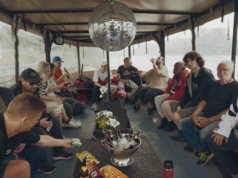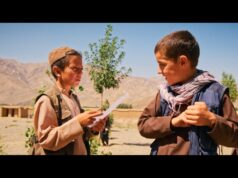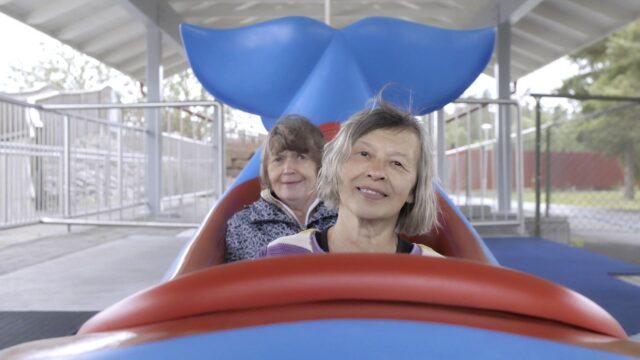
Swedish docs have been on a roll lately – and plenty of Swedish titles are at Nordisk Panorama this week, among them Alexander Mihalkovich and Hanna Badziaka‘s documentary Motherland, sold worldwide by Lightdox and which won one of the main awards at CPH: DOX; Carl Olsson’s Vintersaga and Maria Fredriksson’s hit doc, The Gullspång Miracle.
“The ongoing success of Swedish documentaries owes a lot to co-production forums and festivals such as Nordisk Panorama,” says Anna Weitz (who has been Documentary Film Commissioner at the Swedish Film Institute since August 2020). “For Nordic filmmakers, the Nordisk Panorama is the one where concrete collaborations take off…it is really the place to go to pitch a project that can turn it into a Nordic co-production.”
As Commissioner, Weitz uses the event to “get an overview” of key challenges facing the sector. “It can be lonely to be a filmmaker and it can also be lonely to be a commissioner – so it’s really important to meet sometimes,” she says of social and networking side of the Panorama.
It was unexpectedly announced earlier this month that Annette Novak, the CEO of the Swedish Film Institute, is to leave her post. Weitz acknowledges she didn’t know in advance that Novak would be quitting. “[But] it doesn’t affect my day to day work. I continue the assessment of projects and I continue giving out support.”
She believes the Swedish feature docs screening in Malmö this week are “excellent examples of the high level of documentaries being made in Sweden today. They vary greatly in terms of style and subject matter but they exhibit a very concise film language and strong artistic signature.”
There are also many eye-catching Swedish projects in the Forum, among them The Smuggler by Sylvelin Måkestad (about an elderly lady who heads to Finland to regain a long-forgotten pistol which carries clues to her life story); Man And His Daughters by Michael Strindberg (an autobiographical road movie involving a father, his daughters, their bikes and a 6000km journey), and Ania Winiarskas’ Good Girls, set in a Polish correctional facility for troubled teenage girls.
“If I look at this year’s Swedish documentary repertoire, one thing which stands out a bit is that there are several films addressing the state of democracy and its fundamental principles,” Weitz reflects, citing not just the crop in Malmö but hits from earlier in the year like Fantastic Machine by Axel Danielson and Maximilien Van Aertryck, and The Society Of The Spectacle by Roxy Farhat and Göran Hugo Olsson.
An upcoming film in similar vein (included in works in progress in Malmö) is Susanna Edwards’ The Dialogue Police, about the eponymous Swedish police department that is tasked with upholding democracy and freedom of speech. During elections, they have to deal with everything from Koran burning to blazing rows about inflation to the climate emergency. Weitz expects this to be completed by early next year – and to generate strong interest among buyers and festival programmers.
“Some of the commissioners I have met in my own career have been very inspiring and important to my work in film,” Weitz explains why she decided to join SFI at a time she had a blossoming career as a filmmaker at Mantaray Film. She is serving as a commissioner on a fixed term of five years (in her case slightly interrupted by a period of maternity leave).
“When I got the question if I was interested in this job, I thought it was a privilege [to do it]. I have been on the other side and I know what the support means,” Weitz reflects on how commissioners can help usher films into existence. “I see it as a very meaningful job with a big responsibility of course. I was also curious to see if I could use my experience in this way for a few years.”
There is no fixed amounts that the SFI invests in films. “We look at each project’s needs and the possibilities we have [to support it] in relation to the priorities of everything else we do…[but] we are never the only financier in a project.”
Sweden has “a relatively strong support system” for documentary compared to other countries. Nonetheless, Weitz accepts that there “has never been a working model for documentary films” and that “it is really hard to make ends meet as a documentary filmmaker.”
The pandemic has only exacerbated the problems facing the sector.
“When it comes to theatrical, it has always been very difficult for documentary films in Sweden. I think distribution is the biggest challenge…creatively, we are doing very well,” Weitz reflects on the situation facing Swedish docs. They win awards at festivals and yet struggle to engage local audiences. This paradox will be explored in Monday’s panel, Praised Abroad – Forgotten At Home? (https://nordiskpanorama.com/en/praised-abroad/)
When docs find their way to public service TV, they do find huge audiences…but not all docs are picked up by the broadcasters and streamers. “That’s something we really have to look into and find some answers,” Weitz says. One idea she floats is a special online platform being set up by the Nordic countries which could serve as a shop window for at least some of the films.
As ever, there are plenty of emerging Swedish documentary directors and new producers to tempt the eyes of international festival directors and distributors. Weitz mentions Ballad Film AB, which was behind The Gullspång Miracleand is pitching The Smuggler in Malmö, as an example of a dynamic new production outfit.
The Swedish Film Institute has a programme that was hatched during the Covid period called ‘Talent To Watch,’ through which new voices from all over Sweden will be given the opportunity to make documentaries.
As yet, the big streamers aren’t currently a major factor in Swedish docs. “I don’t think we have seen them being part of production budgets we have supported…almost at all!” Weitz doesn’t regard this as a frustration but simply as the market reality.
When it comes to gender equality, Weitz says it is not a struggle to ensure that a 50/50 split is met. “I think [in]the documentary field, this has not been a challenge,” she says. “Of course, I keep track but I don’t have to make an effort to reach 50/50. It almost comes naturally, which is great of course!”