When Marius K Lunde, close friend of director Frederik S. Hana, decides to track down the mother who abandoned him when he was a child, the subsequent odyssey is presented not only as emotionally charged documentary storytelling, but as a piece of bravura and inventive genre filmmaking.
When he was five years of age, Marius’ Japanese mother left the family home in Norway and disappeared, making no further contact. Twenty five years later he determines to find her.
But in the meantime he has developed, together with his pal Fredrik S Hana, a serious love for films, especially B-movies and esoteric Japanese cinema, and the more grand guignol the better.
When the pair eventually decide to collaborate on a film project (Fredrik is by now a fully-fledged and bona fide film director) they turn to the serious subject of finding Marius’ long-lost mum.
But Codename Nagasaki would be no ordinary observational or fly-on-the-wall doc, nor indeed one laden down with earnest talking heads. Rather it was destined to be a film in which every bureaucratic hurdle and emotional/psychological dilemma (and there are many) would be presented as a piece of colourful and audacious genre cinema, whether in the style of 1940s gumshoe, creepy horror (a la Hideo Nakata’s Ring) or uber splattery trash, redolent of Kenji Misumi’s Lone Wolf and Cub series.
It would be easy to assume an overt sense of levity on the part of the filmmakers’ in terms of their approach to the important task in hand, but this is far from the case. For Marius the search for his mother is an emotional rollercoaster which takes him back to Japan, after convoluted and time-consuming communications with the Japanese Embassy in Norway and having engaged the services of a private detective in Tokyo. These types of search rarely go well, the detective tells him, so when it looks like there is a chance that Marius’ target may come into sight, he is quite rightly prepared for the worst.
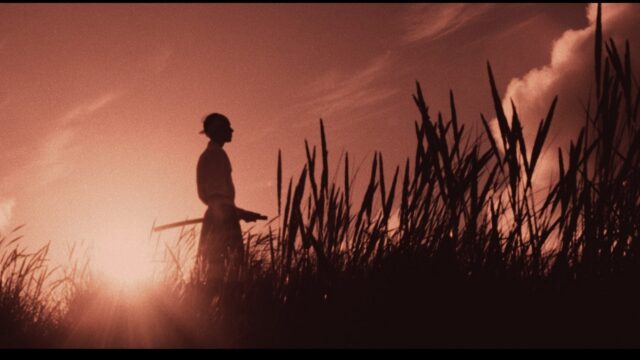
“From the get-go, when we decided that we were going to make this documentary, we felt that we needed to bring along our knowledge and our experience with genre films as the tools to tell the story,” comments director Hana of their unique approach to the film. “We knew that it needed to be a hybrid documentary, but in the beginning we didn’t really know what kind of function that would serve. The first day of shooting was Marius on the beach with a [samurai] sword and I didn’t really know what am I going to do with this, but it just felt right to just have some fun and let’s see what sticks, let’s just keep it up in the air… And then things just really like escalated.”
The film was made without a script with Hana editing on the hoof, and ideas were raining down from all angles, such as the character of the demon they devised to represent the significant emotional pressure Marius was feeling. “Maybe it’s not a good thing that he’s trying to track her down,” Hana explains his friend’s thought processes. “So the film was like an open experiment, all these elements came while we were feeling these emotions of insecurity. And we were just trying to react by using these tools from the genre film universe.”
The lines of demarcation were clear from the outset in terms of who did what. “I’m the guy to choose between A or B in the end, and I’m also the editor,” says Hana. “I’m kind of having that overview of the whole film, but Marius is a big source for inspiration. We never wrote a script for the film but we were constantly working together, trying to figure out how these fictitious scenes [interweave] with the documentary side of it.”
But a documentary it most certainly is and, like most other documentaries, has a hard stone of truth at its core. And the closer Marius gets to resolving his dilemma, for good or otherwise, the more Hana begins to question what the hell he is doing there with his camera.
“There’s definitely a part in the film where the perspective kind of changes more towards me. And that is because at some point I felt like the greatest gift I could give him [Marius] was the gift of privacy, even though there’s a film director inside of me that says, ‘oh, now it’s the good stuff, now you’ve got to film,’” says Hana. “So being stuck in-between being there as his friend but also being there as a filmmaker, trying to make a film that works, was something that was, for me, a whole new experience. I found that to be extremely difficult.”
“I know that Marius has always thought, okay, okay, if he gets rejected, maybe that’s also a story worth telling,” Hana adds. “I definitely think he’s absolutely right, but at that very moment I couldn’t see how this film was going to get made if we couldn’t find some kind of inspiration in it.”
From here on in, I will write no more about the film content, so as to reveal nothing. No spoilers, other than to say that Hana was able to find inspiration to carry on. But could he ever imagine making a more conventional documentary, one that doesn’t flaunt its genre mash-up credentials like a badge of honour?
“It feels good and motivating to make a film that you feel that only we can make, you know, and that was our idea from the very beginning,” he answers. “I’m not really drawn towards documentary filmmaking at all. I’m already, you know, geared towards fiction and genre films and all that stuff. So the quick answer is no, I don’t think so.”
“But if the project is interesting, it kind of doesn’t matter what kind of format or genre it is,” Hana adds. “Even though my heart belongs to genre films, I really love the playfulness that came along with this project. It took four years to make the film. So we were able to have a first year as the project took a while to find its footing. And it took a while to find out how to juggle all these elements in a way that felt emotionally pretty pure. In a way that didn’t alienate the regular viewer. So it was an adventure just to find a way to make it all work.”