Shortly after Russia’s brutal full-scale invasion of Ukraine, Silver Bear-winning director Malgorzata Szumowska and her creative partner Michal Englert met in Warsaw with representatives of “Superhumans.” This is the national centre for war trauma which rehabilitates victims using the most cutting-edge technology and the best prosthetics. Its services are badly needed. Over 130,000 Ukrainian war veterans currently have disability status.
“They’ve been trying to build a very modern hospital for soldiers in Lviv,” Szumowska explains. She and Englert were invited to visit the hospital, thus setting in motion the process that would lead to their new feature documentary Bodies (of War), screening this week in Polish Competition at Millennium Docs Against Gravity.
“So we travelled there. It was very complicated at that time. It was just the beginning of the war. We were travelling many, many hours [to get there].”
The two directors weren’t able to bring their own equipment. They had to hire a camera in Ukraine. “Then we were facing all of these soldiers…it was a tough moment in Ukraine.”
The soldiers had lost limbs and were often mentally as well as physically scarred. Englert and Szumowska “got some amazing material” of these war victims. But then the conflict escalated and the filmmakers weren’t able to return to Ukraine.
“And also we lost contact with Superhumans. They were more focused on the hospital,” Szumowska recalls. She and Englert knew that although they had some very strong material, it wasn’t enough for a film on its own. That is why they have expanded the canvas and introduced other strands to their documentary.
One of their main protagonists is Dana Vitkovska, a Ukrainian transgender artist and dancer now living in Poland. “If she would be [still living] in Ukraine, she would be a soldier in the army,” Szumowska points out. “That perspective opened our eyes. We realised she might be a great character.”
The two directors therefore include a section of the film that shows what Dana could have faced in Ukraine. There are Kafkaesque moments in which recruiting officers refuse to accept she is a woman because she is still shown as a man in her passport.
The directors also collaborated with Open Group, the Ukrainian artistic collective that showcased work at the 2024 Venice Biennale, exploring the impact of the war on Ukrainian civilians.
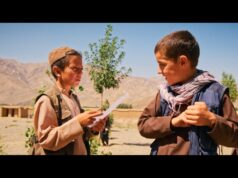
In the film, we see close-ups of the faces of different Ukrainian civilians and survivors, intoning and murmuring what seem at first like abstract noises and meaningless words. Only gradually do we realise that they are trying to represent the sounds made by Russian bombs. This is from Open Group’s “Repeat After Me” video installation.
“We found this to be very cinematic and thought it could be a great part of our film. We approached them [Open Group] and asked if they wanted to be part of the film and they said yes.”
The two directors are also working closely with Ukrainian artist Pavlo Kovach, who is serving with the military and continuing to create work from the front line.
“We organised professional equipment, cameras and stuff, and we sent them to him [Kovach]. We had these tutorials just so he could get familiar with it [the equipment] and we were talking about the things that we would love him to shoot for us,” Englert explains how they secured the extraordinary front-line footage from the artist that is included in the film.
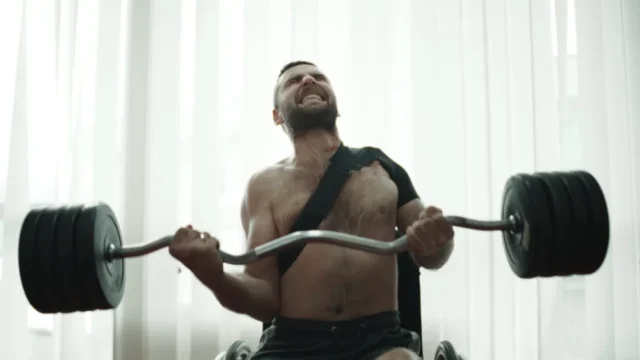
There is black and white archive footage of athletes – gymnasts, athletes, wrestlers, bodybuilders and rugby players – and imagery of sculptures of bodies that have been broken or shattered. This is juxtaposed with the material from the hospital Lviv where the wounded soldiers are doing their often-gruelling rehab.
In Bodies (of War), we also hear from some of those who don’t want to fight.
When they were filming the injured soldiers in Lviv, Szumowska and Englert were determined to be respectful. They weren’t there as news journalists looking for high impact images of amputees. Instead, they wanted to capture what Englert calls “the extreme determination” of the soldiers to “get back to their lives.”
“I think we were quite sensitive observers,” he adds. Both directors were taught in their film school days by representatives of the Polish Documentary School of the 1950s and 1960s and that’s where they learned the power of quiet observation. “That’s the way of storytelling we always favour. Without words, you can say a lot.”
Many very striking Ukrainians docs have been made since the full-scale invasion began. Titles like Milantropos, 20 Days in Mariupol, 2000 Metres to Andriivka, Girl Away from Home, Traces and Intercepted have won prizes and are shown at international festivals.
Ask Szumowska and Englert what fresh insights they, as Polish filmmakers, can bring to the conflict and they point out that they were initially asked to film the wounded Ukrainian soldiers. That’s why they began the project.
“We did that and we came back to Poland.” Szumowska notes. She adds that Bodies (of War) offers a “Polish perspective.” They have “empathy and sensitivity on a human level” to what the Ukrainians are enduring but acknowledge that “this is never the same as being from the nation that is involved in this horrible experience.”
The two directors have worked together for several decades now. Szumowska and Englert met at film school in Łódź. She was studying directing, he was on the cinematography course. Their early short doc Silence (1998), about life in a rural Polish family, won many awards. “We have been collaborating for more than 25 years,” Szumowska says. “It’s a crazy combination.”
The duo are also now close to completing their next fictional movie, The Idiots, starring Aimee Lou Wood, Johnny Flynn and Vicky Krieps, sold by The Match Factory.
Despite their illustrious reputations, the two filmmakers still have to fight to get projects like Bodies (of War) made. “It was tough, really tough,” Szumowska acknowledges that financing the documentary was a struggle. Backing came from the Polish Film Institute, Canal+Poland and private equity. There was also cash rebate support. No distributor or world sales agent is on board as yet.
“It’s not easy to get money for independent films. It is getting more and more complicated,” she sighs. “It’s always a struggle, always a fight.”