When you’ve been on a US Government watchlist, it probably doesn’t seem so intimidating to have a mere family on your tail, even if that family is the notorious opioid peddling Sacklers. Nevertheless, as she unveiled her feature documentary All The Beauty And The Bloodshed at the Venice Festival last autumn, Laura Poitras told the press she was sure that lawyers for the billionaire family were following her Venice press conference.
In the film, which won The Golden Lion in Venice and which is now in contention for an Oscar, Poitras shows how campaigning artist Nan Goldin, together with advocacy group PAIN, takes on the Sacklers. The Sackler family was rich and powerful anyway, but got even richer through sales of the highly addictive opioid Oxycontin. The family has tried to launder its reputation by making hefty donations to arts and academia. Thanks to Goldin and co, the Sackler name has been scrubbed from many prestigious museums and universities in the US and beyond, among then the Met, The Guggenheim and the Serpentine.
Since the film’s premiere, Poitras hasn’t heard anything directly from the Sacklers. “I do think they probably rightly understand that if they were to make any legal moves we would, of course, make those public immediately, and it would very likely backfire on them…but we’ll see.”
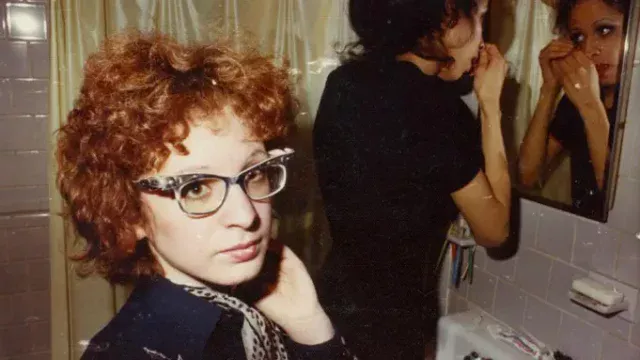
The documentary isn’t just about Goldin’s attempts to hold the Sacklers to account for the hundreds of thousands of deaths caused by OxyContin. It’s also a very intimate portrait of Goldin as an artist. It deals with some harrowing events in her family life including the death of her sister Barbara as a teenager. Poitras chronicles Goldin’s emergence as an artist and her experiences during the period when she lost many of her closest friends and colleagues to AIDS.
“For me, the entry point was the contemporary actions that Nan was doing in museums. I was really interested that she was using her power in the art world and her personal experience with OxyContin addiction to confront these museums with these demands. That resonated with the films that I have made in the past,” Poitras (an Oscar winner for her Edward Snowden documentary Citizenfour) notes of the way she came into the project.
Goldin had already been filming her activities and was looking for outside collaborators. Poitras was ready to come on board. “There was a part of me that was a little bit nervous, a little bit allergic to, like, a biopic of a famous person,” she admits. “That is a genre. It seems like everybody gets a film. If you’re famous, you get a film…instead of a lens that looks at purely the individual, I wanted to make a film that is a portrait reflecting on the larger society…that is a critique of the larger society.”
If you don’t fit in, what happens to you? That was one central question she was looking to answer through Goldin’s story. She hadn’t anticipated, though, how moving and harrowing Goldin’s testimony would turn out to be.
“In collaboration with an incredible editing team including Joe Bini, who is a master storyteller, we mapped out a structure that would interweave the contemporary storyline with certain key points of Nan’s biography – and those two things would converge with the AIDS crisis,” Poitras explains. “We were building towards this parallel connection where you see two things – Nan taking a historical stand and then the government failure at that moment, and the devastating loss…[but] even when we had it mapped out a bit in writing, it took a long time in editing, iteration after iteration, to really make it work, because we were throwing a lot of balls in the air.”
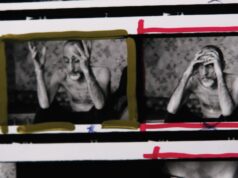
Goldin’s art work forms a central part of the documentary. Her autobiographical slide show and book, The Ballad Of Sexual Dependency, appeared in the mid 1980s during the AIDS epidemic. It had a profound effect on Poitras. “I probably saw it in ’88,” she remembers. Back then, she didn’t know the background stories about Goldin’s friends and subjects like Cookie Mueller (who appeared in many John Waters films) or David Armstrong. “There is this rawness…somehow you felt the relationship Nan had with the people she photographed, the sense of narrative. Even if it’s a still photograph, you feel like you’re being dropped into a narrative. The sense of place, the lighting – all of it was so cinematic and ravishing and raw.”
Poitras refers several times to Goldin’s “emotional honesty” and her “unfiltered honesty.” That unflinching honesty is also a characteristic of Poitras’ documentaries. “But, listen, she puts things about her life that I would be scared [to]…I think she is more brave!”
Poitras is “always obsessed” when she is making a film. Whether it’s about a whistleblower like Edward Snowden or an artist like Goldin, she “lives and breathes” her subject during every waking moment. “They’re always hard…they always have challenges,” she says of her docs.
On Citizenfour, Poitras was “really afraid for everyone’s life.” The “magnitude of the disclosures” and the “power of the adversaries” made this a deeply scary project to undertake.
That wasn’t the case on All The Beauty And The Bloodshed. “There were a lot of risks and fears [but] more on the part of Nan and PAIN.” There was clear intimidation of Goldin and her colleagues through snoopers and private investigators. (Poitras herself is hardened to being targeted in this way. She confides that she has been under surveillance since 2006.)
Patrick Radden Keefe, author of the award-winning 2021 book about the Sacklers, Empire Of Pain, is one of the key interviewees in the documentary. “Patrick was very involved in the story because he wrote this New Yorker article [about the Sacklers]. When Nan comes out of rehab, she reads it and goes ‘what the fuck is this?’” The article was one of the main spurs which drove Goldin into taking on the Sacklers.
You might expect some rivalry between Keefe and Poitras. After all, they were both telling a similar story and Goldin features prominently in Keefe’s book too. Poitras, though, talks of the support they gave each other. “Patrick was always 100% generous with me. I don’t think either of us thought it was competition. His is book form, ours is documentary, we knew his book would come out first. He was very generous…I think we’re proud of the synergy which exists between his book and the film.”
Poitras regards the Golden Lion award in Venice for All The Beauty And The Blood as “one of the proudest moments of my life.” The film was the only documentary in the main competition in Venice.
“I do believe, and I have always argued, that documentary is cinema. Yes, it is about real life. We have to be journalistic, we have to bring a lot of other things to bear, we have to get the facts right but, at the end of the day, it is cinema. It should be judged as cinema,” she insists.
Altitude is handling international sales and UK and Irish distribution on All The Beauty And The Bloodshed (released in UK and Ireland on 27 Jan).