It has been a while but two years after its premiere in Venice, Luca Guadagnino’s feature documentary Salvatore: Shoemaker Of Dreams has finally been released in US cinemas by Sony Pictures Classics. The film, about the legendary Italian shoemaker Salvatore Ferragamo, is being tipped by some as a potential Oscar contender.
Given that the Italian director’s cannibal romance Bones And All is already a front runner for awards, it’s conceivable that Guadagnino might end up with separate nominations for two movies, in both dramatic and documentary categories.
Shoemaker Of Dreams was scripted by leading US fashion journalist, Dana Thomas. The collaboration between Thomas and Guadagnino began when she wrote a big piece about him for the New York Times style magazine ‘T’, entitled “One Italian Filmmaker’s Ultimate Set — His Own Home.”
“It was the very last day he [Guadagnino) was filming Call Me By Your Name,” Thomas remembers the 2016 interview. “We just got on really, really well, sitting at his kitchen table.”
Around a year later, the Italian director called her out of the blue. He told her he had been asked to do a documentary on shoemaker Ferragamo. “And I want you to write it.”
Thomas’ 2007 book ‘Deluxe: How Luxury Lost Its Lustre’ had included a section on Ferragamo. “He [Guadagnino] knew that I knew the story, and he knew that I knew the subject. And he thought the idea of having an American write this story was good because the heart of the movie takes place in America.”
Ferragamo’s story is one of those archetypal immigrant’s tales. The shoe designer was a poor, uneducated kid from Bonito, a tiny village in southern Italy, who went to the US and turned himself into a shoemaker to the stars in the process. The luxury brand he set up in his name still exists today.
Thomas had never written a script before but Guadagnino blithely told her he was quite sure she could pull it off. “And he was right. I could do it. It’s very similar to writing a book – but it’s a lot shorter and you don’t have any end notes.”
The author says she approached the Shoemaker Of Dreams script as if it was a profile piece for a newspaper or magazine.
One key source was Ferragamo’s own autobiography ‘The Shoemaker Of Dreams,’ which Thomas describes as “terrific” and “just delightful.” She also travelled to Florence to explore the very rich Ferragamo archives which included clippings, photographs, catalogues and radio interviews.
Alongside the meteoric rise, there were many reversals and tragedies in Ferragamo’s life – car crashes, bereavements, bankruptcies.
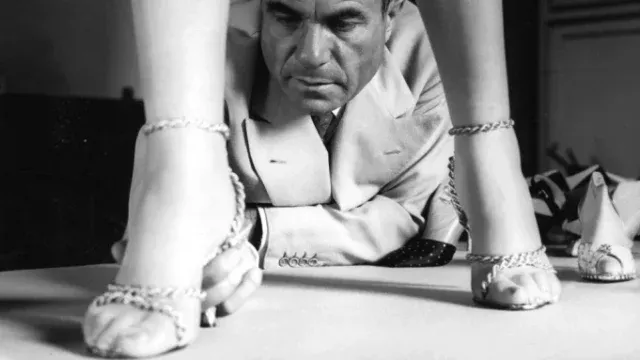
“It was the classic rags to riches story,” Thomas suggests. “I really wanted to know where his hunger came from beyond being so poor and wanting to rocket out of that little village into something bigger.” She likens the Italian designer to tech billionaires today. “And I love his obsession with feet, with creativity, with craft. He wasn’t thinking about wanting to become a millionaire or billionaire or have a big brand. He just wanted to make fabulous, beautiful shoes and he wanted to make, particularly, women look fabulous and beautiful too.”
One of the mysteries about Ferragamo is just where his creativity came from. In the documentary, he suggests that his shoe-making ability was a gift that simply possessed him, as if it was something he had known how to do in a previous life. Thomas, though, notes that his determination was there even when he was very young, helping his sister, whom he adored, by providing her with shoes [which the family was too poor to buy] for her first communion.
Ferragamo’s daughter Giovanna Gentile Ferragamo gives her full blessing to the documentary. “We were very excited,” she remembers the family reaction to Guadagnino making the film.
“Of course, he [Salvatore Ferragamo] is not the only one. Many other people have started from nothing and been very successful. But I think it is so special the way he approached his life, with such a determination, from being very poor but with a very high ambition and objective.”
As a kid, daughter Giovanna used to love listening to Salvatore’s’s stories about his life and career. She sees the documentary as a way of sharing these stories with a much wider audience. Her father, she suggests, is a role model. “He’s quite an example [of] how to approach life without getting disappointed when something is not going the right way.”
Her father’s philosophy, she continues, was always “to go on.” The most important decisions Ferragamo took in his life were often made at moments of the greatest crisis.
Whenever she returns to her father’s home town Bonito, Giovanna says “it is quite an emotion.” Ferragamo is a hugely successfully luxury goods business based in Florence that has been in existence for almost a century but its founder came from the most humble roots imaginable.
“I’ve been there [to Bonito] many, many times. Until a few years ago, there were still some relatives of mine, especially from mother’s side. I really feel my origins. Both my father and mother were from the same village. My blood is totally southern blood, although I was born in Florence and have lived in Florence all the time.”
Ferragamo worked with some of the most glamorous movie stars from Hollywood’s golden era, Gloria Swanson and Joan Crawford among them. He also provided the cowboy boots for early westerns. He built and re-built his business. There were many moments of crisis. Nonetheless, according to his daughter, he always treated his employees as if they were part of the family. Many stayed with him for their entire working lives.
“Something he used always to teach us was to have great respect for all people working for us. He said that no matter the work, even cleaning the floor or packing things, you need everyone – and you need everyone to be happy and to be proud of the brand they’re working for.”
Guadagnino regards Ferragamo not just as a shoemaker but as an artist. “The reality is that he was a genius,” the Italian director says of his subject.
Salvatore: Shoemaker of Dreams is released in the US by Sony Pictures Classics.