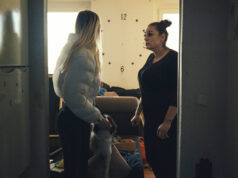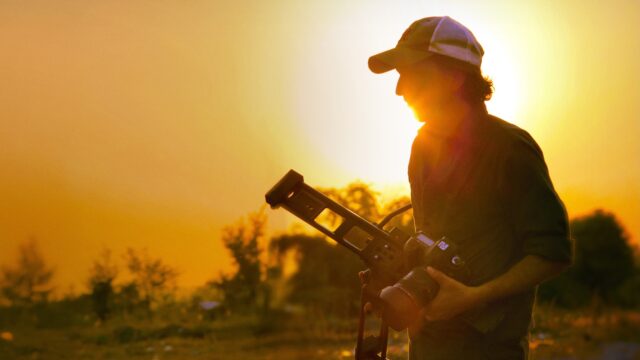
The HBO short Armed Only With a Camera…, nominated for an Academy Award, serves not only as testament to the professionalism and dedication of Brent Renaud, the first US journalist to die while reporting on the war in Ukraine, it is also a loving portrait by a younger brother, Craig Renaud, who, together with Brent, reported from some of the most violent theatres of conflict for two decades-plus. The late Brent Renaud is credited as co-director of the film.
It all makes for a tough and uncompromising watch, with bloody footage of US troops under fire in Iraq, the aftermath of the 2010 earthquake in Haiti, shocking hostilities in Somalia and the ongoing war in Ukraine. It also includes deeply upsetting footage of the deceased Brent, taken immediately after his death, and later as he is laid in his coffin.
“I knew what Brent would have done,” Craig describes both his brother’s clear and unsentimental approach to the business of reporting, and his own decision to keep the camera rolling after Brent’s death. “Brent really believed he can’t shy away from the horrors of war and what it does to people. And so, I felt, why would it be any different when I’m filming my brother versus all the other war zones with people that we have documented? It felt like the right thing to do… I think when Brent was killed, it was instinctual, I knew that I had to keep filming…It was a hundred per cent what Brent would have wanted me to do.”
Furthermore, it was a decision which their own mother understood, and to which she subsequently gave her blessing. “I remember her bringing up Emmett Till’s mother, who famously decided to show Emmett Till’s open casket so that the world could see what violence in that situation did,” Craig stresses. Emmett Till was an African-American 14-year-old boy who was abducted and lynched in Mississippi in 1955 after being accused of wolf-whistling a white woman.
That said, Craig also understands that the film is not for the faint of heart. “You always have to find that balance in the edit room of what’s too much. And even to this day, when I’m in theatres watching with audiences… I’m still not 100% sure if I made the right decisions of how much to show and not show. It’s always tricky.”
The film is 38 minutes in duration, but such is the breadth of the story it could easily have been a feature, even a series, I suggest. “It’s actually the first short I’ve ever made in my career,” Craig responds. “I’ve been doing this for 20-something years and Brent, and I always did features and series. We typically would always do longer projects. But in the edit, it felt like the right length.”
The reasons for this were twofold, Craig suggests. “[With] the narrative of bringing Brent home from Ukraine, if you spend too much time flashing back to other countries, that narrative starts to fall apart. And I think it’s hard for the viewer to keep track of [the fact that] this is ultimately a story of bringing him home,” Craig explains.
“Also, when we show it in theatres, most people say they can’t believe it was only 38 minutes, because it just feels so heavy, it’s like you’ve been through a much longer experience.”
The two brothers were always very close – “we were latchkey kids growing up,” says Craig – and would hang out together when not away on reporting duty. Still, Craig didn’t want to over-egg the closeness of their relationship, preferring to keep the focus squarely on his much-loved brother.
“I always followed my older brother and admired him and looked up to him. And so, there was a lot of love and loss that I wanted to express in the film,” Craig tells BDE. “But in the edit, I asked my team to try to help me find a balance. We’re not usually in the documentaries that we make. So that was uncomfortable.”
“This was a story about Brent. It was important that people knew about our brotherhood and our work together, but it needed to be primarily about Brent. So we tried to use it [our relationship] sparingly just to paint that picture, but not go too far with myself in the story.”
HBO were very supportive throughout the whole process, and placed no restrictions on Craig using even the most difficult and upsetting content.
“I’d had a conversation with our executive producers at HBO – we’ve known them for a very long time,” Craig tells BDE. “Brent and I had done a number of films with them throughout our career. So they knew Brent personally, and my family as well. I had a lot of conversations with them about how much I was planning to show. I remember being in places like Haiti during the earthquake where it was unimaginable what you would see. And we were constantly, you know, trying to find the right balance of how much you can show without losing people’s ability to watch it.”
Now, Craig is partnering with the Committee to Protect Journalists, to use the film as a way to talk about the risks to journalists today. He points out that 2025 saw the highest ever number of recorded deaths of international war journalists.
“Producer Juan Arredondo [whom we see injured in the film, after Brent’s death] teaches at Reuters, and we’ve been going around to lots of journalism schools all over the country and we’re starting to do it in Europe as well, talking to students and particularly students who have an interest in this kind of work,” says Craig. “Now, with the visibility of the Oscar nomination, it helps us continue to use Brent’s story as a megaphone to talk about all the issues that are raised in the film.”
A final question. Had the circumstances been different, and it was Craig who was killed in the line of journalistic duty, would Brent have taken the same decision to document his younger brother’s life?
“100%, yeah. I can answer that without a doubt. Yes, 100%,” Craig signs off.