

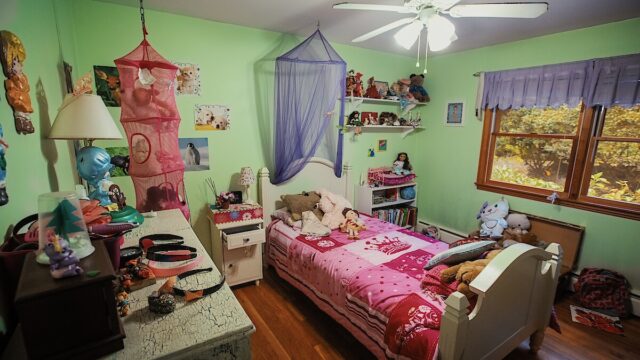
Four years after his 2022 Short Doc nomination for Stranger at the Gate, Joshua Seftel is once more Oscar-nominated, this time for the Netflix documentary short All The Empty Rooms.
The new film follows well-known CBS broadcast journalist Steve Hartman and his friend, photographer Lou Bopp, as they visit homes of kids who lost their lives in school shootings. In each home, Bopp takes photographs in the bedrooms of the deceased children or teenagers. The family is then given an album with the pictures. There is something extraordinarily poignant about seeing inside these rooms which, in many cases, have been left exactly as they were before the shootings, with socks scattered, school exercise books left open and posters on the walls.
“For me as a human being, I dread asking and imposing on the families…I dreaded that, saying ‘hey, can we come into your house and go into empty bedroom with a camera crew.’ No-one wants to ask that of anybody,” Seftel tells Business Doc Europe.
But the filmmakers quickly discovered that the families were glad to have them there. Parents realised that both Hartman and Bopp, and Seftel and his crew, were determined to “document their child, tell the story of their life, and share it with the world…that’s what they wanted. All four families who participated in this film, they wanted the world to not forget who their child was.”
There was therefore a sense of “shared mission” between filmmakers and their subjects.
In certain cases, the visits of Hartman and the filmmakers were cathartic for the families. For example, the parents of Gracie Muehlberger, the 15-year-old student girl killed in the Saugus High School shooting in 2019, were keen to move out of their home and start a new life.
“[But] they couldn’t bring themselves to do it because they didn’t want to pack up the empty bedroom. When Steve gave them that photo album and then when the film came out, they packed it up and they moved,” the director remembers. “That idea of giving them the freedom to do what they wanted to do was meaningful for us.”
Javier Cazares, whose nine-year-old daughter Jackie was killed in the Uvalde shooting (Texas) in 2022, told the filmmakers that he lives every day of his life with one goal – to make sure that Jackie’s story is told.
At a later screening in Chicago a few months ago, Javier’s wife Gloria commented at the Q&A afterwards that now the film had been made, she knew that Jackie would “live forever.” “That idea is very moving to me,” Seftel says.
In the documentary, which was acquired by Netflix after its world premiere at Telluride, it’s not just the parents who appear on camera. In one heart-rending scene, we see one of the victim’s siblings too.
“That for me was one of the hardest moments,” Seftel admits. “I remember we had a long conversation with the parents about interviewing their sons. We agreed, and the sons agreed, that they wanted to do it.”
It turned out to be a deeply emotional experience. “Our feeling was that we need to show people this because people need to understand the toll gun violence is taking, not just on parents but on siblings. These people will never be the same – and this could happen to anyone.”
Collaborating with a consummate TV veteran like Hartman was clearly different from working with a documentary subject who didn’t know the media.
“Honestly, and I think Steve knows this, I’ll say it, it made it harder. We didn’t want a film about a correspondent being a correspondent. We wanted a film about a journalist being a human being. We wanted a film where he would not be in the role of the Steve Hartman character, but would be in the role of Steve Hartman, father of three children. I think we were able to get there.”
There were still instants when Hartman would shift into in his TV presenter mode (“he’s so great at connecting with people”) but Seftel argues many of the film’s most “affecting and authentic moments” came when “Steve wasn’t speaking. He makes a living from speaking and filling up the space with his words which are beautiful. He’s an amazing writer. But, in this case, seeing him be silent and watching his face as he reacted to the world he was entering, and the stories he was hearing, was more powerful than words.”
Hartman initiated the project. He and Seftel had worked together decades ago. “I was his first producer at CBS news,” Seftel remembers.
Years passed. By chance, Hartman saw Seftel on TV at the Oscars with Stranger At The Gate and decided to call him and to tell him about his project: how he had written a letter to every parent who had lost a child since the Sandy Hook school shootings, and how he was asking then all if he could film their children’s empty bedrooms. Hartman said to his old producer: “I am trying to figure out what to do with this project and what to do with these photographs. Do you think there is a documentary in this?”
At the time, Seftel’s daughters were two and six years old. He was thinking about the fact that they would have to do “active shooter drills” at schools. This is like a fire drill for kids to know what to do when ‘the shooter comes to kill you,’ and it’s shocking even to think such drills are necessary, a grim sign of how school shootings are now regarded as almost routine. There are now over 100 school shootings a year and Americans risk growing numb to the continuing atrocities. Shootings today are barely reported on, and often forgotten within days.
“I felt that this approach Steve was taking was just a beautiful way of reframing the issue and taking it out of the usual political debate, and focusing on the human toll this was taking and the ripple it leaves with these families who no longer have a child, but just have an empty room.”
This is a film about gun violence that doesn’t even mention the word ‘gun.’ Instead, it shows viewers the direct impact gun violence is having on families probably not so different from their own. As one viewer told the filmmakers, this was the first documentary she had seen on gun violence that wasn’t “angry.”
The filmmakers have been showing their documentary at hospitals and to elected officials everywhere from Washington DC to the House of Lords in the UK (where knife violence remains a huge problem).
“It is very important to us that the film is used by the people who are trying to create change in a positive way,” Seftel says of the ongoing impact campaign behind All The Empty Rooms.
This started out as an independent film, financed in its early stages on credit cards. “Eventually we were able to raise a little bit of money but it was always a labour of love and a film made by a small group of people who believed in this message.”





