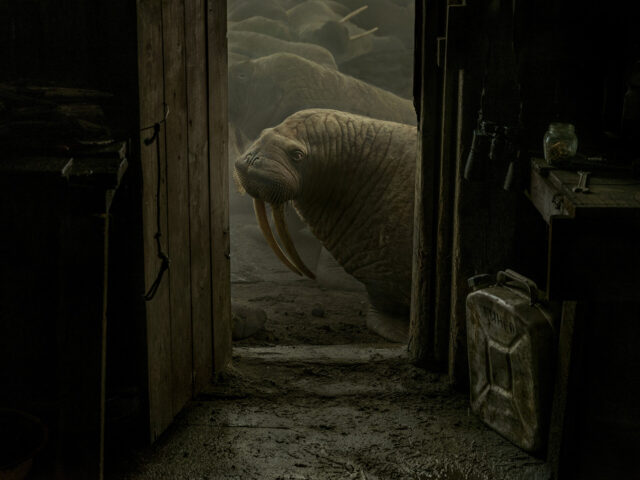
It’s like a scene from an Arctic version of Alice In Wonderland. There’s an enormous walrus and it looks as if it is going to come right through the cabin door. This is a scene from Haulout, the Oscar-nominated short documentary directed by sister and brother team Evgenia Arbugaeva and Maxim Arbugaev, and sold by Berlin-based Rise And Shine.
With their blubber and their tusks, the walruses are very endearing animals, but Haulout has an ultimately chilling message. Its human character, biologist Maxim Chakilev, has been coming to the frozen limits of Siberia to study the walruses for many years. Around 100,000 of them congregate here. That number, though, is very worrying. As the film reveals, they’re forced onto the land, where they are very vulnerable to deadly stampedes, because the sea ice is melting due to climate change.
Evgenia Arbugaeva is a virtuoso photographer whose work depicting Arctic scenes has appeared in Time and the New Yorker. She was born in Tiksi, the northernmost port of Russia. She originally conceived Haulout as a photography project.
“[But] it just felt as if it needed more layers. It needed sound, it needed time. To fully capture the atmosphere of the place, it couldn’t be just still images,” the director says. This was Evgenia’s first film and it took her a while to get used to working with moving images. “But it all comes down to storytelling,” she says.
During filming, Evgenia and her brother stayed in the hut with Chakilev. They were there for three and a half months. The diet consisted largely of canned food, “very simple things.” They slept in a bunk bed.
At certain times, thousands of walruses surrounded the hut. “They may look threatening, especially the big males with the big tusks but they get scared so easily and they are so vulnerable on the shore because it’s not their natural environment,” Evgenia reflects on the creatures. Any unusual sound or smell can scare them. Even the aroma of burning wood could make them panic. The filmmakers therefore tried to keep the sounds they made, and the scents they gave off, to the minimum. That meant not using the stove or the generator.
“This was a totally independent project that I financed myself. The reason for that was that we were deep in the pandemic,” Evgenia recalls of shooting in the summer of 2020. “We felt such an urgency to shoot this film…I really wanted a sense of freedom with this story. It really made it challenging but as a creative process, it was liberating that we didn’t have any responsibilities.”
Sometimes, when she was filming the walruses, Evgenia’s hands would begin to shake and she would find herself sobbing. “Some scenes were just too hard to watch and to witness,” she says of moments when the walruses were in stress or danger. “Because we’re coming from that area and belong to the native community, the relationship with animals is very close…it goes back to creation stories of how we are all equal on this land. Where we grew up, animals and humans are on the same scale in terms of the value of their lives.”
In the region where the documentary was made, there are many legends of animals turning into humans and vice versa. “It’s so connected that one can’t help but see animals as creatures that are so close to us…it’s so scary to see they are suffering because of us and things that are done far away. They have nothing to do with it, and there is nothing they can do to help themselves.”
Haulout is now available on the New Yorker website. Evgenia had worked with a producer there when she was photographing the young climate activist Greta Thunberg for a Time Magazine ‘Person of the Year’ cover.
Evgenia and her brother Maxim (a renowned cinematographer in his own right) have been collaborating in the Arctic for many years. “We are coming from a very adventurous family. Our father is a dog sled breeder,” Evgenia explains. “We go on expeditions on the frozen ocean. As a team, we are very close.”
Over the many weeks they were there, the filmmakers took time to soak themselves in the atmosphere of their icy, far-flung location and to understand the scientist and his character.
Having grown up in Tiksi, Evgenia spent a year in the US as a 16-year-old, discovering photography in the process. “I instantly knew that this was something I wanted to do.” She now leads a double life. Half the time, the director is in her homeland in the Arctic and half the time she is in the west. (She is based in London but has also lived in New York).
Ask about her inspirations and the filmmaker cites “Nordic painters from Scandinavia in terms of aesthetics and the use of colour.” She is not so keen, though, on some of the projects made by outsiders in the Arctic. These “often times comes from the western world, the western perspective, either conquering the Arctic, colonising the Arctic or just showing it as this empty sublime landscape.” For her and her brother, none of these visions ring true. In her own work, she will often focus on domestic stories or stories about women, and will always try to get beyond “the surface layer of beauty” of the region.
Haulout is drawing attention to the ongoing environmental crisis. Migratory animals that live in the Arctic are at threat because of global warming. The walruses will spend their summers in Russia and their winters in Alaska. They don’t know borders. Evgenia argues that science and art should be outside politics. However, the research work done by scientists like Chakilev is being affected by the war in Ukraine.“We just need to understand that this is about all of us. What is happening in the Arctic Ocean will impact us here in the UK, in America, in the south, everywhere…this is what our film is about. Being nominated [for an Oscar] proves [it]. We felt supported,” the director says. “This film was completely financed by me out of my own pocket. The reason why we made this film is that we wanted to show people everywhere what is happening in the Arctic to the animals, to the eco-system…we need to know what is happening to the walrus population, we need to know that the ice is disappearing regardless of which country these waters belong to.”