There’s a Chinese proverb which suggests, a little cryptically, that you can’t have both a fish and a bear’s paw at the same time: you have to make choices. The proverb provided filmmaker Violet Du Feng with the name of her production company, Fish and Bear Pictures. This is the outfit through which she has made her new feature documentary, Hidden Letters, co-directed by her cousin, Zhao Qing.
The film, released this week in the UK at the Bertha Dochouse Cinema and which will be having red carpet premieres in New York and LA later in the month, has already picked up several festival prizes while being included in documentary awards shortlists. Cargo Film & Releasing is handling distribution and sales.
“My whole mission in making films in the past 20 years, mostly about China, is that I want to make films that can both be seen in China and also appreciated outside of China…so I want both,” comments Feng (whose other credits include Harbor From The Holocaust and as producer, Singing in the Wilderness, Confucian Dream, Maineland and Please Remember Me.)
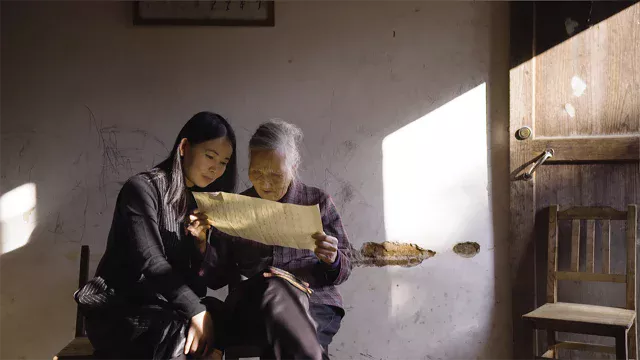
Hidden Letters is ostensibly about Nushu, an old secret language used by women to communicate among themselves in periods of patriarchal oppression when they were prevented from reading and writing. Its real subject, though, is the situation of women in China today. The days when women’s feet were bound and they were forbidden from learning are now gone. However, the film’s protagonists, two contemporary women who are passionate about Nushu, still suffer in a society in which females are often treated as second class citizens.
One of the women, Hu Xin, works at a provincial museum. She is sophisticated, highly educated and an expert in Nushu. The other, Wu Simu, is a respectable young woman, an aspiring singer in the big city, preparing for marriage. She too is obsessive about Nushu. The documentary makers delve deep into both of their lives.
“Honesty plays such an important role here,” Feng explains how she won the trust of the women. “Especially making films in China, our subjects are under much higher risk compared to subjects you portray in other places. They can easily lose their freedom. They can easily lose their jobs.”
The filmmakers made sure the subjects understood the intention behind the documentary. “This is not really a film about Nushu. It’s a film about them…about the challenges they are facing as women.”
Hu Xin and Wu Simu realised that Feng would be trying to act “in their best interests.” They knew she would be “discreet” and would not use material in the film that could harm them.
The director set out to make the documentary in a quiet, observational style. We learn about the women’s struggles by seeing them in their everyday lives, in “the most organic, intimate settings.”
Feng didn’t want to be judgmental. There are moments when the men here can behave in a boorish way but, as she points out, they also suffer from “gender expectation” and societal pressure.
The director further notes that she didn’t want to “make a straight-on story about women’s rights. I like to use a vehicle, a lens, to take you into a much deeper layered facade…but Nushu itself is such a fascinating thing that I think that even by making this film, to elevate the power of Nushu and the legacy of it, I am already winning.”
Feng herself encountered Nushu 17 years ago when she read Lisa See’s 2005 novel, Snow Flower And The Secret Fan. “I stumbled on it and I was completely fascinated by it. As a Chinese woman, born and raised in China, I felt that should be part of my history but I didn’t know anything about it. That book left a profound impression on me,” says the Emmy-winning producer and director who received her MFA in journalism from University of California at Berkeley. “But it was not until I moved back to China that I personally experienced the gender inequality in a way that I had never envisioned before.”
It was at this point she began to conceive Hidden Letters. She wanted to make a documentary that would connect Nushu “from the past to the present.”
The project had a very personal resonance for her as a “woman, mother, wife and a female filmmaker” then living in China. Her mother had been a nurse who took a great pride in her work. Feng certainly hadn’t grown up thinking that women in China “should function more in a domestic role.” However, when she returned to the country after living in the west, she was startled by the income gap between women and men and by “the impossible roles that women had to fulfil to fit the ‘good woman’ definition.” They have to raise their kids, look after their in-laws, earn money and coddle their husbands.
The film was made over a period of four years. One particular challenge was “how to tell the back story” of Nushu. At one stage, Feng considered using animation. She worried, though, about “romanticising” her subject matter – and that was something she was determined to avoid.
Both the cinematographers on the documentary, Tiebin Feng and Wei Gao, are men. “I actually tried to find female DPs in China and I didn’t have any luck,” says Feng.
The documentary ends with footage of Chinese women of different ages and backgrounds going about their daily lives. What was she trying to show here? “That we are all in this together…” she replies. The women come from all parts of China. One of the younger girls, glimpsed briefly in the final shot, is her own daughter. “We intentionally tried to film these images from multiple places in China. It’s a group effort from a few different camera persons.”
Feng recruited some intriguing collaborators to help on the project, among them British X-Factor winner, Leona Lewis. “I’ve listened to her for many years. I love her songs. But she turned out to be a friend with my EP James Costa [Co-VP of The International Documentary Association],” she explains Lewis’ involvement as co-composer alongside Chad Cannon.
The film is a Chinese-US-Norwegian-German co-production. It has been feted at festivals from Bergen in Norway to London and the Austin Asian American Film Festival. Following its theatrical screenings, it will be available on TVOD from December 23.