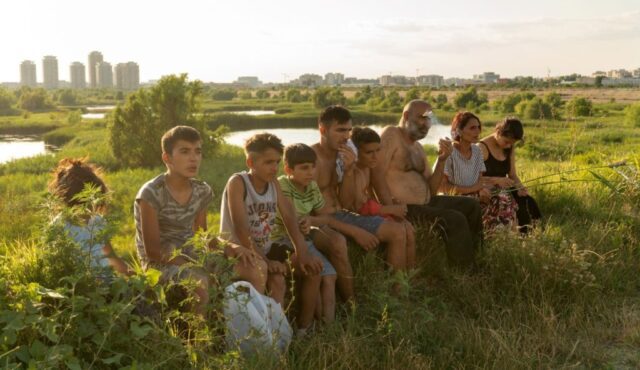
Acasa, My Home by Radu Ciorniciuc
Andrea Prenghyová, Project Director of dok.incubator, tells Business Doc Europe what project teams should be looking to expect during the 2021 post-production workshops, and in return what she is demanding from this year’s submissions. “The most important thing for our selection is the quality of the material and its originality,” she stresses. “We are simply looking for good films.”
Prenghyová is more than happy to underline past successes that have, at least in part, resulted from participation at dok.incubator (which, in 2021, will be presented in hybrid format). 2020 Sundance World Cinema Competition alone saw three projects that had been developed during previous dok.incubator editions. These were Acasă, My Home(Romania/Germany) by Radu Ciorniciuc, The Earth Is Blue As an Orange (Ukraine/Lithuania) by Iryna Tsilyk and Once Upon a Time in Venezuela (Ven/UK/Brazil/Austria) by Anabel Rodríguez Ríos.
Eight projects will be selected for this year’s workshops (exact dates TBC):
1st session: online/hybrid, April 2021. Rough Cut.
2nd session: residential, June 2021, Czech Republic. Fine Cut.
3rd session: residential, September 2021, Sweden. Near picture lock.
Business Doc Europe: What, in your opinion, distinguishes dok.incubator from other initiatives that look to radically improve doc projects in post-production?
Prenghyová: There are two very important things that distinguish us from other training programs and workshops. Firstly, we are a workshop that comes quite late in the filmmaking process – at rough cut stage. So we are able to work with the real material and to participate in a truly creative way. Secondly, there is our special methodology. Our participants are learning through doing – we are a very pragmatic workshop, but at the same time, we are very complex.
So, on the one hand there is a very high level of creative input. On the other hand participants receive an all-encompassing assessment/overview of their film – we test their film. They will meet around 24 tutors from different sectors. Our workshop is not only about the creative side and editing, but also involves marketing, PR and distribution strategies within the development of the project. So, they get to meet experts from very different fields which they don’t usually encounter.
This means that by the time the film comes to market it is better developed than other projects. The participants are not only developing their content, but the full film project.
Business Doc Europe: What are the qualities you are looking for in the projects you select? Is it the story? The subject? The mix of creatives within the production team?
Prenghyová: The most important thing for our selection is the quality of the material and its originality. We are simply looking for good films. We don’t care about genre. We take films of all genres and actually we like to mix different kinds of films with different kinds of filmmaking styles. So we have everything from historical films to current issues to very extravagant intellectual pieces. What is also important of course is language – we are searching for a film language in documentary stories. In the second round, of course, who the director and editor are is of importance – as are their previous works – but it is the quality of the film material that is the first thing we consider.
Business Doc Europe: How carefully do you match teams to experts?
Prenghyová: We are totally convinced that film is a team effort. So, it’s not the director’s name we look for on the application. The producer of course is important as he/she is the key to a good production and a guarantee of the project’s completion, but the most important person for us is the editor.
At this stage of the production, the editor is key, and a lot of the creative process depends on his/her ability, on his/her skills and limits. A lot of filmmakers want to apply to our workshop without an editor on board, and I would say this is not possible. For us, the editor is king.
The second thing to know is that we do not accept project teams that are not complete. Over the years we observed that films without a full team (for example where the editor is also directing, or the director occupies the same chair as the producer) cannot be developed as effectively or as quickly as films with a complete crew. Our workshop runs for just six months and we have come to realise that films on which the director is also the editor require twice as much time to develop. And you can’t do this in a six-month workshop. That’s why we only take projects with a full team attached.
Business Doc Europe: And how do you match the teams with the tutors?
Prenghyová: That’s also something that is quite compelling about our workshop, because no project gets to choose who they work with. It is the tutors who decide which project they want to co-operate with. The reason for this is that we need tutors with passion for the films, so they know how they want to help them. It’s much better this way as it provides the projects with a higher level of creative input and a lot of good energy. Each film gets one tutor for editing, one for marketing and one to supervise its development.
Business Doc Europe: Can you give an example of, say, one of the 2020 Sundance titles and explain how the workshop enabled it to blossom? What was it like on arrival? What were the workshop factors that helped shape it into a work of such high quality?
Prenghyová: A very good example is the film Acasa, My Home which was awarded at Sundance 2020 (Special Jury Award for Cinematography). This was a film by a first-timer, journalist Radu Ciorniciuc, who had been following a traveller family for several years. Most of the material was shot Radu by himself. He didn’t have any film education, but he found a very good producer – Monica Lăzurean-Gorgan – and also a great editor. They came to the workshop and, of course, it seemed very difficult for Radu. He had a good team but limited film skills, and we weren’t sure if he could make a real film for cinema from his (partly) reportage material, or indeed if he was able to build characters with a really close relationship to the audience. We had a long discussion about whether this project was better for TV or for cinema, or if he could make it strong through use of film language.
But Radu is extremely open and talented, and he learns really fast. So even though he had no film education, he learned quickly not only from the tutors but also through the creative discussions with other participants, and very quickly he was able to navigate his project towards a cinematic way of storytelling.
At the end of the day, this project which we had many doubts about in the selection was one of the most successful dok.incubator projects of 2020. It has won more than fifteen festival awards, it has travelled around the whole world and we are extremely happy about it. It’s very satisfying for us, but also for the producers and the whole team.
Business Doc Europe: How many submissions do you expect to receive? How difficult is the selection process?
Prenghyová: We expect to receive a little more than a hundred applications again this year. Each of the films will be screened and considered by two selectors. The best rated twenty-five projects will go to the second round at which point each of the projects will be seen by another five selectors – the future workshop tutors. They will discuss not only the quality of the material (which is the basic criterion for the first round), but also the quality of the team and the potential of the material. At the end of the process, we expect to select eight films for 2021 again.
Business Doc Europe: Do you prefer filmmakers who are at an early stage of their career?
Prenghyová: We think it is best to have a mix of experienced participants and newcomers. We don’t want a workshop full of beginners and we don’t want a workshop full of experienced people. We prefer a mix which creates an inspiring and creative atmosphere.
Business Doc Europe: On an initiative like yours where harmony and top-level creative interaction between all participants is crucial, how does/will ‘online’ work? Are you confident that hybrid will be possible in 2021?
Prenghyová: I am convinced that hybrid will be possible. If participants won’t be able to travel to the residential workshop, we think the most important thing is that our tutors can fly to the editing rooms, because you cannot replace that essential personal contact that creates trust between tutors and participants. So, we definitely hope that at the very least the tutors will be meeting the participants.
Strong relationships develop between our participants, because we usually meet much more often during the year. However, right now, people don’t have that many opportunities to meet and exchange ideas about films. That’s something we can’t replace. Which is why we sincerely hope that the second and the third workshops this year will be residential.