It is rare that you sit down to a documentary and are moved to tears, only to find out it’s a fiction but be equally moved to elation. Brothers Saša and David Vajda talk to Business Doc Europe about their extraordinary German film Jesus Egon Christus, which features the mesmerising Paul Arámbula in the lead.
Jesus Egon Christus is a film about addiction and psychosis. It’s a film about the offer of Christian salvation to the fallen, to those undergoing cold turkey in a rehabilitation centre. It’s also a film about how the Jesus that resides within the head of central character Egon seems strangely at odds with the Jesus being promoted by the centre’s evangelising priest.
Maybe the lines between doc and fiction are totally expunged in the Vajda brothers’ film. Maybe, on the other hand, the two forms are inextricably interwoven.
“I think in the end it doesn’t really matter whether it is a fictional film or a documentary,” says brother Saša, suggesting how maybe the work can be read as a fiction with ‘holes’. ”Sometimes you just creep into that hole and go back and forth between a rather fictionalised world and scenes which are completely improvised and therefore very documentary-like. It’s somewhere in-between.”
Co-director David agrees: “We started in the reality, researching all these stories, going to drug rehabilitation facilities, going to methadone clinics, getting to know all these people…then we fictionalised everything we experienced, and then as soon as we shot the film, we almost documentarised that fictional script again by incorporating improvisation, by employing a very documentary-like style with our camera, by changing the script around when we were shooting based on what we experienced with the non-professional actors on set.”
In the main, the actors in the film are recovering addicts that the brothers met during their research, such as Roxanne Stewens (Jenny) whom the filmmakers met in a Berlin methadone clinic; Ben Stein (who plays his namesake Ben, and who sadly passed away in May 2020) who Saša met through a Facebook group of recovering addicts, and Angelo Martone, another recovering addict.
“He [Angelo] has a very diverse biography…he lived several lives in one…he was one of the first persons involved in the whole process of the film,” says David. “We met him two and a half years before we started shooting, and from an early stage on he really inspired the film, and ended up being in it.” The character of Pinky is played by Zora Schemm, a professional Down’s Syndrome actor.
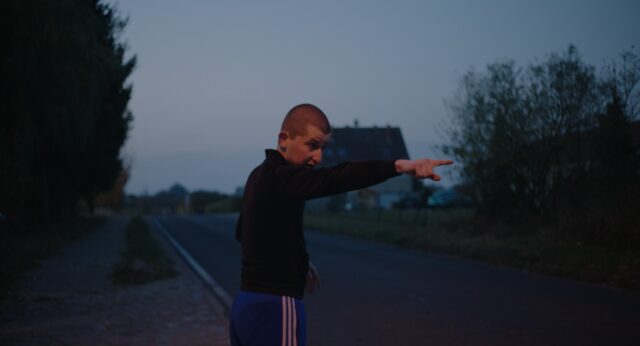
But at the core of the film is Egon, pale and vulnerable, an adolescent misfit who mumbles and repeats, frustrates and infuriates throughout the film. He maintains continual inner dialogues and conducts the actions of everyone and everything around him with elaborate hand gestures, returning to same spot on a busy road to direct traffic. In a world where cleanliness is next to godliness, the Jesus is in his head tells him it is ok not to shower, to the violent consternation of the self-appointed priest.
The Vajda brothers tell how they initially saw actor Paul Arámbula (who is American and whose German “was virtually non-existent”) in an art performance and then randomly met him on the street as they were trying to find a lead, immediately engaging his talents.
“We didn’t have to tell him that much,” says David. “Because he really understood where we were coming from. He really got the script from the beginning…he added so much to this film, so much improvisation. He was very creative with the text.”
This includes a long and painful joke that his character insists on telling the assembly, all in German. “In the scene, he told the joke and made everybody laugh, but then afterwards we found out that he didn’t know what the joke meant. I think that added to his psychosis, to the sense of alienation…there is a difference between what is said and how it sounds and we are really playing with that.”
Arámbula also provides a fractured yet highly blasphemous monologue inspired by the Jesus in his head which, while improvised, reads like pure Dadaist lyric when written out. “Acting-wise he was on spot, you don’t really have to direct him,” says Saša.
“He understood the character of Egon better than we did,” David ends.