

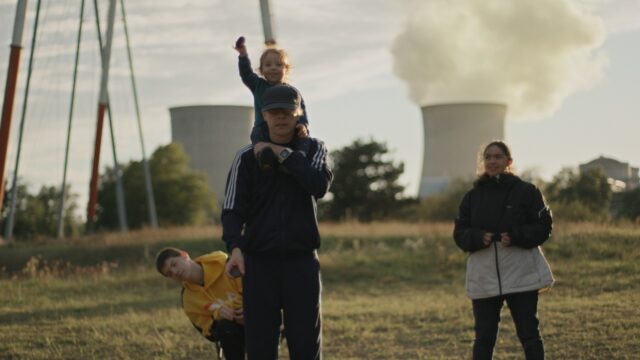
Kilian Armando Friedrich and Tizian Stromp Zargari are students from the same film school, HFF Munich. They have also been flatmates. Now, they have partnered on the feature documentary Nuclear Nomads, which has its world premiere in the Berlinale’s Perspektive Deutsches Kino (and is sold internationally by Rise And Shine).
The film follows workers cleaning up nuclear power plants in France. It’s tough, itinerant work, exposing them to radiation, potentially dangerous for their health and entailing huge amounts of travel.
Both of the young filmmakers had a connection with France. Zargari had lived in the French countryside while Friedrich grew up close to the Cattenom Nuclear Power Plant, one of the biggest in Europe.
It was Friedrich who came up with the idea for the film to examine the “lifestyles of the nuclear nomads.”
The two directors got very close to their subjects. The documentary features many scenes shot inside the cramped mobile homes of the nuclear nomads. During production, the filmmakers were “sharing” the protagonists’ lifestyles.
“Following these nomadic workers, we needed also to be nomads,” Friedrich explains why they hired their own camper van which they worked out of, and slept in, during production. They parked in front of the same nuclear power stations or campsites as their subjects. This meant they were always able to knock on their doors.
“They have quite a tough lifestyle. They drink a lot, they smoke a lot after their work, also to cope with the solitude,” Friedrich says of the workers.
There isn’t much you can do to relax when you’re living in a mobile home outside a nuclear power plant. There might be scope for some fishing if there is a river nearby but other recreation opportunities are hard to find.
“Don’t leave, stay longer,” Zargari says of how the filmmakers gained the trust of the nomads. They were always there, drinking and talking with them. (The team also included cinematographer, Jacob Maria Kohl, who is part of this year’s Berlinale Talents).
“Living in a camper car means living in your bedroom. Allowing someone to enter into your camper car means allowing them to enter into your most intimate space,” Friedrich notes of the strong trust the nomads eventually showed to the filmmakers. “You have seven square metres. That’s your whole life. That’s where you live.”
The lifestyle is damaging on families and relationships. It’s tough to bring up kids in such an environment. You can’t plan ahead because the work requires so much travel and often takes place at night. The filmmakers talk of their desire to give their subjects “dignity.”
“We wanted to show them as humans who try to love each other,” Friedrich observes. “We tried always to be driven by their emotion…and to let the audience feel what it means to live like that.”
Zargari, meanwhile, talks of their “creative” approach. The film isn’t intended as a polemic about the exploitation of workers. It is more intimate than that. There in an obvious political message but it is couched in intimate and poetic terms.
The workers are sub-contractors forced to compete against each other for work. Somehow, against the odds, they maintain some semblance of community.
“Nobody wants to be there. It is a complete destabilisation of private life, what we see there. The result is complete solitude,” Friedrich says. The documentary doesn’t have a voice-over because the filmmakers want the audience to “feel” the loneliness of the protagonists.
Much of the film is shot at night. We see the nuclear plants in the distance, like dark, satanic mills.
“It was very atmospheric and we wanted to show these industry complexes as modern monsters a little bit. They have apocalyptic architecture and, at night, you have great light which shows that,” Zargari explains why so much of the documentary was filmed after sundown. “To be there during the day is tough but to be there during the night is horrifying…the wind is blowing, you hear the electricity and the water pumping from the power plant.”
“Thanks to the improvement of modern cameras, it is also possible to shoot in low light conditions,” Friedrich adds a practical note.
The nomads themselves tend to work at night and sleep during the day. The filmmakers don’t actually show them inside the nuclear plants but their stress and exhaustion is apparent throughout. You only need to look at their faces to understand the extreme demands the work is putting on them.
It’s easy to understand the economic lure of the nuclear power plants. As the filmmakers point out, a young labourer without qualifications in France will earn a monthly wage of, say, €1200 for working in a factory but can earn almost three times as much cleaning the nuclear plants. There is an elaborate system of bonuses and overtime payments to do with safety risks and overtime. The workers, though, are risking destroying their own health. This is yet another example of the “gig economy,” whereby the workers have very few rights.
The two directors made the documentary through the university. They rented the camper van, borrowed camera equipment and spent almost three months on the road, following the nuclear nomads around.
Now, Friedrich and Zargari are cutting a 52-minute version of the film that can be sold to broadcasters. (They insist, though, that this is a film for “the big screen” and that is full of “emotion and feeling” that you would never find in a magazine article on the same subject.)
Both express their delight at securing the slot in the Berlinale, one of the world’s most prestigious film festivals, with a project they shot in “the most indie way ever.”





