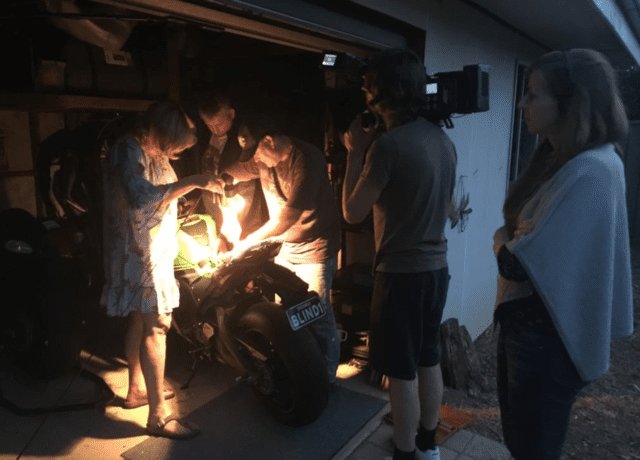
On the set of Dark Rider, director Eva Küpper far right
Dark Rider may be about bikes and speed and men trying to break records, but it also the stories of both a mother and a wife, as told by self-confessed petrol-head director Eva Küpper and produced by not so petrol-head Flemish producer Ellen de Waele
When Serendipity Films producer Ellen De Waele heard about Australian biker Ben Felten who was looking to break the blind land speed record, she revved into action. With director Eva Küpper, herself a two-wheel obsessive, they had been investigating the subject of disability and speed for some time, and was alerted to the story of Ben by his moto-rival Stuart Gunn.
“I told Eva that Ben wants to break the record in Australia in three weeks, so free your agenda. You have to go there,” says producer De Waele. “So she went with a DoP (Carl Rottiers) and a local fixer, and this was the start of this project.”
The film follows the travails of Ben, his very supportive wife Karin and his best friend Kevin Magee, a World Grand Prix legend, who will be his guide rider on the attempt, through all the ups and downs, disappointments and gains, as he speeds inexorably towards his motor destiny. Whether or not it ends in success, we only know at the film’s end.
As importantly, we meet the teenage Jed, a gentle Harry Styles lookalike, whose favourite pastime is to ride bulls rodeo style. Sadly, he is recently diagnosed with a similar degenerative eye disease to Ben’s, and therefore sees the biker as a symbol of both hope and inspiration.
“The film is a really cinematic experience where the viewer gets to see the world through the eyes of the blind, in this case those of Ben and Jed,” says De Waele.
Dark Rider is produced by Serendipity together with fellow Belgian Clin D’Oeil Films and Rotterdam-based Dutch Volya Films, as well as BR/Arte, RTBF Télévision belge, VRT/Canvas and Telenet. The 93-minute €535,000 feature doc is now complete and at RE>CONNEXT De Waele is looking for sales representation, distributors and festivals. Audio description for visually impaired audiences will be available for the film.
Earlier in 2020 director Küpper told BDE that a key factor that inspired the film is that she herself has a disabled older brother who was injured in what she terms “a very gruesome accident’ when he was 23 years old. He is still living with the consequences of the incident after he “clawed his way back from a very dark time.”
“I really recognised those things in Ben, but also in Kevin and Jed, all three of them in different ways and what they were going through. There was a real sense of recognition. I understood what was going on. This wasn’t about making a really cool motor cycle story. [Their stories] moved me in a very different way.”
And what was it like for Küpper and her female production companions to enter what seemed an almost exclusively male domain to make her film?
“I have been used to those worlds for a while,” she responded, simultaneously recalling that the first headline ever coined about her read ‘Eva Knievel’ [IDFA Daily 2010]. “I have been obsessed with motor cycles since I was a little kid… I just loved them and I started riding on race tracks in England and Europe for a long time. I was really part of it.
“So I got a lot of respect for being a woman and being so interested in what was going on in their world. I think the guys really appreciated it. It’s not something that is very usual or found very often. I felt fine swimming in those waters.”
De Waele takes up Küpper’s primary point: “I think the most important element is that Dark Rider is a very inspiring story, that people can be bigger than life, or that a situation can be bigger than life. This is what happened to Ben. He was determined to break the record despite his disabilities. He overcame his limits, which is one of the most inspiring stories you can give to an audience, because they are so determined to really focus on their dream and make it happen. He proves that whatever you encounter in life, you can overcome it.”
“There is a broad audience for this film, whether at festivals, for theatrical release or for screening platforms. Everybody can relate to it,” she concludes.