Radji directed by Georg Götmark & John Erling Utsi
Back in 2017 Belgian producer Frederik Nicolai had a big idea – how were ordinary people’s lives being impacted along the borderlines throughout Europe? Now that big idea is a big series of six creative documentary features. The producer explains the concept to Business Doc Europe.
The Borderline project has premiered three films already at various festivals (Four Seasons in a Day, Where The World Ends, The Wire). The final three films in the series are now in post-production and will be presented at Flanders Image’s Re>Connext online event as works-in-progress.
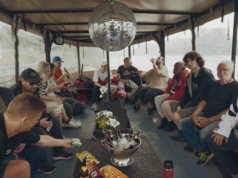
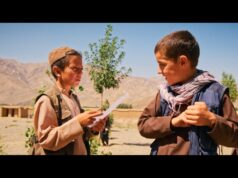
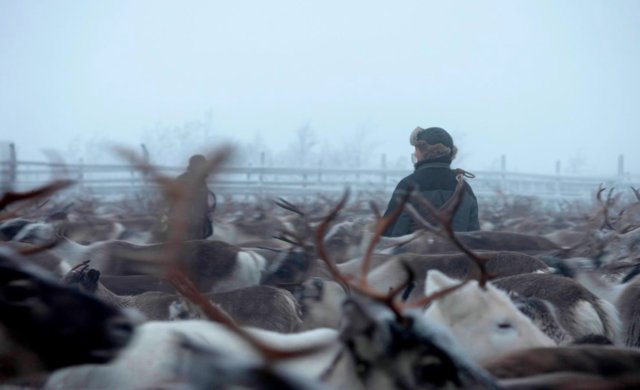
Those are Before They Meet, directed by Vytautas Puidokas and set in the border between Lithuania and the Russian exclave Kaliningrad, where ornithology researchers hope to collaborate; Liberland directed by Italian filmmaker Isabella Rinaldi set on the border between Serbia and Croatia where a Czech man wants to establish a micro-nation; and Radji directed by Georg Götmark & John Erling Utsi, set on the Sweden-Norway border examining the government conflicts with the indigenous Sámi people.
Nicolai remembers the moment in 2017 when the idea first ignited in him: “In 2017 I was researching another project in Estonia. I ended up in Narva-Jõesuu, an old spa at the seaside close to the Russian border, exclusively visited by Russian-speaking people. I made a walk on the beach towards the border, which turned out to be just a little river you can perfectly wade through. On the other side, there were also people having a good time on the beach, but I was not capable to reach them. The river wasn’t an issue, but a big sign stating that if I would pass the EU, the Russian border patrol was allowed to arrest me. It was actually one of the first times in my life I encountered a hard border that was impossible to pass, and this made me think about it a lot.”
He continues, “The border seemed to be the perfect arena to question our actual society. Do borders offer real protection, or rather a false sense of security? What is kept in and out? And what are the interactions between the separated parties? How do they look at each other and how do they define the past, present and future?
Relevant questions that invite us to reflect on our identity and our position in world history.
The project of course had to start with intense years of research. They settled on six films because, he thought, “this was a realistic number on the creative and production level.” Nicolai produces all the films for his Brussels-based company Off World (with dozens of partners and funders contributing, resulting in many co-production companies for the various films). 3BOX MEDIA handles sales for all six.
Of course, it couldn’t be Nicolai sitting in Brussels who found the most compelling human angles across these destinations. “I always aimed for a sustainable approach and to work with people who know a specific border situation from the inside out. I wanted films that would still be relevant in 10 years and could also target the local population, and not just exotic portraits of the outskirts of Europe. I wanted films that would be universal and also be relevant for the portrayed regions themselves, shining a new light on their local border actuality. This could only be possible involving local talents (producers, directors, crew) and finding domestic financing and distribution.”
That could have potentially been chaotic with hundreds of different people involved across the series, but Nicolai was pleasantly surprised to learn how, “you can collaborate with a team existing out of more than 10 nationalities and you can all understand the same language of filmmaking. It was a fantastic experience.”
Each of the six films had a unique research time and approach to pulling the creative and financial elements. “In order to define the final context of each film, there were different dynamics involved. In some cases, we found a subject we absolutely wanted to tell, so we started looking for local partners. In other cases, we started from directors we absolutely wanted to work with…We invested a long time in developing each storyline. I visited the locations, wrote and developed each script together with the directors and in some cases also joined the filming, and I think that we were able to create both a coherent and diverse project.”
The producer was looking for common attributes across all six films – “character-driven, reflecting from the present to future and past, direct cinema, dramatic evolutions. So we logically would avoid archive footage and interviews, but within this rather obvious and cinematographic framework, directors could absolutely concretize the stories and situations the way they wanted.” Some of the production teams were constant across all six, including the composer, colour grader and post-production sound supervisor.
Nicolai is proud that these six films can have such a relevance today, when Europe is “at a turning point.” He hopes Borderline as a series can have impact with younger people: “they are the future, and they will have to decide how our future society will look like.”
As producer throughout this huge project, he says he personally learned that “you have to persist….I thought many times about giving up. We faced so many ups and downs and it took us so long to finance the project.” It also took some time to convince backers that the films would work both individually and within a series. Finally, he says with a laugh, “now that everything is finished, and both series and individual films are distributed, everybody understands the concept.”
Even with this mammoth six-film project nearly completed, Nicolai still has the energy to think about another big undertaking. “At this moment I’m working on a new series together with Annabel Verbeke (director of Four Seasons in a Day) and six non-European filmmakers titled T(w)o Work, about the struggle and challenges migrants in Belgium face while looking for a job.”