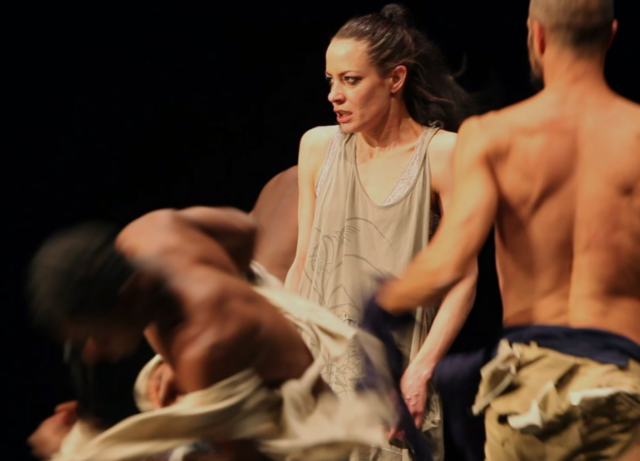
The genesis of Why We Fight was Mirjam Devriendt’s attendance at Alain Platel’s production of the dance piece ‘Nicht Schlafen’, in which the level of harsh physicality among the performers, comprising a handful of men and a sole woman, reached almost dangerous heights, and was at times painful to watch.
But for Devriendt it was mesmerizing, so much so that she took a seat by the stage and recorded the performance. She sent the video to Platel who responded immediately. “We are going to make a film,” he mailed back.
But the feature-length film, produced by Flemish production company Cassette for timescapes, required more than just performance footage. Yes, Devriendt experienced a visceral response to what she saw, although she admits to hating violence. When she was a small girl seeing violent films, she would never be mollified by adults telling her it wasn’t real. She knew violence a hundred times worse was being perpetrated elsewhere in the real world, and what she was watching served as a portal that delivered her there. And she didn’t like it.
So Devriendt and Platel embarked on an odyssey to explore what it is that drives people to conflict, whether on the personal, micro level (and we see numerous examples of sickening one-to-one violence as fights are caught on CCTV or mobile camera) or as a collective on a macro scale, at times ideologically-driven, as we see in mass (bloody) demonstrations on-screen. In this, we are instructed by highly insightful talking heads, such as historian Philipp Blom and sculptor Berlinde De Bruyckere, on the sociological, historical, economic and philosophical conditions that drive our species inexorably towards violence.
But this is also a film lensed by artists, and throughout we continually return to the sumptuously physical and jaw-droppingly beautiful aesthetics of the stage as human forms enact their choreography of violence, accompanied by the music of Mahler. For Devriendt, this was always going to form the visual basis of the film.
In some ways, it is the film’s counter-intuitive observations on violence that are most instructive, such as how the dancer Samir, the French-born son of immigrant parents, felt that the physical punishment he received was given out of love, and exacted very much within a loving family. The articulate and expressive conductor Teodor Currentzis is very convincing when he expresses how there has never been one second in the history of humanity when war hasn’t been waged somewhere across the planet. War is a virus we all carry from ancient times, he stresses, and something we feel “pathologically” compelled to repeat.
Perhaps most instructive is philosopher Tinneke Beeckman’s assertion that women’s potential for violence is fantastically underestimated, as evidenced by some IS women who have taken both themselves and their children into warzones, yet still forgiven for their actions as they are mothers. “Women are also fully responsible for what they do,” she says. “The complexity is that people can be victims in one situation and perpetrators in another.”
Other reasons for why we fight are articulated in the film. We all have multiple identities but in times of crisis we focus on one, which will invariably be that of nationality or religion, which are two “axes” that affect people greatly, and can be a precursor to conflict. Elsewhere, we are told that feelings of low esteem lead to a sense that little to no respect is forthcoming. The easiest way to gain respect is through fear. Therefore when you join a violent gang “such as the Mafia or ISIS, the entire world suddenly fears you…it is a shortcut to fame.”
These pronouncements are delivered in parallel with the visually stimulating and artistic splendor of dance, during which, little by little, a sense of satisfying (and quite beautiful) resolution is achieved, even if the final sequence of the film, showing violence among Arctic wildlife, offers little by way of metaphorical comfort.
The filmmakers jointly explain their rationale: “By using various types of imagery and visual metaphors, the film analyses social change, the lack of emotional processing and the power of humanity, which always seems to balance between creating something spectacularly beautiful and something horribly cruel. Also, when you put different forms of images together it seems to us that we might create a possibility that something can happen in the mind: you create a kind of gap where an idea, an emotion, a thought can emerge.”
“In that way we try to add layers in the mind, in a way that every person can fill ’the gaps’ with his or her own thoughts,” they conclude.