

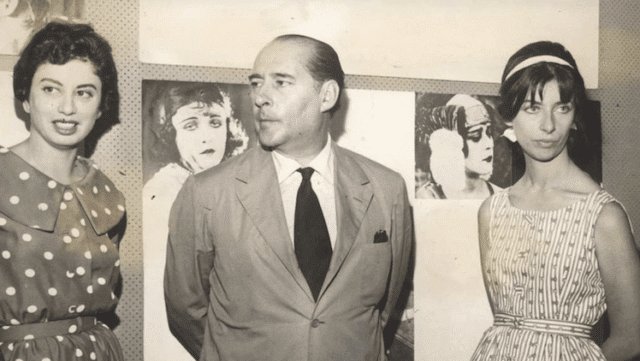
The Roberto Rossellini shown at the beginning of Living Without A Script (the new archive-based documentary premiering at the Rome Film Festival) is at a low ebb. He is now in his 50s, and close to broke. The glory years of the 1940s, when he turned out such classics of neorealism as Rome, Open City and Paisan, are a long way in the rear-view mirror.
The press are still hounding him because of his controversial marriage to Ingrid Bergman, and his films with Bergman have been poorly received. It’s a time for reinvention — which was why, when President Nehru in India offers to finance his work, he leaps at the opportunity, flying off to sub-continent in late 1956.
Roberto Rossellini – Living Without A Script is the latest production through B&B Film, the company which also made the hit 2020 documentary, The Rossellinis, about the great director’s colourful and eccentric family dynasty. In the new film, the focus is firmly on Rossellini himself.
The three directors, Ilaria de Laurentiis, Andrea Paolo Massara and Raffaele Brunetti, have ransacked the archives, searching high and low for material featuring their subject.
Unlike Ingrid Bergman, Rossellini didn’t write an autobiography. The filmmakers therefore had to discover his story for themselves. “We searched everywhere. We searched the family archive, the TV archives…we were maniacs! We searched newspapers, books, letters,” Massara says. They also had all the stories that Rossellini’s descendants had told them when they were making the first documentary.
The project looks in detail at the last 20 years of Rossellini’s life, from 1956 to 1977. This was a period in which it was clear that Rossellini wanted to “free himself” from the baggage of his past.
“We realised that Rossellini was really sick of being the ‘father’ of neorealism and of being identified with Rome, Open City,” Brunetti notes.
“It was the most terrible crisis of his life,” Massara says of Rossellini’s predicament. “But, for Rossellini, crisis was a sort of resource, a way to be alive.”
From the outside, it looked as if the filmmaker’s career was falling apart. In fact, as the documentary shows, this was also a time of renewal, creativity and radical new ideas. “I think I discovered not so much the filmmaker, but Rossellini the man, his fragility and his contradictions.” de Laurentiis, who painstakingly edited the material, chimes in.
Narration comes “100%” from Rossellini himself: the comments he gave in interviews or conversations with friends and admirers like François Truffaut, and the thoughts he expressed in his letters to his wife and children.
The documentary makers use of both contemporary classical and rock music from composers Mattia Leonardi and Ruggero Catania (who also worked on The Rossellinis) to give new zest to the archive images. The filmmakers wanted the music to reflect their subject’s intrepid sense of adventure as he went on expeditions to India or embraced the student protests of the late 1960s, or carried out his own scientific experiments, or raced his Ferrari. As Ingrid Bergman famously said of him, he did everything at high speed.
Living Without A Script is also intended to have the narrative drive of drama. “We are not afraid of treating the archive material like fiction – of trying to make a dramatisation and to have a narrative arc that is no less strong than a fiction film,” Brunetti observes.
As we see in the film, Rossellini was open-minded and endlessly curious, but there was a streak of conservatism about him too. He didn’t want Ingrid Bergman to work with other directors. “This is a typical Italian man,” de Laurentiis says of his sometimes chauvinistic attitudes.
He was devoted to his craft – but he was obsessed with women and cars too.
When he was working in India, he fell in love with Sonali, the wife of director Harisadhan Dasgupta, and hired her as a screenwriter. They began a romance. He was so besotted with her that he abandoned his crew in the jungle. Nonetheless, his collaborators always forgave him. They adored working with him and didn’t mind if he sometimes left them in the lurch.
In the 1950s and 1960s, TV was eroding box office. Most major Italian filmmakers shunned the small screen, predicting it would kill off cinema Rossellini, though, embraced it. He saw its possibilities for telling stories in greater depth and finding a much bigger audience than movies ever had. “He was fascinated with television because he found it an amazing tool to spread knowledge. Also, he was fascinated with the technology…he was not scared at all. He was always curious – and he wanted to go for it.”
What does Rossellini mean to filmgoers today? De Laurentiis acknowledges he is not so well known by the younger generation as he might be. “But I was very surprised when, one month ago, there was a big screening of Rome Open Cityin Rome and it was full of young people.”
Brunetti believes that Rossellini’s name is familiar to anyone with a knowledge of cinema. After all, he is one of the “mythical” figures in movie history. However, he also accepts many people don’t know much about him beyond the fact he directed Rome, Open City.
“This is also one of the reasons we wanted to show this part of the life of Rossellini,” he explains why the film looks at a period long after the “maestro of neorealism” had made his most celebrated works.
Living Without A Script is the only documentary in competition at the Rome Film Festival. Given its illustrious Italian contributors, including Sergio Castellitto (voicing Rossellini), Kasia Smutniak as Ingrid Bergman, and – speaking as themselves, Isabella Rossellini and Tinto Brass – the filmmakers decided this was the best place to premiere the movie. Fandango is handling the Italian and international distribution. The film will be seen in Italian cinemas for three days in late October.
The filmmakers have also cut together a one-hour version of the feature for the TV partners (who include ZDF/ARTE).
After making two Rossellini documentaries, B&B Film have “very good relations” with the Rossellini family – and they haven’t discounted the possibility of making a third documentary, perhaps about the young Rossellini.
“We took some years [to make Living Without A Script]. We are quite tired because, as you can imagine, especially in Italy, it’s not easy to produce documentaries,” Brunetti says. “B&B Film is a very small company although we have a wide range of interests for several reasons. One is that we are very curious, probably like Rossellini. We are not afraid to make television…we do everything from cinema to docu-reality to anthro-enterainment [anthropology and entertainment] and serious crime series.”
The company’s other recent credits include Simone Manetti’s Achille Lauro – The Terror Cruise, which has just been broadcast to mark the 40th anniversary of the hijacking of the Italian cruise ship; The Young Berlusconi, and Because Of My Body, about the sex lives of people with disabilities. Projects in the pipeline include a new series on Berlusconi and an adaptation of the book, ‘Nadia Comaneci and the Secret Police: A Cold War Escape.’





