

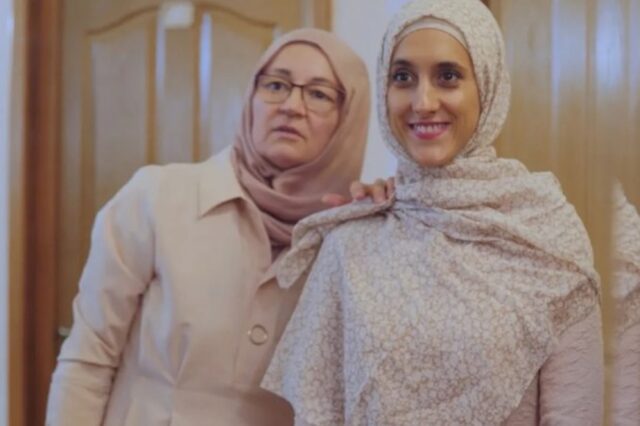
In their debut feature doc My Muslim Husband (an international premiere in Sarajevo’s Documentary Competition), filmmakers Daniel Bărnuți and Alexandra Lizeta Bărnuți, a newly married couple, put themselves squarely in the frame.
Daniel converted to Islam around 12 years ago. By then, the young Romanian had begun to travel abroad – to explore different cultures and countries. “But every time I came back to Romania, I felt a lot of prejudices and preconceptions about the faith which I had chosen,” he remembers. He felt that the western media’s portrayal of Islam was also full of bias. That was partly why he first decided to make a film.
“I had thought in the film, I would be at the back of the camera,” he remembers his original approach. “[But] after I started to work more consciously on the film, I started to switch the camera onto myself.” By then, he was studying film at university. He was also soon to fall in love with Alexandra ‘Liz’. (Appropriately enough, they first met in a cinema).
It soon became apparent that the documentary was going to focus on their relationship and the intense pressure it was coming under, from family, friends and, sometimes, from each other.
“In the beginning, I thought it was going to be easy. We would film something and then we would have a movie. That was not the case. It was much more complicated,” Liz observes of what turned out to be a deeply personal and complex affair – and for which they filmed over 700 hours of material of their own experiences as a recently married couple.
There were tensions with their respective families. Their parents and grandparents had firm expectations of how the marriage would turn out. “We had a tough time for a period,” Daniel acknowledges. “But we have very nice relations now.”
The two directors also had to overcome their own vanities and insecurities. There was an obvious temptation to cut out moments that weren’t flattering. Liz admits that “every time it is a challenge when you see yourself [on screen]…as a woman you want all the time to be pretty, to be arranged, to look beautiful – but I realised that if I was thinking like that, nothing of this film will be shown.”
“The camera can be very cruel sometimes and this is the case in many moments of this documentary. Using it not as an object, but as an invisible interlocutor who sees everything and gives it to the audience, the camera functions more like a therapist than a device used for recording moments,” they acknowledge in their Directors’ Note.
The final film is just over 70 minutes long. Editing was a Herculean endeavour. “At some points, our lives became one with this movie and we didn’t have a private life,” Liz says.
In 2018 Daniel and Liz were selected for the Documentary Campus Master school and they began to “craft the story.” They later won the Best Pitch award at DOK Leipzig.
One of the directors’ earliest and most important champions was Prague-based Hanka Kastelicová, HBO Max’s VP of documentaries (and whose other credits include Oscar-nominated 201i9 documentary Collective by Alexander Nanau). She came across the future doc at the Astra Film Festival (where it also won Best Pitch). “She was interested about the project and she gave us hope at a very early stage. We are calling her the ‘mother’ of the project.”
The world premiere was held at the Transylvania Festival in June. It received an emotional response. There was an intense and lengthy Q&A at which audiences asked searching questions about Islam and about the couple’s relationship.
“This was our point with this movie to open space for dialogue,” Liz says. “We knew we had some support for the film but we didn’t know how they [the audience] would react to see our life…but in the end, it was a very good surprise because people were coming to us at the end and they were crying, [saying] ‘it’s amazing what you are doing.’”
“Personally, I feel I grew up during this production,” Daniel adds.
The filmmakers acknowledge that some of the old prejudices that Daniel encountered after his conversion to Islam still persist. “In Romania, people are still afraid of what they don’t know,” he says. “We want to use our film as a tool. We are open for this, not only for cultural [purposes] but also for couples and family issues and discussions. For us, it [making the film] was also a therapeutic process.”
HBO will broadcast My Muslim Husband in the autumn – and it will screen at festivals in Sofia and Astra before then. “It’s our first film. We could have made it better. But we are really proud [of it] and happy that we finished it,” Daniel reflects on a documentary that couldn’t have been made closer to home.
Daniel and Liz are now beginning work on Broken Roots, a new doc that touches on mental health. “I don’t want to spoil it too much because we are still in development,” Daniel says. They will be pitching the project in Sofia. They are not “100% sure” they will be in front of the camera as protagonists, but “for sure it will be a personal perspective,” they assure BDE.





