

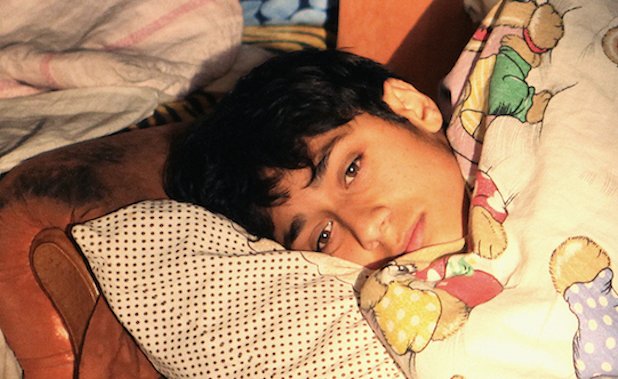
In 2009, brothers Nasmi and Sedat were repatriated to Leposavic, Kosovo, together with their mother. They were evicted from their secure home in Hemmingen, leaving behind their father and older brother, and sent to a horrendous IDP (Internally Displaced Persons) camp where they were forced to sleep twelve in a room. Nasmi wasn’t even born in Kosovo. He was born in Germany, where his father and older brother Vedat still reside.
To some extent, viewers can breathe a sigh of relief at the beginning of Katalin Bársony’s I Saw a Suno, selected for Sarajevo Documentary Competition. We see from the outset that the 15-year campaign undertaken by Vedat to get his brothers back to Germany – one that was filmed at all times by Bársony – was ultimately successful.
“It was a deliberate decision,” the Hungarian director explains why she structured the film this way. “What Nasmi endured as a child – the trauma of deportation, the loss of home, language, and education – is incredibly difficult to watch. Knowing that he eventually found safety allows the audience to witness his story with a measure of hope. Telling this story in his own voice was part of his healing, and also a way for viewers to connect with him, both as a child and as a young father still working to rebuild his life.”
Of course, what we see of life in the Kosovo camp is horrific. The conditions are squalid in the extreme. The boys and their mother are compelled to live next to a hazardous waste site that poses a constant risk of lead poisoning, and they must defend themselves from local abuse from Serbs and Albanians alike. They are labelled “dirty gypsies” as they dodge the rocks and stones propelled their way.
“It wasn’t just the shock of the camp, but it was just as much the cultural shock of what they went through,” Bársony tells BDE.
Over the period of the family’s separation, the director and her camera provided a means of communication (even if Vedat and his father are left emotionally traumatised when they see what their missing family has to endure in the camp). Nevertheless, the footage enables all parties to retain a modicum of hope that one day they can be united.
Middle brother Sedat experiences the bittersweet joy of a return to Germany after he is smuggled back, but he knows that he has left an increasingly lonely Nasmi behind. It is Nasmi’s story that then forms the emotional heart of the film.
All the time, Nasmi dreams of his return to Germany and his family. In the Gurbeti Romani dialect, the ‘suno’ of the film’s title means ‘dream.’ “The film became, in many ways, a meditation on dreams: the ones we cling to, the ones that sustain us, and the ones that are almost lost,” Bársony writes in her film notes.
“I Saw a Suno is not just about borders, identity papers, or policy failures, though all of those are part of the story,” she adds. “At its core, this is a film about love, separation, and the enduring desire for home.”
Despite the audience knowing how events turn out, the film still plays like an action movie, especially as an emotionally satisfying to the family’s story seems just about impossible. “The structure and the tension are indeed very much like those of a thriller,” Bársony says. “The way information is delayed, and the challenges that protagonist Nasmi faces, really contribute to that atmosphere. The pacing and narrative flow are well crafted – starting with the introduction of the main character and the background, moving through the family’s increasingly desperate yet helpless efforts, and building to a peak moment when Nasmi disappears…”
I Saw a Suno was a Herculean undertaking that involved more than 200 funding applications. “It has been the longest artistic struggle I’ve ever experienced, for 15 years making a film on the subject on the Roma culture amid growing hostility towards migrant people, and Roma in general,” she says.
“But also coming from a country where we don’t have a Hungarian film fund for the work we are doing, we had to acknowledge that fact and seek investors and partners from outside the country where we are living,” Bársony adds. She further speaks of her depression she felt that “nobody really wanted this story, nobody wanted to hear us.”
Her perseverance and her “stubbornness” paid off, however, as she garnered finances from the likes of the Bertha Foundation (South Africa), the National Endowment for Democracy (US) as well as the Romedia Foundation, an NGO and production house dedicated to empowering the Roma community and championing their through innovative and socially impactful media productions. The production also qualified for Hungarian National Tax Incentives.
The pandemic years of isolation proved beneficial as Bársony ploughed through “hundreds of hours” of material recorded in five languages. “It was a struggle to script it, to put it in a language we all understand and, yeah, to edit it. It has been two years of addiction.”
The film has resonance well beyond Germany and Kosovo, Bársony argues, and offers significant Impact potential. “We are seeing all those forced returns from the US,” she says. “Our story has a global appeal. It has a message to communities who are arriving as migrants and who are forcibly returned, and who are longing for the other family members left at home.”
“In the film, you also see the untold history of the sufferings of Roma during the war in Kosovo and afterwards, and that situation with IDPs and stateless people is still ongoing in the territory of former Yugoslavia. It is an issue that we would like to raise awareness of in Bosnia, in Kosovo, in Macedonia, in Slovenia, in Montenegro – countries which still host refugees…and we think that by inviting the communities to remember the sufferings of the ‘minority of the minority,’ we are going through a reconciliation process, an effort that helps us to put ourselves in the shoes of Nasmi.”
Representatives of the Goethe-Institut and the German embassy are invited to the August 19 world premiere. “We are hopeful that it will be eye-opening for them, and maybe we will have some attention on [this issue] in Germany as well that could potentially lead to rethinking the process of visa-free travel. And also the continuing forced returns. It’s not former Balkan refugees anymore, it’s the Syrians and those who came after 2015.”
On the eve of Sarajevo 2025, Bársony’s satisfaction at seeing her film world-premiere in Documentary Competition is palpable. “It is very few Romani women in Europe who actually have the chance to premiere at an A-category festival,” she says. “And it’s not just me, half of the team are also from Romani backgrounds – the DOP, the sound, the producers. These people shine professionally…and it’s beautiful to see.”





