

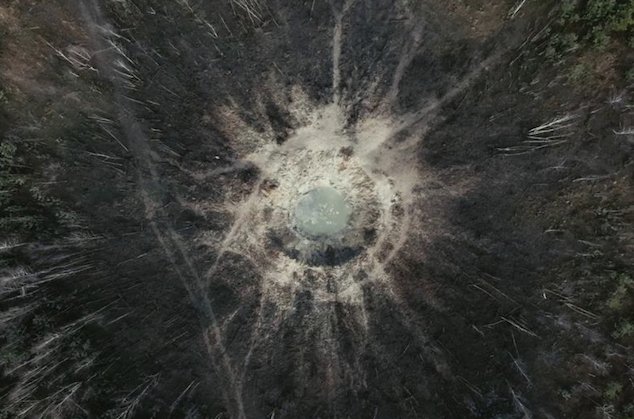
In Ukrainian Dmytro Hreshko’s Divia, selected for Sarajevo FF Documentary Competition, the idyllic tableaux depicting brown bears, wild boar, egrets, horses and dolphins, much of the time filmed overhead by drones, soon segue into scenes of devastation more reminiscent of the hellish paintings of Hieronymous Bosch.
Slow and meditative, and at times accompanied by a soundtrack both sinister and rasping, the feature doc Divia presents an apocalyptic vision of the natural world destroyed by war, in this case the war waged by Russia since 2014.
Across vast plains and along Slavic waterways, trees burn, armoured cars explode and bridges are sunken. Bovine carcasses are strewn haphazardly, and deer explore the new and massive craters that have appeared within their habitat. The earth is impaled by unexploded mortars, broken dams flood the wheat fields, and scorched human skulls turn away from Hreshko’s curious lens. Much of the time, smoke from forest fires dims the sun’s light.
But nature is yet resilient, and regenerative. Seasons turn and new shoots start to reach skyward, and even as the war continues to rage, sunflowers will always turn their face towards the warmth.
“This is an observational, meditative journey which contains neither dialogue nor a vocalized narration: its tone is set by the juxtaposition of images, music and sound design,” producer Polina Herman of Ukrainian UP UA Studio told BDE in 2024. “A slow-moving camera leads the viewer from harmonious nature to war, its consequences and nature’s attempt to recover. Through music and sound design, the viewer should feel the presence of the nature goddess Divia.”
“Divia should serve as the symbol…of nature and all living things, who is opposed to war, destruction and death,” agrees director Hreshko in his notes.
Herman points out to BDE the film’s global significance, how war is capable of destroying nature and ecology far beyond Ukrainian borders. “Using Ukraine as an example, this can happen everywhere. Our project is very universal, since our film is without dialogue and there is no language barrier. Our cinema is a universal cinematic language that will be understandable to everyone,” she explains..
Nevertheless, the tragedy of the war in Ukraine is one of the defining catastrophes of our time, with its ecological as well as human and political consequences. “The destruction of nature is a significant part of the cost we Ukrainians pay for our freedom from Russia, which views nature and the world around it merely as resources for exploitation and expansion,” Herman adds.
“Documenting the Russian military’s eco-crimes and the destruction of natural landscapes and ecosystems is crucial. Understanding the scope of these issues is the first step toward solving them. While environmental concerns might not be a priority for Ukrainians amidst pressing issues, neglecting them could threaten our lives more than anticipated.”
Hreshko, an environmental activist and documentary filmmaker, commented further on his film when pitching it at Ji.hlava 2024: “It’s hard to put some emotions into words because most of them are inside this project – it’s really personal, and it’s hard to realise how many natural resources have been destroyed, mined, or occupied by Russian military forces.”
“When I come here [to Ukraine], I see so many beautiful lakes, forests, hills… It’s really awesome… But what if all this beauty were to disappear? This project focuses primarily on loss. That being said, I believe in freedom and preservation, which will defeat the ideas of occupation and exploitation,” he continued.
In advance of the film’s world premiere at Karlovy Vary 2025, Hreshko explained how his core musical inspiration was Godfrey Reggio’s Koyaanisqatsi, even though he didn’t want the effect to be quite so vast and symphonic as the Philip Glass soundtrack.
“The film’s producers wanted to involve a famous composer in the film, so we were looking for composers abroad, and that’s how I came across Sam Slater’s work, and after listening to his latest album ‘I Do Not Wish to be Known as a Vandal,’ I realised that this was exactly what I needed. Because his music is not based on the usual instruments, and he tries to create his own instrument with his own sound every time,” comments Hreshko.
“The music had to have a non-human sound and be alien. I had the opportunity to work with Sam personally in Berlin in his studio, and it was my first experience of such collaboration. And I really liked it, Sam is very sensitive to emotions and the task at hand.”
Producer Polina Herman first met Hreshko in the Carpathian forest when she was location scouting there in 2019. They have worked together ever since, and their friendship was reinforced after surviving a massive shelling operation by the Russian military. “Now we trust each other completely,” she says.
“I think his ideas for films are brilliant and their implementation is very deep and meaningful,” Polina adds. “His qualities are deep-thinking, sensitive to the world around him, brave, responsible and logical. He knows what he wants.”





