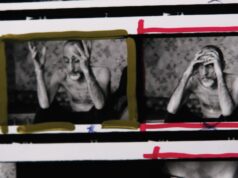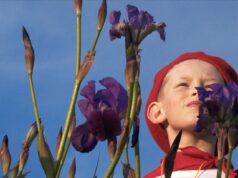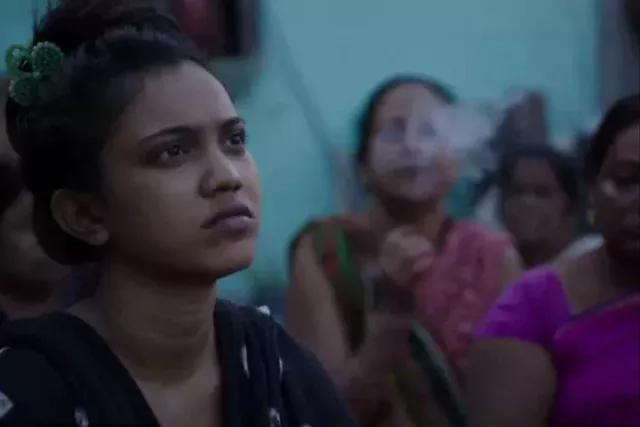
At the heart of CAM ON, the creative community dedicated to telling the stories of folk within Kolkata’s red-light community, is Rabin, himself the son of a sex worker. “He could have become a pimp, but instead became a storyteller,” director Bipuljit Basu tells BDE before the world premiere of Redlight to Limelight, selected for Sheffield First Feature Competition. “Now I call him Rabin Hood,” Basu adds.
In the film we follow the entire troupe, but the focus is mainly on the older Meena, who is asked to play the mother in the upcoming short film ‘Nupur: A Story of Two Sisters,’ and Afsara and Bilkis who play the titular siblings. The spotlight is also placed on Rabin who, throughout the film, is industrious, authoritative, kind and encouraging in equal measure. He directs, he teaches and he arranges, and at one point even arranges to pay off the bribe demanded by the local police so that shooting can continue.
A defining ethos of CAM ON is to break the cycle of prostitution for the next generation, and learn to survive through the art and craft of cinema.
Most of the Kolkata sex workers we meet in the film are working the streets out of necessity, but they make for a collegial outfit. When Meena was thrown out of her house by her husband’s abusive family, she took the train to the city. Desperate, she had no idea what to do or where to go. At the main station a taxi driver drove her to the Kalighat red-light district where she was taken in by the sex worker community.
That said, the workers still suffer abuse, are derided publicly and at times turn to alcohol, all of which is recreated in the scenarios acted out in their film. Such is director Basu’s skill (and indeed that of Rabin) moments of genuine real-world reflection blend seamlessly with what is created for CAM ON. At one point we see a violent family row in which the sex workers protect a daughter from her domineering father, only for the participants to burst into laughter when Rabin cries ‘cut.’
The documentary progresses towards an emotional public screening of the film. The doughty sex workers leave no turn unstoned with their ‘in-your-face’ promotion of the screening. Yes, they still receive some horrible comments – they are referred to as “voluptuous sluts” and are told “if you strip, we will definitely watch” – but they manage to fill the open-air cinema whose screen is created by folk from the troupe. But can Afsara, who has been painfully shy throughout the entire production, repay everybody’s confidence in her with the performance of a lifetime?
Bipuljit Basu is a self-taught filmmaker (an “organic” director, he says) who started in the film industry as an overseas distributor of Bengali cinema, promoting socially conscious films to Indian diasporas worldwide. In 2020, when working on a film about sex workers, he encountered CAM ON, and was amazed that such an outfit could exist, run by sex workers and their children, and who “create films for joy yet receive no recognition.”
“Immersed in their world, I saw how social participation and equity shaped the spirit of filmmaking,” he writes in his film notes. “Over four and a half years, I lived with them, witnessing their agony, ecstasy and creative drive. As I understood their vulnerabilities, they sensed mine, opening their deepest truth.”
“I wouldn’t have become a filmmaker if I had not met this wonderful community,” he adds to Business Doc Europe. “They shaped me as a filmmaker, awakened my emotions as a filmmaker, and they helped me to grow as a human being…Trusting their collective intelligence made this film possible.”
He further describes the women working in the brothel: “As a collective, their creative intelligence, their spiritual intelligence, their philosophy, their human value system, their integrity, their solidarity among the community, how they stand by each other, was absolutely mesmerising for me, and this compelled me to tell their story.”
The director tells how the work that CAM ON produces has elevated the organisation into Indian mainstream culture and that cinemagoers in Kolkata are becoming increasingly aware of its films both in artistic and societal terms. Likewise, Meena is no longer considered to be a sex worker, he argues, rather somebody “with dignity as a storyteller, as an actress, as an artist, as a community leader… her sex worker identity has now become secondary. Now it’s completely her storytelling identity coming forward.”
What’s more, on Basu’s next film, Who Kissed Me In The Dark?, about a terminally ill girl who is collecting stories to survive, all the time drawing vitality from them, he will be relying heavily on the personnel who made Redlight to Limelight possible. “Eighteen members worked in front of the camera. Twelve members worked behind the camera as my production staff. In my new film the entire 30 members will work in different production roles behind the camera.”
Over the past four years, Basu has developed the film at many labs and has honed his presentation skills at many industry platforms, including Sheffield MeetMarket in 2022. “I’m completely the product of the pitch forum, I would say, because I started with almost nothing,” he tells BDE.
“I wasn’t supposed to make film because I started with zero. It’s my first film, but in continuous manner, over the last four years, I have been participating in the pitch forums, and it has helped me to understand how the story should be told. The tutors, the mentors, the labs, the exposure definitely helped me as a newcomer, first-time-filmmaker to understand the essence of documentary storytelling.”
Producers on the Indian/Finnish/Latvian documentary are Nilotpal Majumdar, John Webster and Uldis Cekulis. Sales are handled by Taskovski Films.