

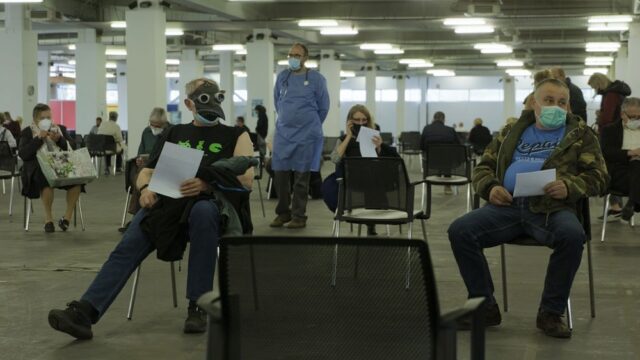
Even in advance of its world premiere at Sheffield DocFest, Croatian director Goran Devic’s Pavilion 6 (sold by Film Harbour, see trailer) is already being billed as a Covid movie with a difference – a feelgood affair about a feelbad subject that approaches the pandemic in a humorous and surreal way. The film will be shown on BBC Storyville later this year.
The idea came to Devic when he accompanied his very nervous mother-in-law as she went for her first Covid vaccination at the Zagreb Fair complex.
“My wife asked me to accompany her mother. From the first moment, I realised that my support was unnecessary…she [the mother-in-law] started to talk with other people waiting in line with us. When I listened to what people were saying, I immediately fell in love with their way of communicating.”
Devic asked the organisers for permission to shoot the people waiting in line for their Pfizer jabs. “I was asked only one question [by the organisers]. Are you pro or against vaccination? When I gave the right answer, they allowed me to shoot.”
Devic’s technique was very straightforward. He would mix with the crowds. When he found anyone who had something interesting to say, he would engage them in conversation. After 10 minutes or so of chat, he would introduce to himself, mention that he was making a film and ask if he could mic them up and follow them from a distance on camera.
“Nobody refused!”
The subjects all knew they were being filmed but the documentary makers were discreet, staying 20 metres or so away. Whenever Devic realised a conversation was interesting and worth pursuing, he’d move the camera a little closer. After the crowds thinned out, the filmmakers turned the lens on the doctors, cleaning ladies, security guards and emergency crews.
The first 16 days were filmed “without any budget…when I realised we must shoot this story, I immediately called my cinematographer and my sound man. Both are my friends. I said obviously we can’t wait to get proper financing. We will start filming tomorrow or we will talk about opportunities missed in the future.”
Eventually, the filmmakers secured support from the Croatian Audiovisual Centre. The project also passed through Docu Rough Cut Boutique organised by the Balkan Documentary Institute (“a great platform for unfinished film,” says Devic) and CineLink Sarajevo. Devic and his crew ended up with more than 100 hours of material.
Pavilion 6 makes enjoyable viewing. We eavesdrop on conversations between strangers who, after lockdown, are clearly craving company and the chance for a good chinwag.
“After the isolation, I felt I was in a new better Zagreb. I felt that every single individual I met there was happy to communicate. Even the shooting was some kind of communication. Nobody asked us why we were shooting. Everybody was very happy with our decision [to make the film] and supported us.”
Nonetheless, the director acknowledges he was startled by the lack of trust the public seemed to have in the authorities.
“It surprised me how much scepticism there was in people toward the system and to the medicine. Nobody believed in anything anymore,” he says.
The film’s subjects were people who had agreed to be vaccinated. Devic could only imagine what the other part of the society felt: those who didn’t choose to be vaccinated and were even more frightened and alone.
Devic and his team (including editor Vanja Siruček) spent more than a year and a half pulling the film together. “In the beginning, we were editing a film about the Covid times, and at the end I think we were editing a film about society,” he says of the shift in perspective that took place during post-production.
“It [the film] is much more optimistic than pessimistic if I must choose one of these terms,” Devic continues. “This is a picture of us…who we are, including me…and the fact you are somewhere outside your home with a camera is an act of optimism from the beginning. I can’t start shooting a movie from a pessimistic point of view.”
Humour, he adds, has always been “one of the tools to survive. In the Balkans, that is a little bit more than in the rest of Europe maybe. We have this tradition of black humour and to make jokes about literally anything.”
As for his own experiences during the pandemic, Devic faced the same dilemmas as everyone else. He “believed in the science” and took the opportunity to be vaccinated as soon as it arose. He admits, though, that he was “a little bit scared…this global point of view of scepticism touched me as [it did] anyone else.”
Pavilion 6, produced by Hrvoje Osvadić, is just one of several films that Devic and Petnaesta Umjetnost, the production outfit he founded back in 2007 because he was “not happy to wait in line and beg other people [for funding],” have been working on in recent months. The writer-director is currently preparing the fictional movie Flood, set in a Croatian concentration camp during the Second World War, and also recently completed the feature doc What’s To Be Done (a film about a railway wagon factory in Zagreb). This screened in Sarajevo’s Documentary Competition.
The collaboration between Devic and producer Osvadić began in highly unlikely circumstances. “He was a friend of a friend. I worked for him on some TV project and he fired me at a moment when he realised I wasn’t happy any more on the project. I said look at that guy, he’s very intelligent. He needs only a few days to realise the problem and make the solution. When I established my company, I offered him 50% of shares because I respect the way he fired me!”





