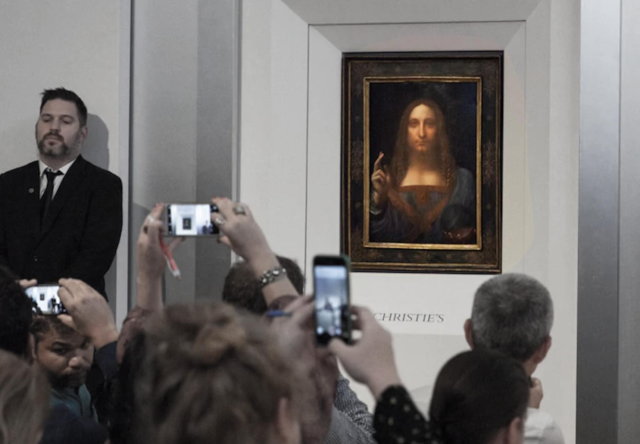
The Savior was for sale and you could have him for a mere $400 million. When Salvator Mundi, a work attributed to Leonardo Da Vinci, was auctioned at Christie’s in 2017, this was the amount that the Saudis paid for it (not counting the $50 million in commission for the auctioneers). This was roughly $499.990 million more than the $10,000 paid for the same painting when it went it had gone on sale in New Orleans 12 years before.
The story of how Salvator Mundi became the most expensive art work in history, even though many experts still doubt it was fully painted by Leonardo, is told in Antoine Vitkine’s feature documentary The Savior For Sale: The Story of the Salvator Mundi (a UK premiere in Sheffield Doc Fest this week).
Vitkine acknowledges that this is a departure for him. “I don’t have a very close relationship with art, I must say.” He tends to make documentaries on social or political issues, for example his book and TV film about Hitler’s bestseller ‘Mein Kampf,’’ or his films about the Libyan dictator, Colonel Gaddafi. He had been working on a documentary about Saudi Crown Prince Mohammed bin Salman [MBS] and was intrigued by why the Saudis wanted the painting and what they planned to do with it. That, more than the art historical side, was what fascinated him.
The film deliberately leaves out any reference to Jamal Khashoggi, the Saudi journalist murdered and dismembered in the Saudi Arabian consulate in Istanbul in October 2018 – an incident which provoked global revulsion against MBS. “No, that is not part of the story. It could have been part of the story,” the director reflects. “I had to make some choices. I had to focus on the Salvator Mundi…I chose not to mention it.”
Nonetheless, the documentary is packed with the kind of colourful characters you might expect to be playing villains in James Bond movies: ruthless art dealers, Russian oligarchs, shadowy politicians and impressionable curators and museum directors.
Several powerful people were prepared to talk to Vitkine. The director believes that some appeared because they wanted their “point of view” about the painting to be heard. “Also, you have ego which is a good reason to participate in such a film…some people, they love to be in front of the camera.” It helps, too, that Vitkine is tactful and diplomatic. Subjects tend to trust him.
Among the most prominent interviewees is urbane Swiss art dealer Yves Bouvier who ended up being sued by Russian oligarch Dmitry Rybolovlev for the huge commissions he took for the deals he struck on the Russian’s behalf, including one for Salvator Mundi.
“Bouvier is very smart…he’s a fox. It’s an incredible story itself,” the director says of him. “Bouvier talked quite frankly. The reason he did that was, I believe, that talking to me was a way to protect himself, because if something happened, everyone and the police would think about Rybolovlev.”
On camera, the art dealer presents himself as an honest broker, doing the bidding of his hugely wealthy clients. He downplays his own cunning.
In the film, members of the public and some celebrities are shown staring with rapture at Salvator Mundi, a painting some commentators liken to a male version of Da Vinci’s Mona Lisa. Vitkine, though, doesn’t share their awe. He prefers more modern art. “To me, this painting [Salvator Mundi] became too much [about] marketing,” he says. It’s hard, he adds, to “find this painting interesting, beautiful and emotional” when you learn about how it has been horse traded.
“Art sometimes makes people become stupid,” Vitkine suggests of why intelligent, hugely wealthy figures sometimes behave with the same lack of restraint as kids in a sweetshop when they’re dealing with paintings like Salvator Mundi.
Vitkine gives his interviewees nicknames. One will be labelled “the mercenary.” Another will be described as the “expert.” The director explains that he labels them in this way partly in reference to Guy Ritchie’s Snatch and partly to establish them in the audience’s mind as “archetypes.”
Spotted fleetingly on screen is British author and documentary maker Ben Lewis, author of a book, “The Last Leonardo’, about the painting. Vitkine acknowledges that this “excellent book” helped him with his own research. Thanks to Lewis, he knew “on which track I had to go and to dig.”
International sales on The Savior For Sale are handled by MK2. The film premiered on TV in France earlier this year. It has also sold widely but its roll out in cinemas has been affected by the pandemic.
“I want the maximum of people to see it,” the director says. The film has also already provoked a furious media storm with its revelations that Prince Mohammed bin Salman had been willing to loan the painting to the Louvre for its huge Leonardo exhibition only if it was displayed next to the Mona Lisa. (That would convince the world it was authentic). Critics complained that to do so would be akin to “laundering” the reputation of an art work still shrouded in controversy.
Having dived into the Leonardo Da Vinci controversy in this documentary, Vitkine is making a fictional project but one rooted in “geo-politics.”
“This [fiction] is in a way a new world,” the director reflects. Others, though, might point out that the story he tells in Savior Of The World is far stranger than that found in any novel.