

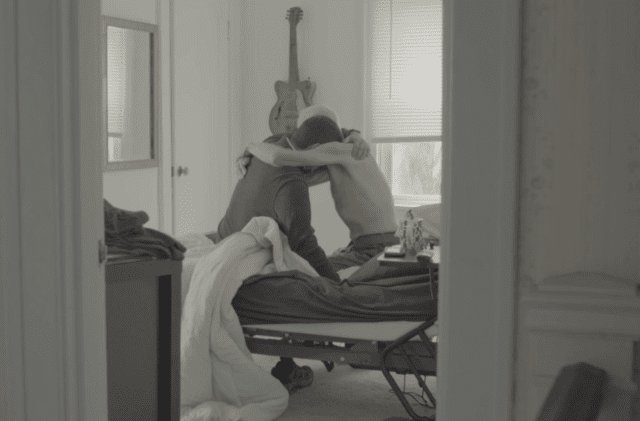
65-year-old Bob Rosenzweig is an abrasive, quick-witted Jewish New Yorker, devoted to his family. He loves to play the guitar drink a whisky and tell stories about his wild, carefree youth – how he went to Woodstock as a teenager and his encounters with famous rock stars.
But Bob is also suffering from Parkinson’s Disease. He is in extreme pain and needs medication. He has now taken the decision to end his life, using Washington State’s Death with Dignity law. Award-winning Australian filmmaker Amiel Courtin-Wilson is chronicling his last few days on earth. That is the starting point for film Man On Earth, premiering in International Competition in Sheffield DocFest.
The challenge for the director and his crew was ‘to melt into the shadows” during some truly overwhelming moments including the point at which Bob’s assisted death finally takes place.
“It took between 50 and 55 minutes in total between him taking his medication and him taking his last breath,” Courtin-Wilson remembers. “Our sound recordist Steve Bond, our cinematographer Jacqueline Fitzgerald, they were sobbing so visibly…” At times, the camera would shake as the crew members tried to contain their emotions. The fact that ‘House of the Rising Sun,’ one of Bob’s favourite songs, was playing in the background only added to the weird intensity of the occasion.
“Bob was adamant about us filming his actual death and including it in our film. He would joke that “it was the best way in the world to guarantee an audience sticking around to the end,” the director recently joked. In his interview with Business Doc Europe Courtin-Wilson describes the process of filming his subject’s final days and moments as “uniquely humbling and certainly an experience like no other.” He talks of “Bob’s incandescence.” Every story that Bob tells on camera has an extra force and poignancy. “Not only was it the last time he would tell that story but it was the last time he would have that memory probably. That sent an electric charge through Bob and inevitably through our crew.”
There’s a paradox at the heart of the film which some will find uncomfortable and even baffling. Bob has an obvious lust for life. He is still in possession of his senses and seemingly able to enjoy himself. Why, some may ask, is he so determined to die?
“I was absolutely conflicted about three days in,” Courtin-Wilson admits. “It seemed kind of crazy [for] someone who had as much energy and humour as he did.”
The director explains, though, that it was not only the pain Bob was feeling or the dependence on others. He had cared for his own father, whose mind had been eaten away by dementia in grim and degrading fashion.
“I think it was a mixture of knowing that he wouldn’t be able legally to make the decision [to die] once he was deemed not to be of sound mind – that scared the hell out of him – and the doctors explained to us that Bob had less than six months [to live]. Even though he was seemingly shining quite brightly in that week, he could so easily have fallen off a cliff at any moment. I think he was acutely aware of that.”
The director first discovered Bob through another feature doc project, Traces. Due to be released next year, this was shot in a hospice and used black and white thermal imagery to show the heat leaving the human body after the moment of death. Bob heard about the project. He was keen for the end of his life to be chronicled.
“I don’t know if I would have requested this kind of access with someone and his family. The fact that it came from him and was really his idea to make this observational film set the ethical parameters pretty strongly for me,” the director states.
Even if Bob was pushing for the film to be made, his relatives (in particular his sons) took some convincing. “Initially, to be totally honest, they were totally sceptical. They were quite suspicious of a film crew being around their father at such a vulnerable period.”
The filmmakers agreed not to ask them to sign release forms until they had seen a cut of the film. “It just seemed that absolutely they [the family] should have all the power in terms of being able to veto material after the fact.”
Courtin-Wilson deliberately kept the crew small. They filmed without lights and tried to be unobtrusive. It took a day or two for the relatives to get used to having them there. “But that abated pretty quickly.” The film crew and the family soon became very close. They still remain in touch.
The director realises that his film is bound now to be caught up in the ongoing debate about the ethics of assisted dying. “I definitely did not want to make an advocacy film. I would hope that both sides of the debate could look at Bob and at Bob’s story,” he reflects. He has heard “frightening” stories from some American contacts about health insurance companies putting intense pressure on low-income claimants to “make this decision and end their lives for obvious money-saving purposes.”
Man On Earth has already secured Australian theatrical distribution through Bonsai Films. The aim now is to secure a sales agent and strike further distribution deals.
The film was produced by Flood Projects, the company through which Courtin-Wilson has been making work since his debut feature documentary, Chasing Buddha, premiered at the Sundance Festival in 2000. This may have been a small-scale documentary but the director was working with some very illustrious collaborators, among them cinematographer Fitzgerald (whose credits include True Detective) and editor Peter Sciberras (who was Oscar nominated a few months ago for his work on Jane Campion’s The Power Of The Dog).





