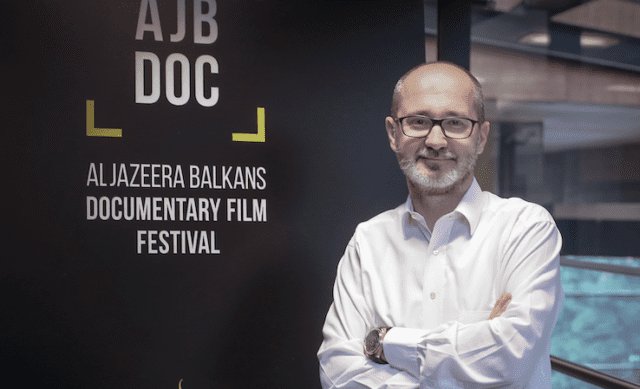
“The theme of ‘JUSTICE?’ arose naturally,” comments Festival director Edhem Fočo of the sense of urgency that drives the seventh Al Jazeera Balkans Documentary Film Festival (AJB DOC), running September 13 to 17 in Sarajevo. “We wanted to focus on the issue of Gaza and Palestine. It pains us that other film festivals have somewhat overlooked this topic, as if it were not the most important issue today,” he underlines.
“We know that there is no justice in the world,” he continues. “It’s no secret that, historically, there never has been any justice. American Indians have been completely unjustly erased from their land, as have Australian Aborigines. But, today, we are witnessing live what is happening in the world. We are witnessing all kinds of injustices inflicted upon the Palestinians, and it really bothers us that the world tolerates these injustices, especially those who promote human rights and values. It truly bothers us, as it should bother every normal human being, not just documentarists.”
This year 24 documentaries will screen across four programmes: Competition Programme, AJB Screening, Last Minute Cinema and SmartDoc, with four additional Special Screenings. In total, the festival will present nine international, 12 regional and five B&H premiers. Nearly 300 films were submitted to the festival this year for consideration.
The decision of Best Film in the Competition Programme will be made by an international five-member-jury comprising Deborah London-Harrington, documentary filmmaker and Head of Production Management at Dogwoof; Namik Kabil, film director and writer; Mila Turajlić, documentary filmmaker; Francesco Montagner, documentary filmmaker, and Myriam Francois, journalist and documentary filmmaker.
The films within the Competition Programme will also compete for the AJB Programme Award, presented by the Al Jazeera Balkans Programme Department Jury. All films screened at the Festival will have a chance to win the Audience Award.
“Our criteria are always the same: we want human stories, realistically told, with topics that are relevant for most of us,” Fočo tells BDE of his selection rationale. “We do not aim to please the critics or some avant-garde view of a selected few. Of course, often our films are great for audiences and great for experts (many of the films selected later become shortlisted for Oscars or win prestigious awards) and we are happy if both of those standards are met. But the priority is our audience and the relevance of the topics.”
Two highlights films from Bosnia and Herzegovina are selected for this year’s Competition Programme, Forgive Us Our Debts by Sergej Kreso, a Bosnian based in the Netherlands, and Prison Beauty Contest by Srđan Šarenac.
In addition to documentary film screenings, the Seventh AJB DOC Festival will offer a rich accompanying program of talks and presentations, including a masterclass titled “Life Between Checkpoints” and a panel discussion on “Violence Against Women.”
AJD Industry Days
Al Jazeera Documentary Channel will present the 3rd AJD Industry Days, that seeks to connect top new documentary projects with leading international decision-makers.
270 documentary projects from nearly 50 countries were submitted this year, of which 29 were selected for presentation across four categories. A prize fund of over 120,000 euros will be distributed among the winning projects. AJD Industry Days confirms that it will be visited by over 80 decision-makers from major film festivals such as Sundance, Berlinale Forum, DOK Leipzig, IDFA, as well as by directors and representatives from ARTE and other major public broadcasters from Austria, the Czech Republic, and Croatia, which will also award prizes.
“We have a number of unique selling points – [the] festival and Industry Days is organized by a major broadcaster, who is a major buyer/producer of documentaries,” Festival director Fočo stresses. “Awards at Industry Days are substantial and have the inclination of being increased. It is not overcrowded, so you have the opportunity to present your film to the very top of the documentary industry and mingle with them at ease. That boutique approach enables us to take care of both decision makers and filmmakers and I believe that is one of the reasons why there is a very big demand to apply for the AJD Industry days among all stakeholders.”
“Next, we focus on geographical areas which are not very common at other industry events – Middle East and North Africa, Southeast Europe and Caucasus,” he adds. “Amazing films are pitched that come from Palestine, or Algeria, or Libya, or Chechnya, or Georgia, or Azerbaijan, or Macedonia, etc. I should also add here that 2 out of 11 highly competitive films in the main competition selection of AJB DOC were awarded projects from our first AJD Industry Days. It is great to see that circle somehow closes here.”
How does Fočo reflect on the importance documentary these days as a tool for education and/or enlightenment, especially as people can turn to less reliable platforms, such as social media, for information and opinion?
“It would be fantastic if documentary films can be ‘in’, or to be at least some kind of a trend, among younger population,’ he responds. “We are trying to make it happen on whatever level. We have interests for screenings from schools and universities, we provide trainings, masterclasses and workshops primarily for younger people who are interested in documentary films. As you have mentioned, today’s [audiences] get a lot of information from social media. Even if it is credible and reliable, it cannot even scratch the surface in getting to learn or understand anything.”
“I accept that in a modern, digitalized and highly visual world it is getting more and more difficult to get people to read books, journals and serious articles, unfortunately,” Fočo continues. “In that case, in my opinion, documentary films are ‘the next best thing.’ They can provide much better context, create an impact – because the viewer is made to empathize with the subject or topic of the film. He or she has visual, clear images that can stay in one’s mind longer, so documentaries should be the place where you go to learn something more about any given topic. As I said, we see great interest from younger audience, it should be the goal for other documentary festival or content providers. Get viewership first and once they realize the beauty and quality of documentary films, they will stay for a long run.”
And what will constitute a successful edition of AJB DOC in 2024? What will Fočo’s ideal takeaways be after doors close September 17?
“I am satisfied with realistic things [that are] not taken for granted. I would be very happy if audiences again turn up in big numbers and if they leave cinemas wanting to come again to AJB DOC. I would be happy if filmmakers say that this was one of the best festival experiences they have ever had. I would be happy if all competition films and all industry projects find awards, money, partners. Is this too much to ask?” he signs off.