

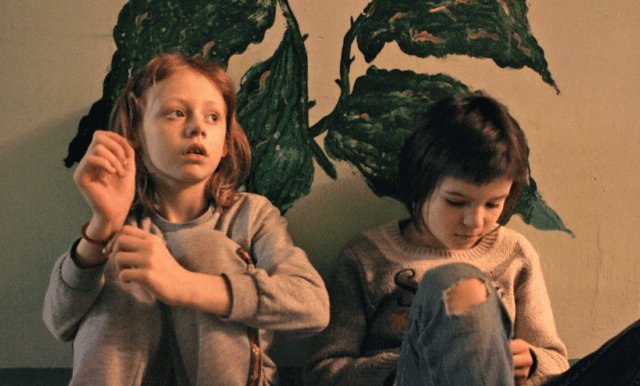
Danish director Simon Lereng Wilmont discovered the orphanage that features in his new documentary A House Made of Splinters, selected for Sundance World Cinema Documentary Competition, when he was in Ukraine making his The Distant Barking Of Dogs (2017). That film was about a young boy living near the frontline of the war with his grandmother.
When the grandmother became ill with heart problems, Wilmont couldn’t help but worry about what might happen to Oleg if he could no longer live with her. That was what led him to research how kids left on their own in Ukraine were looked after by the State.
In the Donbass region, many families have come under intense pressure because of the war. Domestic violence and alcoholism have spiralled. Parents have been struggling to look after their children. When they can’t cope, the children are often placed in temporary shelters. The time they’re allowed to stay in these shelters is limited to nine months. At the end of this period, the State is supposed to decide what should happen to them next – whether they should go home, be adopted by foster families or put into orphanages.
The shelter in which Wilmont eventually made his documentary was “completely different from the other places” he visited. Its staff were incredibly dedicated and kind-hearted toward the children.
“It was cosy and it was small, relatively worn out but it just had this…simple human warmth. The staff had put old but colourful wallpaper in the kids’ dormitories. I also noticed that the kids were hanging out and helping the staff every time they had a chance. That warmth made me super curious but it also made me fall in love with that place.”
The documentary (made through renowned Danish production company Final Cut For Real and sold internationally by Cinephil) concentrates on the stories of three of the kids: Eva, Kolya and Sasha, following them from their arrivals to their departures. However, Wilmont also features many of the other children.
In one extraordinary scene, two little girls talk about their friendship. They’re not sure how to express their affection and so they start scrapping.
“I do my own cinematography so it’s not a big team. It’s just me and a camera and my assistant director, who helps me with the translation. But I enjoy hanging out a lot, meeting both the staff and the kids, getting to know everything about their lives, their situation and their characters…I think the kids could actually feel that. Also, I think I was a welcome distraction from their ordinary life,” the director speculates as to how he was able to win his subjects’ trust and to film them at such intimate moments. “They forget me as soon as they notice me.”
As for the scene of the little girls talking and then fighting, he describes it as his favourite moment in the entire film because of its emotional nuance and complexity. “They’re not able to say ‘I really like you’ and so instead they fight.”
Wilmont chose his main subjects because of their personalities: “a gut feeling really, plus they look good on camera and they’re really good to hang out with – and they seem to like hanging out with me.”
Music is used throughout the documentary. For the director, this was a way of adding to the warmth, humanity and hope contained in the film in spite of the terrible circumstances in which the kids find themselves.
“They’ve been through what a lot of people will never experience. They’ve been through a lot of tragedy in their lives but still they have this beautiful and super precious hope that things will be better in the future,” Wilmont observes of his subjects’ resilience and survival instincts.
At certain moments, parents and grandparents turn up at the shelter. They often defy expectations. Mothers aren’t just “bad alcoholics who want to get rid of their kids.” The reason they can’t look after their children are always far more complex. The alcoholism isn’t the cause of their misery but more a symptom.
The film is screening in Sundance this week. There are also plans for screenings in Ukraine. Yes, the director is disappointed not to make it to Park City in person after the decision was made to hold the festival online. He won’t get to experience his documentary with a big audience for the first time. “I’d really love to be there, see the reaction and feel the room.”
Wilmont is in contact with two psychologists in Ukraine who specialise in children in crisis. They’re taking care of the kids and providing regular feedback about what is happening to them. One of his main hopes is that the film will provoke long overdue debate about how much help is needed for families in the Donbass region. “These social problems are spiralling out of control. It’s also about the hearts and minds. If you really want to turn around that area, now is when to do it…”





