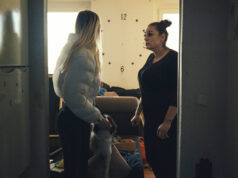
Viewers of The Battle for Laikipia (the new film from Daphne Matziaraki and Pete Murimi which world-premiered in Sundance’s World Cinema Documentary Competition) are likely to have conflicting sympathies.
They’ll understand the terrible plight of the “pastoralists,” the indigenous, semi-nomadic Kenyan farmers whose livestock can’t find grass to graze on in the Laikipia region because of drought.
They’ll see clearly the perspective of the conservationists struggling to protect the land and the animals.
They might even feel a little compassion for the white ranchers who may have come to the country in colonial times but have now been there for generations – and their way of life is under threat too.
As the film shows, climate change has exacerbated tensions that have long existed between the film’s different protagonists.
“From the beginning, when we conceived the idea, we were really talking about how to achieve a result where an audience would be able to shift perspective,” Greek-born director Matziaraki says of the film. She and producer Toni Kamau of Kenyan production outfit We are not the Machine realised very early on that the different parties sharing Laikipia all had their “own story, their own interpretation of history and their own connection to the place…the only thing that is really absurd is that they don’t talk to each other!”
Although Matziaraki (Oscar-nominated in 2017 for her short doc 4.1 Miles) is Greek, co-director Murimi, producer Kamau and most of the other key members of the team are Kenyan. They know the story at first hand. The film’s executive producer is Roger Ross Williams, the Oscar-winning US filmmaker.
Matziaraki had met Williams when they were on the Oscar campaign together in 2017. He had his film Life Animated up for awards. The conflict in Laikipia was then just beginning to simmer. She told Williams that this was a story she wanted to explore in a film. He put her in touch with Kamau, one of Kenya’s leading producers [and who had first worked with Williams on the 2020 film I Am Samuel, directed by Pete Murimi.)
As shooting on The Battle For Lakipia got underway, the filmmakers were discussing continually among themselves the agendas of all their protagonists. They also acknowledged their own “baggage,” preconceptions and biases.
The tensions between the groups portrayed in the film, all sharing the same eco-system, frequently flare into violence – but there are no obvious villains.
“None of these people are what you call evil, bad people at heart,” Matziaraki reflects. “It is their interpretation of history that makes them react at certain times in certain ways.”
“Part of what makes this film special is that it has deep access to [all] sides. Yes, that can be unsettling, to oscillate between [three] different vantage points and [three] different perspectives on home and belonging,” Kamau agrees. “Obviously, every viewer will interpret the film based on their own political beliefs or their own sense of justice. We really wanted not to be heavy-handed.”
The documentary is deliberately left open-ended. The filmmakers believe that this very Kenyan story about land rights and survival will have a resonance everywhere that you find similar disputes.
“It’s reflective of many other places across the world…the planet is warming, resources are limited, there are vying histories and a legacy of colonialism,” Kamau pinpoints themes that are becoming increasingly universal.
The filmmakers tracked down Maria, the tough and resilient white farmer, and her son George after reading the blog that Maria kept. Matziaraki had lived in Kenya for many years and had contacts who already knew Maria. “But the most important thing was that, at that time, Maria really wanted to tell her side of the story.”
Having listened to her, the filmmakers were determined to hear the other side too. That led them to Simeon, a Samburu pastoralist who was also “desperate to tell his side of the story.”
Mainstream media were already covering the story but in a very simple-minded way that portrayed the pastoralists as cattle thieves and bandits. Simeon was happy that he was at last being given a proper platform.
The doc was shot over a period of almost six years. “It was a constant, constant building of trust and relationships,” Matziaraki says.
At the time, interruptions because of Covid or funding shortfalls seemed deeply frustrating. On reflection, though, Kamau believes that the extra time “gave us breathing space constantly to interrogate the story and to interrogate our own perspectives.”
She admits that as a Black Kenyan, “I don’t really know the white community…I have my own perspectives on them and how they came to this country. It was also interesting and revelatory for me to get to know these people…and to empathise with them as a Black Kenyan.”
There were more than 300 hours of footage. It took two years to edit. Sam Soko, director of films like Softieand Free Money, did the cutting.
“We had to leave so may scenes out of the film, even characters, in order to tell this long and complex story through very personal points of view and personal experiences. It was only in this way that we felt we could engage our audiences, make them feel empathy and associate with the different characters,” Matziaraki notes.
The filmmakers are currently working on an impact plan for the doc and will be at FIFDH (International Film Festival and Forum on Human Rights) in Geneva in March with the project. The aim there will be to devise strategies for community screenings in Kenya, Africa and beyond.
Before Sundance, the filmmakers screened the film for their protagonists. “They were not altogether in one room but it was incredible to see how they are all embraced it and loved it and how transformative it was for some of our characters. It helped them reflect and re-think. It was received really well by all of them. They felt it was…fair.”
Geoff Martz (One Story Up) was also an exec producer on the film which received funding from, among others, The Ford Foundation. Kamau was honoured with the Sundance Institute and Amazon MGM Studio Producer Award at this year’s festival.