“Who are you? All I know is that you are from the BBC…” reads one of the text messages sent by Syrian activist/cameraman Abd Alkader Habak to his contact in London. That was over a decade ago. He was providing the contact with footage from the battle for Aleppo where he was then based.
Flash forward to today. Habak and the contact, former BBC reporter Janay Boulos, are now a couple. On the January afternoon that Business Doc Europe speaks to them, they are at home in London getting ready to fly off to Sundance for the world premiere of Birds Of War, the film they have jointly produced and directed. She’s a Lebanese Christian. He’s a Muslim. Their documentary, which premieres in the World Cinema Documentary competition and is sold by Dogwoof, tells the story of their love affair – one which began in extraordinarily unlikely circumstances, in the shadow of war and upheaval.
No, Boulos says, their respective mother-in-laws haven’t yet had the chance to see the documentary. “We haven’t been able to share the film with them yet because it has been crazy getting it finished for Sundance. But they both know what is in the film and they both know how they’re represented. They’ve consented to everything…and they are very proud of us for being in Sundance.”
Back in the days when they were communicating by text about potential BBC news stories from war-torn Syria, neither Boulos nor Habak knew much about each other. “Basically, for me, in the beginning, the text messages were really professional,” Habak says. He was simply trying to connect with journalist contacts abroad.
There came a point, though, when they started “talking more.” From texts, they moved into to phone calls and video messages. It was then they began slowly to get a sense of each other’s personalities. “For me it was quite tough. I was supposed to be reaching out to activists in Syria and I had contacts with a few,” Boulos remembers of this period. “At the same time, I knew of the bombing and what was happening to them.” She began to notice Habak’s charisma and his humour. She also had a strong empathy with him and what he was going through.
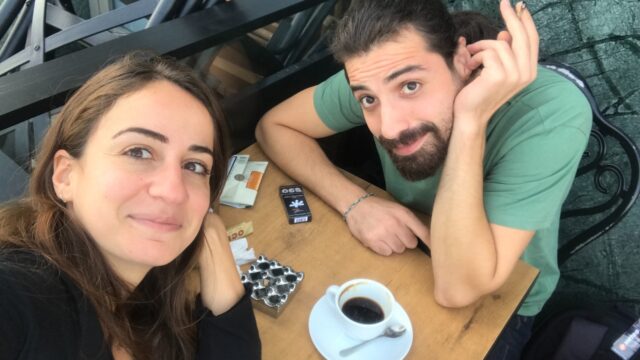
The documentary chronicles how Habak eventually left Syria, escaping into Turkey. That was when the couple first met. “We met, we had coffee, we chatted – and, after that we continued to chat virtually,” Boulos remembers.
Habak adds that he was amazed she would come all the way to Istanbul to see him. “She kept saying I’m going to come and see you. I thought, who is this person who is going to travel from the UK to Istanbul to see you and have a cup of coffee with you!”
From those early cups of coffee, one thing led to another and they soon became a couple.
One obvious challenge for the filmmakers with the documentary was how to balance their burgeoning romance with the political side of the documentary. They had huge amounts of material to draw on, a reported 24 terabytes of footage, and were dealing with war and convulsion in Syria and Lebanon as well as with their own relationship. “The core of it was the love story and events that were pivotal in both of our lives,” Boulos says.
Habak and Boulos aren’t just the producers and directors. In this case, they’re their own subjects. Habak observes how, usually when he is telling a story, he likes to see the main character as a hero. “But when we started making the film, [I realised] I am the hero…”
“We knew from the beginning that we needed fresh eyes, that we couldn’t be on our own, we needed people who are more experienced to support us,” Boulos notes. She pays tribute to editors Will Hewitt and Clare Ferguson as well as to producer Sonja Henrici for helping them to give the film its “spine.”
Birds Of War has a strong Scottish connection. Henrici and Hewitt are based in Edinburgh. Much of the film’s post-production was done in Scotland. Screen Scotland was one of the first funders to get behind the film. There was also backing from an IDA Logan Elevate grant to develop the project thoroughly.
Boulos had worked for a decade for BBC News, from 2012 to 2021, before combining with Habak to set up their own company, Habak Films. “I wanted to do the things that mean something to me personally,” she explains why she left the BBC. “I wanted to be more independent, and work on these sort of stories.”
For Habak, leaving Syria and coming to live in north London was a wrench. “It was very hard. I never thought about mental health and flashbacks when I was living in my country…then I came to the UK. It was a really stable country, nothing happening, easy life. At this point, I started having the flashbacks and triggered the PTSD.” Working was one of his means of coping. “I was trying to make myself as busy and I can – to work on stories in Syria from here [in the UK] and to help people there.”
There is one very evocative moment midway through the documentary when Habak takes one of his old cameras out of storage and realises he can smell the dust from Aleppo still on it. This brings back memories of the bombing, burning and the buildings collapsing.
Despite the fall of the Assad dictatorship in late 2024, he remains wary about what the future holds for Syria, in particular the threat of a civil war.
Boulos strikes a wary note about Lebanon too. “We always say it is going to get better but there is always something happening. People just want to live. They want to be happy, to enjoy life and they deserve that…but the politics is sadly not allowing them to.”
Habak Films has another companion project close to completion. Until The Buzzing Stops is about Syrian exile Ali Alzein, the CEO and Founder of Bees & Refugees, an initiative that uses bee-keeping as therapy for traumatised refugees. He has a bee farm in Kent but, after the end of the Assad regime, he went back to Damascus to set up a similar venture there.
While they finish that project, they two filmmakers are also planning an impact campaign for Birds Of War. They hope to use the film to inspire local storytellers in Syria and Lebanon to make their own documentaries.
When they were first communicating by text all those years ago, Boulos and Habak had pet names, calling each other little birds. “It’s a play in Arabic on ‘love birds.” The word ‘war’ in Arabic and English has one letter difference. This is saying ‘war birds’ rather than ‘love birds,’” Boulos explains the enigmatic title.
As for Sundance, they’re delighted to have been selected. “We’ve bought our snow boots, but we heard they give directors coats,” Boulos says of their wardrobe for one of the chilliest festivals on the circuit.Nine of the team behind the movie will be in Park City for the premiere of what they are planning as a very big celebration of a project that has taken many years to complete.