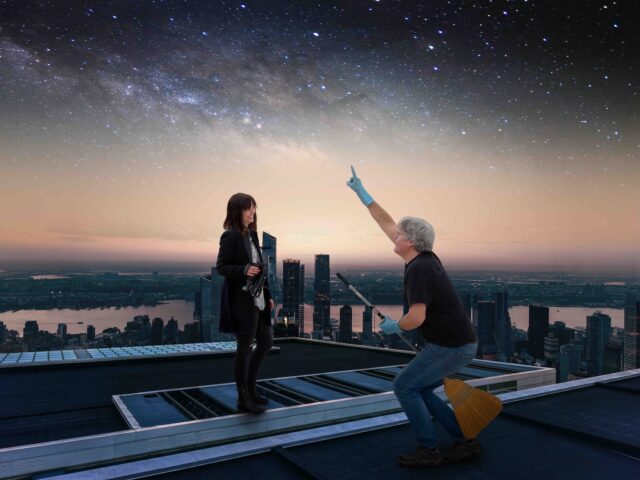
Norwegian filmmaker Elisabeth Rasmussen remembers the precise moment she had the idea for the feature doc We Are Stardust. The film, set to world-premiere in the Newcomers strand of the Thessaloniki International Documentary Festival, before travelling to CPH:DOX’s Science sidebar, follows the unlikely story of Jon Larsen – a man armed with a broom and a magnet who scours rooftops and gutters for microscopic extra-terrestrial particles, convinced he has found real stardust despite scepticism from the scientific establishment.
After moving back to her hometown of Tromsø from London, Rasmussen felt creatively restless until she heard a radio interview with Larsen. Already fascinated by astronomy – she had spent countless hours at the Greenwich Observatory admiring images of nebulae – she immediately sensed she had found a story worth pursuing. “I just knew right away that this was a film I definitely wanted to try and make,” she recalls to BDE. “When I spoke to Jon Larsen, I was sure this story needed to be out in the world.”
Filming began in the summer of 2016 and continued intermittently for years, wrapping in June 2025. The long period of prep generated a vast archive of material, making editing particularly demanding. “The hardest part was deciding what not to include,” Rasmussen admits. “There was so much beauty.”
From the outset, she wanted to avoid reducing the story to either pure science or simple populism. Rasmussen recalls being surprised during pitching sessions by how little many people knew about concepts such as the ubiquity of stardust, or that humans are literally made of stellar matter. “I really wanted the film to be accessible,” she says, adding that Larsen himself became the key to that accessibility. “He has an amazing way of simplifying things and making them exciting and unscary.”
At the same time, she emphasised scientific rigour, interviewing leading researchers including NASA scientist Michael Zolensky and Imperial College’s Matthew J. Genge. “The science needed to be accurate,” she notes. “You shouldn’t underestimate the audience – if things are explained properly, people understand.”
Aesthetically, Rasmussen resisted making what she calls a “pure science documentary.” Larsen, a jazz musician as well as a hobby scientist, provided a bridge between art and science. She recalls him telling her that “science and art are two sides of the same coin,” an idea that shaped the film’s tone. For Rasmussen, the story became as much about curiosity and perseverance as it was about micrometeorites.
The shoot was not without technical challenges. Rasmussen remembers filming outside NASA headquarters in difficult conditions while trying to capture Larsen’s emotional reaction before meeting Zolensky. Working alone with a new camera and portable recorder in high winds, she feared the audio might be unusable. “We worked a lot in post to make it audible,” she says, noting that, despite imperfections, the scene remains one of her favourites.
As a Norwegian-Danish co-production involving Benedikte Bredesen, Ulrik Gutkin and Jamie Hever of the Copenhagen Film Company, the project relied on careful collaboration. Rasmussen says she felt “very lucky” that the right partners gravitated organically to the film. Financing proved complex, particularly before a strong rough cut was ready, but participation in the DOK.Incubator programme helped clarify both narrative focus and personal motivation. “The film naturally fell into place during that workshop,” she says.
Post-production was also shaped by distinctive visual effects and music. Rasmussen searched extensively for the right VFX partner before working with London-based Colin Byrne of Little Shadow, who used a blend of traditional and AI-assisted techniques to animate microscopic particles without altering their scientific accuracy. “The still images are pure microscope photography,” she explains. “But I wanted to see them move – flying through space and landing on Jon’s table.” Scientists reviewed the sequences to ensure correctness.
Music by Danish composer Philip Owusu – his first feature score – became another defining element. Rasmussen sought a Nordic yet universal sound, drawing on jazz influences to reflect Larsen’s background while retaining emotional warmth. “It’s moody and deep but still optimistic,” she says. “It never goes dark.”
Currently seeking an international sales agent, Rasmussen hopes to secure representation during Thessaloniki. Beyond festivals and public broadcasters – with NRK and DR already on board – she envisions a wide outreach strategy, including screenings in schools, prisons and hospitals, as well as possible inclusion in Norway’s Cultural Schoolbag programme, which brings films to classrooms nationwide. “I want the film to reach people who might be inspired or comforted,” she says. “It’s about feeling connected – to each other and to the stars.”
Ultimately, Rasmussen hopes audiences will draw courage from Larsen’s example. “You don’t need a lot of money or a degree to do something meaningful,” she says. “Curiosity and persistence are the main ingredients.”