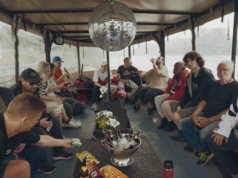
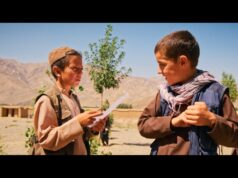
Premiering in the Newcomers Competition of this year’s Thessaloniki Doc Fest, Tirrenica explores the social landscape surrounding one of Italy’s most emblematic infrastructure projects: the Salerno–Reggio Calabria highway. Moving between present-day observational footage and archival material, the film follows lives unfolding along the motorway while reflecting on the promises of development and modernity historically attached to the road.
Directed and lensed by Rosario Minervini, the documentary was filmed in Campania and Calabria and combines contemporary 4K footage with archival material sourced from institutions including the Luce Archive and AAMOD.
Minervini, who also serves as artistic director of Giffoni Film Festival’s documentary sidebar, traces the origins of the project back to December 2019, when he was finishing a short film during film school. Shortly after Christmas, he drove south — and something he saw along the motorway sparked the idea. “I was about to finish a short for my second year of film school, and right after Christmas I got in the car to drive back down south. While driving, I noticed a small football pitch lit up on the edge of the motorway,” he says.
The unexpected sight prompted him to reflect on the hidden worlds surrounding the highway — places overlooked by those simply passing through. “From there I started wondering what existed under the overpasses, and I realised it would be perfect to tell the story of my South through the emblem of the Salerno–Reggio Calabria motorway.”
For the filmmaker, the road became a metaphor for wider regional contradictions. “That disparity of possibilities, of intentions, of narratives, of speeds – I wanted to try to tell something that belonged to me.”
“Then Covid arrived and the project risked remaining just an idea until 2022. After a pitch with Claudio Esposito, we immediately set the project in motion.”
Esposito produced the feature for The Piranesi Experience alongside Limbo’s Stefano Chiavarini, Belino Production’s Antonio Novellino and Il Saggiatore’s Luca Formenton.
The search for characters unfolded over several years. Together with collaborator Castrense Scaturro, Minervini travelled extensively along the secondary roads surrounding the motorway to discover people and places that would shape the film. Those early trips lasted nearly two months and led to the first protagonists. “In the second year, for three weeks we worked on what was still missing and on searching for additional characters to include in the story, like Antonella.”
Further shooting sessions during the third and fourth years allowed Minervini to complete the narrative arcs of his protagonists.
The film follows several individuals whose lives intersect with the motorway landscape, including the aforementioned Antonella (a truck driver nicknamed “La Sirenetta” or “The Little Mermaid”), activist Francesca, elderly scavenger Pasquale, target-shooting enthusiast Mariagrazia, a young boy named Roberto who trains hunting dogs after school, and Mitic, a migrant shepherd rebuilding his life after losing his job during the pandemic. Through these portraits, Tirrenicaconstructs a mosaic of Southern Italy far removed from familiar stereotypes.
To structure the narrative, Minervini divided the film into chapters linked to specific kilometre markers along the highway. “The division into kilometres seemed natural to me from the start. Giving each story its own space was necessary to tell these small corners of life.”
However, he also realised that certain figures would need to connect the different locations and storylines. “We needed some more ‘mobile’ characters that would allow me to connect the various stories and locations in a more fluid way.” Antonella and Francesca therefore act as connective threads, reappearing throughout the film.
Minervini deliberately adopted an observational approach without voice-over narration. “I think narration through images is what distinguishes cinema from television and documentary from reportage. Show it, don’t tell it.”
At the same time, he acknowledges the need to balance cinematic form with accessibility when dealing with complex social and historical contexts. The film therefore incorporates an introductory title card and archival footage that helps situate the story.
Archival material also offered the director a space for experimentation. “Sometimes the archival footage introduces the work in an informative way, sometimes it becomes an element of comparison between past and present, and sometimes it functions as an enlightened narrator on a symbolic level,” he explains. “It allowed me to freely portray what, for me, is the image of the last 150 years of the South.”
The film also touches on the long-standing Italian debate around the “questione meridionale” (“southern question”) — the economic and social divide between the country’s northern and southern regions. “It’s a crucial aspect. This film was also born out of a sort of fatigue with the stereotypical narrative of Southern Italy.”
Minervini acknowledges the risk of reproducing clichés when portraying provincial environments, but aimed to approach the subject with honesty and irony. “In these small chapters of life it’s easy to fall into clichés, choosing one position or another. I try to tell things both in the good and the bad. I tried to offer a different perspective from the way we usually look at the problem in a land where everything changes so that nothing changes.”
As both director and cinematographer, he ensured the motorway remained visually present throughout the film. “Sometimes it’s there for a few seconds, sometimes in the distance, sometimes at the centre, but it’s essential because it’s the thread that connects this South.”
The production relied on a very small crew in order to maintain intimacy with the protagonists. “Everything starts from relationships, and being just two of us most of the time meant the relationships with our protagonists were authentic. At the same time, such a minimal setup came with practical challenges… Human error is easier when you have to take care of many things yourself.”
Yet Minervini believes that vulnerability ultimately enriched the film. “In a way, it also made the film more human. But the biggest work was maintaining relationships between one shooting session and another,” he insists.
Over time, some characters stepped away, while others’ lives changed significantly, but the experience remained meaningful beyond the finished film.
The editing phase lasted roughly a year and involved close collaboration with editor Elisabetta Abrami. “Abrami was able to give the project a completely new identity — ironic and light — balancing the seriousness of the story.”
Post-production for sound and image was completed with Spanish co-production partner Belino Production and lasted several months.
Now launching in Thessaloniki, Minervini sees the premiere as a milestone after six years of work. “This is just beginning. Being presented in world premiere at an important festival like Thessaloniki is already a great source of pride for me.” He also hints that an Italian premiere will soon follow.
“I hope the film will appeal especially to national audiences and create moments of debate and discussion about this South and about this country that continues to move at different speeds,” he signs off.