

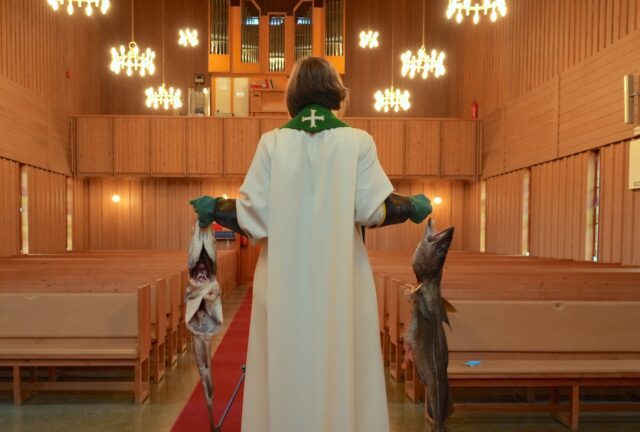
“Did I just make the last film from a vibrant fishing village in Norway?” Guro Saniola Bjerk asks ruefully about her new documentary, In Cod We Trust (sold by Rise and Shine and screening in Thessaloniki’s Newcomer competition).
The film is set in Båtsfjord, 2000 km north of Oslo, a remote but thriving village that was once nicknamed the capital of fish. The director, who grew up there, offers a humorous and loving portrait of the townsfolk. This is a magical part of Norway where you can see the Northern Lights. It may be bitterly cold in winter but for the locals, and for the many workers from foreign countries who find their way here, it seemed like a new Klondike – a hive of opportunity and employment where everybody got along. Only in the last part of the documentary do we spot potentially alarming signs. The cod are getting smaller and harder to find, and tensions are rising with the Russian neighbours.
“I was making the film at a time when the fishing industry and the fishery went extremely well. Fishermen worked hard, got modern boats (speed vessels) and equipment that told them when and where the fish were – they became wealthy. Now times have turned upside down, quotas are reduced, fish are disappearing, cod are going further out/down (due to global warming),” Bjerk strikes a downbeat note. She is, though, an optimist who still believes that Båtsfjord has a strong future.
The director is Norwegian-Finnish. “It all began with my mother coming from Finland to Norway. In 1960, I think, she went to Norway,” she explains her family background. Her mother had come looking for work which was hard to find in Finland at the time. She fell under the spell of a charismatic man who “played guitar and harmonica at the same time.” He took her to his home town, which happened to be Båtsfjord – and that’s where their daughter (Bjerk herself) grew up.
When the director was a young woman, Båtsfjord was prospering. “There was so much money, it was amazing,” she exclaims. “I worked in a pub/restaurant at the hotel and every time you had fishermen coming into the harbour when bad weather was expected, they gave you so much in tips that you could almost live from the tips alone.”
In Båtsfjord, cod is worshipped almost as much as God – one reason why the film includes various wry scenes which combine fish and the local church.
The village has always had a rapid turnover of inhabitants. Many people took seasonal jobs and then left again. The locals were making good money. Houses were cheap. Bjerk remembers her friends being able to buy their own homes “when they were, like, 18.” They earned so much in the fish factories that they could quickly pay off their mortgages. The downside was that the inhabitants didn’t pursue their educations or travel. Instead, they stayed at home to work. They believed the good times would last forever.
Bjerk worked in the shrimp factories. Many of her fellow employees were Tamils. There was nothing strange in that. Båtsfjord is a coastal village that relies on trading, and that had always attracted outsiders. New visitors were valued and regarded with both affection and curiosity. “If you are a good worker, they don’t care where you are from and what kind of colour you have,” Bjerk talks of the tolerance toward foreign workers and immigrants.
Norwegians from the southern part of the country also found their way here and relished the “freedom” of village life. There were far fewer regulations than in the big cities. Finns, Lithuanians and Poles likewise came to the town in big numbers. So did Syrians and Eritreans. “And it was so normal to be friends with the Russians…we have been trading with the Russians for hundreds of years,” Bjerk observes. ‘Nowadays, we have Russians and Ukrainians working in the factories side by side and it’s no problem.”
Ask the director when she first had the idea for the film and she replies that “it is an idea that has been living inside me maybe for as long as I have lived.”
But don’t expect cosy nostalgia. That’s not the director’s style at all. “I was so fed up seeing documentaries about the past, with people sitting in comfy chairs talking about the past, that I thought, ‘NO, that is not ME – I will instead try to put people together, people that haven’t spoken together or normally do not speak – give them a subject and see what happens.’ And I tried that, [it] kind of worked – and I continued doing that, and liked it better and better.”
The director is telling the story of the village but, as she points out, “the village is really the people. The people are colouring the streets, the houses, the environment.”
She adds that “filming in Båtsfjord is just pure magic.” If she wanted to shoot somewhere and wasn’t sure who lived there, she’d run and knock on the door. The residents almost always agreed to be on camera. “95% of the people I met were acting that way.” The locals are “proud” of who they are and rarely feel self-conscious.
When she was growing up, her father was “bossing” the menu and the family ate fish five days a week. “We had steak on Sunday and Saturday was, like, porridge.”
Some residents of maritime communities get sick of eating fish, but Bjerk makes it very clear she is not one of them. “I love fish and eat a lot of fish (fish cakes, fish pudding, fish gratin, salted fish, “bokna” fish (dried a little) and of course, favourite for Christmas; Lye fish…”
In Cod We Trust has already been netting plenty of admirers when presented at events like the Nordisk Panorama and the Finnish Film Affair.
The director believes that Båtsfjord can serve as an example for other divided communities. “I think we had some qualities in the village that are so essential in society nowadays where people are getting more and more afraid of each other, and they’re not talking,” she muses.
Perhaps her colleagues at Wacky Tie Films sum up the doc’s appeal the best. As they point out, the village may be one of the coldest places on earth but it’s here that you find “the warmest and funniest people.”
In Cod We Trust was produced by Benedikte Bredesen of independent Norwegian outfit, f(x) production. The co-producers are Wacky Tie Films from Tampere, Finland. Financing came from The Norwegian Film Institute, Arctic Film Norway, Arctic Film Norway Invest, The Finnish Film Foundation, Nordic Film and TV Fund, AVEK, YLE, RUV, SVT, The Fritt Ord Foundation and The Art Council Norway.





