

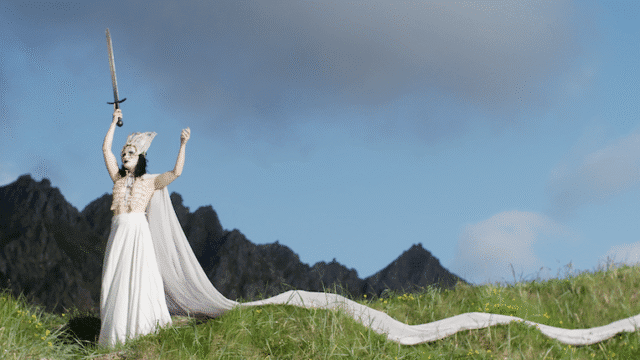
Witch Club Satan are a fast-emerging mega-force in the world of Norwegian “black metal” – and when they play, they make a very big din. In her new film Hex (sold by CAT&Docs), cinematographer-turned-director Maja Holand follows the band’s founders, Victoria, Nikoline, and Johann, as they try to gate crash a male-dominated world.
“Sometimes, I used ear plugs. I tried to do that. But I love going to the concerts and I think I got kind of immune…I love the noise, I just get into it,” Holand says of her own increasing tolerance for the high decibel level. “It just gives me energy.”
In 2022, her subjects had entered into an unusual three-year pact. With “no prior experience,” they vowed to learn how to use their instruments…and “to awaken the witch within themselves” in pursuit of heavy metal glory. Outsiders were sceptical. When they first went on stage in 2022, they used shouting, screaming and the “raw presence” of the female body to make an impression. One critic complained that they were musically inept. “Bureaucratic rock only suitable for government art grants,” he said of a performance that relied on “nudity, sacrificial rituals, ceremonies and all that stuff,” as much as on decent song writing.
But the trio rehearsed and rehearsed. Gradually, they got much better. Fans began to regard Witch Club Satan as a welcome antidote to the neo-Nazi antics of some of the other male groups on the scene. They always put on very colourful shows, with lots of blood and shrieking, that were like pieces of high concept performance art in their own right.
Holand had read an early article about the band. At the time, she was editing a programme showcasing female artists. “There was so much pop music. [I thought] we need something else…” She had also loved the band’s first single, the macabre, ear-splitting anthem, Hysteria.
“I felt really related to them…and because I am a filmmaker, I saw this potential – I saw that this could be really big,” she remembers. “I just had to email them, say hello, and [to tell them] this journey is so interesting that it should be a film.” If no-one was doing a documentary already, she told the trio, she’d be happy to take on the job. They quickly agreed to have her on board.
Right from the outset, Witch Club Satan have embraced feminist imagery and ideas. In particular, they draw on the dark story of the Vardø witch trial in the early 1660s when women were accused of consorting with the devil – and some were burned or buried alive.
At the same time, the band plays authentic heavy rock. “I think they balance it really well,’ Holand says of the combination of feminist ideas and raw power that you get at a Witch Club Satan gig.
Inevitably, in the course of filming the band and spending a lot of time with the three women, Holand developed a strong rapport with her protagonists. “It’s very interesting when you are making documentaries like this and you are really close to them. Of course, we made friends and we travelled together for so many hours. My approach was that I stayed with them, often slept in the same house – and they sometimes just called me the fourth witch!”
At the same time, she knew it was “important I had this distance as a filmmaker.”
The film reveals how sharply the band have polarised opinion within the Norwegian black metal scene. Virulently misogynistic social media posts testify to the hatred some still feel for them. Certain festivals refuse to invite them. Others, though, see them as pioneers, breaking new ground, and have embraced them. “There have been a lot of interesting discussions,” Holand says with evident understatement of the heated debate surrounding the band.
A “big part of the film’ was shot in the remote northern town of Vardø on the site of the old witch trials. “They talk a lot about the witch history in their performances. It came really naturally. It [Vardø] felt like a sanctuary to us, like a place of pilgrimage. You feel something when you are there, it is a really strong monument.”
Before starting working on the documentary, Holand admits she knew very little about the witch trials. “It was like a forgotten history, barely mentioned in schools. I think that because of the new feminism, we are starting to look a bit back on this history.”
“Definitely young women but also everyone [else],” the director responds when asked who she hopes the film will reach. She wants female viewers to “listen closely to what is happening inside them, their inner thoughts. They are there to do something they didn’t dare before, to get some courage to follow what they think is right inside.”
“Don’t be so afraid about being good and perfect all the time,” Holand sums up one of the key messages underlying the movie. After all, Victoria, Nikoline, and Johann have proved that all you really need to launch a band is self-belief and chutzpah.
The documentary is produced by Mari Nilsen Neira through Herstory, the women-led production company based in Trondheim where Holand has worked since 2019.
What’s more, it is screening in Thessaloniki’s Newcomers Competition and in the Sound & Vision section at CPH:DOX. Further festivals are expected to follow. Norwegian outfit Filmdistribution is handling the local release which is set for 30th October – close to Halloween. Arte will be broadcasting the film in due course.
Holand shot the film herself, with some help from Lars Erlend Tubaas Øymo and Kristian Larssen. She also oversaw the lighting and the sound. “For me, it works really fine and I get really close to them…and also it’s the intimacy of being alone [with them],” she says of her own multitasking.
And, no, she wasn’t really tempted to put down her camera and pick up a guitar. “This is the perfect way for me. I got to experience how it is to be a rock star for these three years…of course, I think it is something else to be on stage but I also felt the audience sweat.
”Besides, at one concert, she did get to join the band on stage. “This is why I love being a documentary maker and cinematographer – that I get to actually experience this with my camera,” she says of the adrenalin rush of being on the road with Norway’s most radical and innovative black metal band. “I felt really lucky.”





