

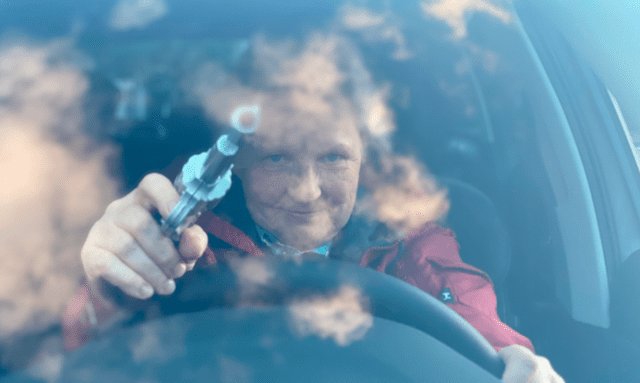
Lisbeth Grägg, the mischievous 66-year-old protagonist of Sylvelin Måkestad’s The Smuggler (a world premiere in Thessaloniki’s Newcomers section) is a woman on a mission. She is desperate to find the long-lost revolver with which her father, fighting for the Finnish army, unsuccessfully attempted suicide after a clash with the Russians during the Second World War.
The 38-year old Swedish-based director is close friends with Lisbeth, whose husband, a sound technician, has been involved in some of her earlier projects.
“Always when I worked with him, I stayed at their house because they were so welcoming. And I became fond of Lisbeth – her black Finnish humour, her curiosity on life and her playfulness. We hang out!”
Lisbeth confided to Måkestad that when she retired, she planned to travel to Finland, retrieve the missing pistol and smuggle it back home to Sweden.
“That was inspiring to me, an elderly woman setting off on a secret mission like this. I thought this is something I can’t miss. I have to apply for money and do a film about it.”
Måkestad realised that the lost weapon had become a symbol of Lisbeth’s relationship with her late father. “For her, finding the gun was a connection to him. To bring it back home to Sweden was almost like bringing dad back home. That strongly resonated with me because my own father passed away when I was in my teens, and I recognised that urge for traces of life in things that remain – to hold on to objects is a way of staying connected.”
Lisbeth sets off on her quest by bus – with a tour group of fellow OAPs, many also looking for connections with family members involved in the war. This may sound like sombre subject matter, but the mood aboard the bus was very upbeat. En route, the travellers drink a fair amount, sing karaoke, play pool, flirt with one another and even do a bit of skinny dipping in the sea.
“I loved it. I love being on the road, that is something me and Lisbeth really share, the playfulness of travelling,” Måkestad says of the bus tour. “I am a bit nostalgic because I remember before the iPhone era, all those deep conversations I had with people while travelling on the bus or aeroplane or train – spontaneous talks where you end up talking about something really personal to a stranger. Sometimes, it can be easier to open up to someone who doesn’t know you.”
Lisbeth and her fellow travellers don’t spend any time looking at their cell-phones. They’re far too busy singing, chatting and conspiring for that.
In her previous documentaries, Måkestad has sometimes taken a “hybrid” approach, exploring the boundaries between documentary and fiction. Here, though, she stays very true to her subject’s story.
“I do a lot of research before we go shooting,” the director says. She knew in advance all the places where the bus would be stopping and so had an idea which might make strong visual backdrops. At times, she could nudge scenes into happening (for example orchestrating Lisbeth’s game of pool with her admirer) but she insists “the themes are 100% documentary.”
The tourists didn’t need any encouragement at all from Måkestad to start singing karaoke. That, she explains, is simply part of “Finnish tradition.”
Måkestad herself is Norwegian but is based in Sweden. “I was actually born in Sweden. We moved to Norway when I was five but I was very stubborn and told my parents that as soon as I am old enough, I am going to move back!”
Aged 16, she returned to Stockholm where she later studied documentary at the Stockholm Academy of Dramatic Art. “Stockholm is a bigger city than in Norway where I lived. I felt there was a bigger opportunity to be who you are without being judged for it.”
The Smuggler is dealing with loss, grief and a daughter’s search for her father but its tone is often still humorous and playful. “That’s often how life fees. Even in the middle of pain, there is absurdity and laughter. I think that can become almost [a matter of] survival. It allows us to look at difficult things without turning away,” the director reflects on how humour helps us all deal with the “heavy” elements in our lives.
Lisbeth isn’t a natural born rebel. “I don’t think she is taking a lot of risks in other places in her life, but this gun meant so very much to Lisbeth. It was like she wanted to show her love to her father even if he was not alive,” the director observes of her subject’s willingness to bend the law if necessary to get the gun home. “It’s almost like she was wanting to be a fellow soldier [to her father] and try do this with him…it was like proving her love, that is why she wanted to do it.”
That’s also why she was relieved when she consulted a shaman who advised her: “you should smuggle with the joy. The spirits are with you.”
Owls feature prominently in the storytelling. The shaman had advised that Lisbeth should “look for birds because they will lead you to the truth.” When she finally found the gun, she was startled to discover that there was an owl’s head stencilled on it.
The Smuggler was produced through Ballad Film, the women-led company run by Ina Holmqvist, Martina Carlstedt and Maria Fredriksson. “I worked with them because they are the best company focusing on humour in Stockholm. There aren’t so many documentaries that work with that style and I really felt that Ballad Film understands that kind of storytelling.”
Backing came from, among others, the Swedish Film Institute, the Norwegian Film Institute, the Finnish Film Institute and various Nordic broadcasters. One of the co-producers was Juha Löppönen at Mouka Filmi OY (the outfit also behind The Beauty Of Errors, likewise premiering in Thessaloniki).
The documentary is expected to surface at further festivals in the spring and early summer. International distribution is being overseen by Raina Film Festival Distribution.





