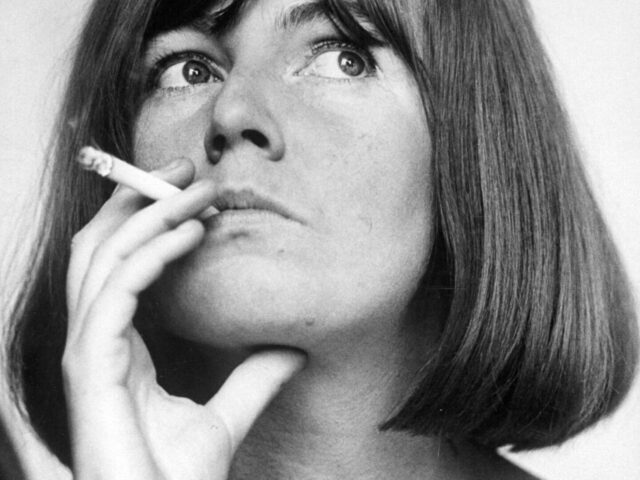
The late Irish novelist Edna O’Brien is the subject of Sinéad O’Shea’s new film, which world-premieres September 8 in TIFF Docs. Ridiculed for decades by the literati of Ireland (and parts of the UK) both for her explicit depiction of female sexuality in her home country and her alleged libertine lifestyle, O’Brien was, nevertheless, feted across the rest of the world, especially the US, for her deep lyricism, her intellectual vigour and her prolific output.
O’Brien died on July 27 2024 at the age of 93, aware and happy that O’Shea’s documentary had been selected for Toronto.
In 1960 the novelist shocked Ireland with the publication of The Country Girls, a paean to female desire, which was subsequently banned by a patriarchal hierarchy led by the likes of Archbishop John McQuaid, the Catholic Primate of Ireland, and Charles Haughey, then Minister of Justice and future Taoiseach (Prime Minister). Both believed, we are told in the film, that “the book was filth and should not be allowed inside a decent Irish home.”
Over subsequent years and decades, O’Brien was tagged with the tag of “fluffy” and “middle of the road” by a literary establishment determined to undermine and neuter her, and it was a long time before her works would be included across Irish scholastic or university curricula.
This was despite, or perhaps because of, her dynamic TV appearances during which she offered brilliant, unnerving and coruscating opinions and analyses. She also conducted high profile love affairs with the likes of Marlon Brando, Robert Mitchum and a highly prominent UK government minister who remains unnamed in the film. She also spent an evening enthralled by a Shakespeare-quoting Richard Burton who foolishly assumed she was more libertine than she was, and was therefore disappointed when she refused to “accompany him to the bed chamber,” as she wrote in her diaries (narrated in the film by Irish actor Jessie Buckley).
In one interview with UK novelist and academic Melvyn Bragg (an avowed admirer of O’Brien) she offers a rejoinder to his assertion that, in her novels, her vision of men is “rather depressing.”
“Well, in my long life and my experience with men, I may have chosen the wrong ones, but I do think that they are shallower than women. I don’t think they have nearly the same grasp on truthfulness, and they expect a woman to be a goddess, to be a whore, to be a mother, and nowadays to be a breadwinner. So the only thing I think that’s nice about men is the occasional sexual pleasure they give us, and nothing else,” she responds.
When interviewer Russell Harty meekly enquires about her relationship with her mum and dad, he gets considerably more than he anticipated. “I hate him [her father] because he murdered me in each and all of my tiniest inclinations, so that I walked with a stoop, thought with a dread, and spoke the utmost untruthful, placating drivel. And she [mother], she stitched me back on. She got a big packing needle that was her heart and a big bale of coarse twine that was her will. Whenever I walked abroad and felt the air or met with the spirit of nature, she called me back ‘quick, quick’ to the world of stir-about and bowel movements, to the cold, dark rooms, reeking of vomited drink…waiting for the next hideous commission of sin.”
Director O’Shea emphasises how the novelist’s performative nature was part of her armoury, despite her being “such a funny mixture of extrovert/introvert.”
“I was talking to [novelist] Andrew O’Hagan about her [and] he was saying she had really taught him a kind of stagecraft as a writer. That was an important skill to cultivate too, which I thought was really interesting. It’s a bit counterintuitive, but actually it does make sense.”
The film deals at length with O’Brien’s disastrous early marriage to Irish-Czech writer Ernest Gébler, who subsequently claimed to have written her first novels. With him, she had two boys, Sasha and Carlo, who chose their mother over their father when the marriage eventually came to an end. Gébler wrote to his children: “She is a vulgar and malevolent woman, of whose existence I do not wish to be reminded, and therefore do not wish to be reminded of your existence…Your ex-father.”
Director O’Shea is embarrassed that for years she was guided by the notion promulgated within Ireland that O’Brien was a lightweight novelist, even despite later works that took on the heavyweight subjects such as the Troubles, the Srebrenica massacre and the Boko Haram kidnap of 276 schoolgirls in 2014.
Indeed, it was when O’Brien published The Little Red Chairs, about Srebrenica, that O’Shea was asked to interview her for the US publication Publishers Weekly. At which point, O’Shea read her earlier works, and was enraptured. “I just look back and kind of blanch at how stupid I was not to have understood…that of course somebody like Edna was going to have been misinterpreted and (mis)represented to Irish people as being this fluffy sort of silly writer. That was all part of the culture at the time to undermine women like her.”
“I can see how it would’ve been very difficult for older Irish people because there was such a strong emphasis here on modesty,” O’Shea acknowleges the conservatism of the past decades. “I think it was all very tied up with Catholicism. I suppose one of the more complex aspects of Catholicism is this sense that you don’t have a self, that you are part of a collective. And Edna had stood apart and she was her own person. And to be a woman to adopt that position, that was really shocking.”
O’Shea remembers her first meeting with O’Brien in 2015. “She’s so singular. Within minutes, your eyes are filling with tears, you’re laughing as you’ve never laughed before. I think we ended up looking for mice in her kitchen, and she’s pretty old at this point. She’s in her mid-eighties and she’s just so screamingly funny, but also draws you into all these psychodramas that are going on and really confides in you. And I just thought she was extraordinary and I never got over it.”
It was after O’Shea got into a conversation with a woman at a wedding in 2022, just before she premiered her Pray For Our Sinners at TIFF, that she turned her thoughts to a feature-length documentary about O’Brien. That person turned out to be Bond producer Barbara Broccoli, who knew the novelist very well. Broccoli (who eventually became an executive producer on the film) persuaded O’Brien of the project’s validity, and after O’Shea sourced development money from Screen Ireland, she conducted the first of two on-camera interviews in August 2023.
Eight years on, the novelist’s health was drastically diminished, but her memory and her diction were as sharp as ever. That said, the first interview had to be curtailed, the questioning to be resumed in Spring 2024, a few months before O’Brien’s passing.
“We knew then we were in a race against time, we knew Edna didn’t have much time left,” says O’Shea. “It [working on the film] was so brilliant and so fascinating, but very pressurised. It was probably a piece of work that should have taken maybe three years that was just crammed into about nine months.”
All the time in Blue Road, we are reminded of O’Brien’s strength, single-mindedness and uniqueness in operating and succeeding within a boozy, male and misogynistic world, even among her writer peers. “The reason why we mention those writers who held sway in those Irish bars, like Brendan Behan, Flann O’Brien, is that there was a very strong culture of wild male Irish writers and artists. But there was really no precedent for Edna.”
“[There was] her lack of university education, and her husband somewhat moved in those circles…they used to sneer at Edna, and they did kind of think she was a very silly little girl. But then, in the words of JP Donleavy, she became the queen of the English literary scene,” she adds.
What does O’Shea believe to be O’Brien’s legacy, if any, for new generations of female creatives, specifically in Ireland? “I think it’s much more acceptable nowadays to say, ‘I want to write, I want to make things and I want people to take me seriously.’ Having said that, this is quite a recent development,” she responds. “That attitude has really only started to relax I think maybe in the last 10 years. The worst thing that could ever be said of an Irish woman prior to that was, ‘she’s so full of herself, she thinks she’s amazing.’ That was just horrific as an analysis of a person. So I definitely think that she made things easier for women. And yet, I suppose concurrently, I don’t think there has been sufficient awareness of the struggles that she endured.”
Given how many of the interviewers in the film are male, whether respectful, fawning or, at times, dismissive of O’Brien, how significant is it that O’Shea, a woman, is telling her story? She bats away the question, but at same time can’t help but acknowledge both her enormous admiration and affection for the novelist. “I would be wary of making the claim for myself that she felt particularly attached to me. I really do think it’s the norm for her that a female interviewer comes along and kind of falls in love with her, and never wants to leave her feet,” she ends.