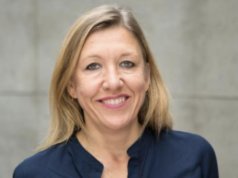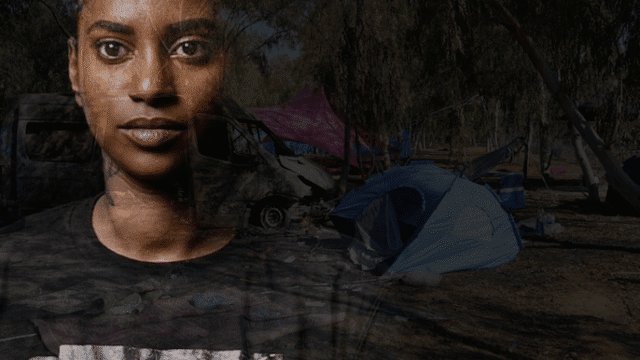
Ethiopian-Israeli Mazal Tazazo survived the Nova festival massacre in southern Israel on October 7 2023 in circumstances that seem close to miraculous. Her story is told in This is NOT a Movie Script, a short film screening online this week as part of the UK Jewish Film Festival. Made by London-based Joëlle Bentolila at Chimaera Films, it is intended as the first in a series of stories that will be put together in feature documentary form.
“On October 7th, so many things happened in many different places. People don’t understand what happened that day,” Bentolila says. “I wanted to do memorialisation work while telling the harsh truth in a very organic and real way.”
In the film, Tazazo is shown talking to camera in a studio setting, recounting what happened to her on October 7. Hamas terrorists caught up with her and murdered her two friends. She received severe head injuries but played dead and somehow survived. The name “Mazal” means luck – and on that day, she had her share of it.
“I’ve done so much research and the stories never stop. All of them are unbelievable,” Bentolila says of the experiences of Tazazo and other survivors. Some belong to the organisation, Survived to Tell.
The director listened to their accounts and then wrote scripts based on their testimonies. Tazazo’s family had left Ethiopia because of persecution. She now lives in the Israel city of Sderot. She sent Bentolila her private footage of the events at the Nova Festival. The film also includes images shot by the terrorists themselves on their Go-Pro body cameras and then posted online.
“There is another part of her story – how she got rescued,” the director notes of an episode that she also plans to cover.
Tazazo was delighted to hear the short documentary about her had been chosen for a festival in the UK. “This truly moves me, and I feel happy and grateful that such content – and especially myself (as a non-traditional figure of an Israeli Jewish woman with darker skin) – is reaching the UK, London in particular, and the world at large.”
The short is billed as “the first of a series unmasking the brutal realities of October 7.” The Tazazo episode is intended as “a bit of a test” to see how people relate and respond to the material.
“The survivors of the Oct. 7 massacres are feeling unheard and misunderstood by the international community and the world,” the director explains why she taken on the project. She wants to debunk the claims that still circulate by deniers that the massacres didn’t happen, even though they were “filmed by the terrorists themselves, and sometimes live-recorded…”
Survivors have been in a terrible situation. “They feel their trauma is downplayed or denied. All suffer feelings of isolation, brutal PTSD, and survivor’s guilt. A few of them took their own lives. That’s why I got into this and made this film, and will make the other films. Not for politics—just to say: this happened. They lived it. It is the truth, and that’s the reality, which I feel should be known and not forgotten. Hence the title. So, fingers crossed, more films and stories of survivors are coming.”
The other parts of the feature will also include the story of a young Israeli woman who was in Japan on October 7. She received notifications on Facebook from her grandmother who was living in a kibbutz that came under attack. The terrorists used their victims’ own phones to live stream the killing.
There will also be an account of the experiences of a young woman who spent the whole day under the body of her massacred boyfriend who had died in a grenade blast while trying to protect her. The couple were planning to marry. They had received notifications to be careful but hadn’t been quick enough to get away.
Another story unfolds in a military base where the soldiers noticed relatively on security screens what was happening at the border. A woman there had been trying to flag her concerns but nobody would listen. The base was eventually attacked. Gas was thrown into the control room and the woman was the only one there who managed to escape.
“It is going to be a bit more controversial because it touches on the slow reaction of the [Israeli] military and government.”
The director acknowledges it is very difficult to work with subjects who’ve endured such harrowing and horrific experiences. “You have to be very understanding of them…but what was great in working with Mazar was that she was very restrained,” she says of how the discipline and bravery of her Ethiopian-Israeli subject in front of camera.
Bentolila repeats that here is still widespread ignorance about the events of October 7. This hasn’t been helped by what she believes to have patchy and selective media reporting.
Her own parents live in southern Israel and she remembers “going crazy” with worry on the day of the attacks. “I was trying to reach them to check everything was OK. They lived in the city that, it was later discovered in the plans, was the next one to be attacked. I wanted to tell them to barricade themselves [in].”
The attacks took place during the Jewish holiday of Sukkot. People had their phones turned off and were taken completely by surprise.
This is sensitive and deeply polarising material. If the short had been screened physically, there would have been risks of disruption and even cancellation. “But what I was trying to do was not to get political, but to say how she lived it,” Bentolila says of her short. “I wanted Io see the impact of it emotionally.”
Now, the director is raising money to complete the project. “Basically, my goal is to show the truth…do whatever you want with it but this is what happened,” she insists.