The World Upside Down by Agostina Di Luciano & Leon Schwitter, world-premiering April 7 in Nyon, contains two dramatic and emotional epicentres, both of which verge on the fantastical.
One evening farmer Omar is sitting outside beneath the stars when he begins to feel uncomfortable. When he opens his mouth a light-ball emerges, which floats away, leaving Omar confused and a little frightened. The doctor says he’s fine, explaining that is probably pre-cordial catch syndrome, a harmless ailment that rises up in the chest and throat. Of course other folk offer other explanations. Grandson Noah thinks it may have been a mirage and witchcraft is mentioned by another person, while his daughter Dana simply laughs at the story.
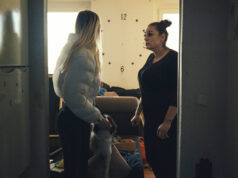
Elsewhere, two housekeepers, Rosana and Lily, dutifully return several times a week to clean a lovely house in the country that really doesn’t need cleaning. The owners live in Buenos Aires and are never there, too busy to ever return, it seems. When the cleaners discover a strange brick wall behind a cupboard door, it takes on a quasi-mystical status, and the women feel compelled to light candles and incense before it. In what feels like an act political defiance, they also feel emboldened to make full use of the house, drink coffee on the terrace, wear the owner’s clothes and frolic in the pool. At the film’s end they stand before the wall to call invoke the rise of the worker.
Meanwhile, youngster Noah shares time with his grandad Omar, also managing to lose a horse in the woods, as single mum Dana goes out dancing in search of companionship.
The house in the film owned by the family of co-director Agostina Di Luciano, and was a place she would regularly visit as a kid, in the process getting to know Dana and her family. What’s more, the country life that Di Luciano observed throughout her childhood was one coloured by superstition.
“I think we were both very fascinated by that kind of life, which is more based on rituals,” agrees partner Leon Schwitter. “We were always very fascinated by these topics and also by things that are still very unexplainable to us humans. And I think that’s very, very much in this region. There are lots of legends, and the people – at least the people that we filmed – they live a life that is not the urban life.”
One such legend is that of the missing Virgin in the local church, whose shadow is said to remain on the wall. “My grandma was always talking about this Virgin that disappeared,” says Di Luciano of her visits to the region as a young girl.
An unusual impetus for the film was a chance meeting the filmmakers had in Mexico with German director Heinz Emigholz who told them of the sadness he feels if he is not making at least three films per year. “We were like, but how do you do it? And he’s like, I just do it.”
So they decided to head off to Argentina to make a film. “Augustina told me about this whole town and the story of the house and we were like, that could be something,” says Schwitter. At first they wanted to recreate a Twin Peaks vibe. “But then the film evolved and evolved. It didn’t really have a script, so it was kind of a chaotic but a very nice spontaneous process where you just observe and try to connect the dots and every time you meet someone you think, could this be something?”
“So it was a big collection of stories, thoughts, observations, and then meeting this family [Omar, Dana and Noah] who we were quite sure from the beginning we wanted to do something with.”
The filmmakers underline that a recurring theme for them is ‘community’ (and its seeming disappearance in the 21st Century). “We [as a species] are just communicating, but there’s no real community anymore,” Schwitter opines of what he sees as a collective malaise. “We just communicate for ourselves and for our own ego, but we don’t really share as a community any values. I think for us it was very interesting to see that there was a community,” Schwitter underlines of the Argentinian family. “And Rosana and Lily, the cleaning ladies of the house, they are sharing together also a daily habit of talking, of sharing values, of communicating. And for us, we wanted to make a film that conveys a bit of hope.”
There is a strong epicurean, organic sense within the film, reminiscent of the spontaneous, freewheeling, collaborative approach of fellow Argentinian director Mariano Llinás (La Flor).
“I think it may be a very Argentinian cliché, but I think in Argentina people just find solutions with the materials they have,” says Di Luciano. “Sometimes it’s crazy how much you can do with very little.”
“It’s very liberating,” Schwitter concurs. “I’m part of this production company collective called Sabotage. And we’re just eight friends who want to make films together. And I think that’s always the most beautiful thing. Even with this film, with this process, all the people that joined our crew, also in the post-production, in the end we are all just good friends and we’ll stay friends for life.”