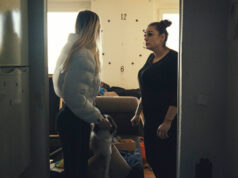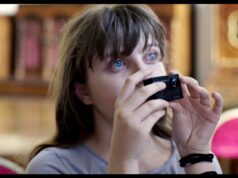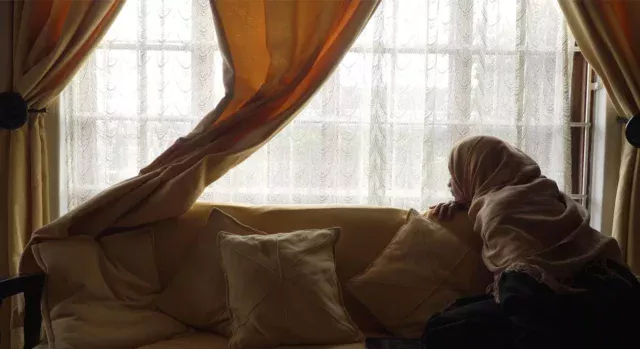
Lulu Scott’s new feature doc Where Two Oceans Meet (a world premiere in VdR’s International Feature Competition) looks very closely at the life of a family in Mitchells Plain, a township not far from the Cape of Good Hope. The wife Kulsum Orrie and her two children are waiting patiently for the release of her husband, Phadiel, who is serving a 25-year prison sentence.
As Scott explains, the title of her movie reflects the history of South Africa “which is based on separation.” At the Cape, the Atlantic Ocean is to the right, the Indian Ocean is to the left. For reasons that still baffle scientists, the waters of the oceans never mix. During the Apartheid era, which lasted from the late 1940s to the early 1990s, the country’s political and administrative system was dominated by the minority whites and it was forbidden to marry across racial lines.
Now, 30 years after the end of Apartheid, Kulsum is enduring her own separation.
Director Scott first encountered Phadiel when she was in her early 20s. He was part of the “Group of Hope,” an organisation set up by inmates at a maximum security prison to help AIDS orphans. The initiative was supported by her mother.
She met and began to write to the inmates. “Because I was involved with this group, I was allowed to take images into the prison,” she says of how she could share pictures of the outside world with the prisoners.
Scott later went to art school in Nimes in France where she specialised in sculpture, video and photography. “All the things I did [at the school] were around correspondence with some of the inmates and some of the objects that they made – they made these paper beads.”
Some of her teachers there grew frustrated at what they saw as her “unhealthy obsession with some prisoners in South Africa…they criticised me a lot for being a white woman with projects around Black men in South Africa.”
Scott received more encouragement when she went to do a masters in creative documentary at film school in Lussas on a course overseen by the University of Grenoble. She was already beginning the project that would become Where Two Oceans Meet.
Although based in France, Scott returned frequently to South Africa to visit family and friends – and to work on the documentary. Much of the film is shot inside the family home in Mitchell’s Plain.
“There was something almost theatrical about [their] little living room. The space is quite small and so it took me a while to get used where I could actually put the camera with the light and the angles. I know the space very well now because I have been filming there for nine years.”
Early on, Kulsum had expressed misgivings about appearing on camera. Soon, though, her attitude changed. She confided she was terrified of the camera being stolen. “She said ‘I wouldn’t want to lose our film.’ From that moment on, in 2016, I knew that she was on board. The camera was always there. Now she says she misses it. The camera just had a space in the house and everybody accepted it.”
Scott would often stay overnight. “I kind of became part of the furniture.” She would also use a few little ruses to get her subjects to open up. For example, she realised that Kulsum’s daughter Mariam was at her most relaxed while sitting on her own in a car in the garage. She therefore filmed Mariam there, giving her the chance to speak very frankly about her feelings toward her absent father.
“That’s where she likes to sit with the cats and just talk about how she feels about him coming home.”
Kulsum’s son Yusuf was a little more wary. “His presence in the film is a lot more evasive and on the periphery. That kind of represents his relationship with me and Kulsum as women in the house…when I did have conversations with him, there wasn’t the same intimacy and ease.”
On one level, the director suggests, her film can justifiably be seen as “a big love story.” Despite Phadiel’s predicament, the family sticks together through all the bad times and he is eventually released from prison.
However, Kulsum also needs to readjust after so many years without her husband. It would therefore be naive to expect a Disney-style ‘happy ending.’
“I would like to see this as an empowering, optimistic film – but, with that, there are the complications,” the director muses. “ Now, in reality, it [Kulsum’s life] dances between the two. There are moments when it is obviously very, very hard, but then there is this elation that he is back home.”
Scott showed the film to the family just before Visions du Réel. “For Phadiel, to hear Mariam talk about his absence like that was quite a shock. He said that they don’t actually talk about it [his years away]…I think the film has opened a dialogue [between them]. They did watch it a few times and I think they needed to digest everything.”
Whatever else, Phadiel’s release from prison provided Scott’s documentary with a natural ending. “Kulsum said it to me: now that Phadiel is home, it is almost like you have to leave…it really felt it was like the end.”
Scott deliberately shoots Phadiel’s return in discreet and respectful fashion, from a distance, making sure he and Kulsum have as much space as they need.
For obvious reasons, Phadiel was very moved by the documentary. It was giving him a precious glimpse of many parts of his family’s life that he had missed. “He was crying a lot. As he watched the movie several times, he said it was a beautiful depiction of their story and that even though it is a small part of the story, it’s a record and it shares the hardship and the love.”
Now, social workers are keen to use the documentary as “a tool in prisons and correctional services for people [inmates] to understand the repercussions of their actions, what goes on behind the scenes, and the effect it has on families.”
Early on, Scott was working on the film on her own, without outside backing. “It was funded by me and my family indirectly because I would always go and stay with them. I felt that I needed to keep filming.” She was doing the writing, shooting and editing all at the same time. Her editor Agnès Bruckert was involved for around three years. “She started working for free, basically. She said, ‘I know you’ll get some money one day but I think you need to start looking at all the rushes and thinking of a structure.’”
Eventually, sure enough, backers like the CNC, LaScam and PROCIREP, the civil society of Film and Television Producers, got behind the film.
“I hope it is a story that can resonate with many different audiences,” Scott concludes of the film she spent so many years working on.