

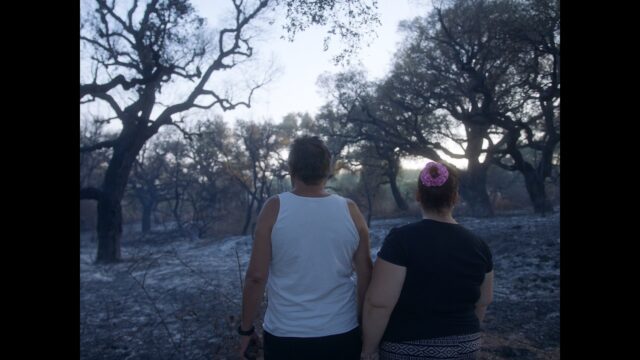
If you go to Niscemi in Sicily, you’ll find both picturesque woodland and, very incongruously, a US base housing a Mobile User Objective System (MUOS) satellite ground station.
Few people from outside the area are aware of the base’s existence but it features prominently in Francesca Scalisi’s feature documentary Valentina and the MUOSters, screening in the National Competition at Visions Du Réel.
As Scalisi notes, “it’s a really, really important place” for the Americans. Military operations involving US interests all over the world are coordinated here. But understandably the local people don’t like having this base, with its huge antennae, looming over them in their backyard. MUOS itself was installed in 2014. Electro-magnetic waves from the base are potentially very bad for the health of anyone who lives nearby.
“Aesthetically, it is terrible,” the director says of the “devastating” impact the US base has on the local environment. It is located in the middle of a beautiful reserve.
When Scalisi went to the area, she met Valentina, a woman in her 20s, living with her parents in humble circumstances in front of the MUOS.
“I was shocked. They were living in front of the antennae. Each day, they were confronted by the military,” the director reflects on the family’s difficult predicament. “I was thinking why do you stay there to live? It’s terrible.”
She discovered, though, that Valentina and her parents had a deep love of the land.
Valentina is in a tough situation. She is still living at home, dependent on her ageing parents. Her father’s health is declining. (His pacemaker is affected by the signals from the antennae). She yearns for independence.
“For me as a filmmaker, it is very important to create a relationship with my character,” Scalisi says of how she earned her subject’s trust. “I spent a lot of time [with her]. It was a four-year journey. Each summer I was in their house. During the year, we were calling, sending messages. I think I showed them [the family] that I cared for them and was very interested in their life.”
Many other media outlets and reporters visited the family and reported on their predicament. Most, though, quickly left again. Scalisi stayed in touch. She showed the family exactly what she was planning to do in the documentary.
“In the beginning, it [the film] started as a story about the base. But then, as I was discovering that the fight was gone and there was no hope anymore, I met the family. I found their resistance [to the base] very interesting,” Scalisi explains why she shifted her focus onto Valentina and her parents (‘this little family that no-one knows.’)
Valentina and the MUOSters is one of several eco-themed documentaries in which Scalisi has explored the predicament of local people whose lives are affected by events they can’t control. The feature length doc Half-life in Fukushima (2016) was made with her partner, Swiss director and producer Mark Olexa, and told the story of a man who refused to leave home in spite of the nuclear disaster on his doorstep. Ligne noire (2018) looked at the tragic human and environmental cost of an oil spill in the mangrove swamps of southern Bangladesh. (The oil caused “a huge black line” on the landscape).
“We are talking about something you can’t see but that is very dangerous probably,” Scalisi observes of situation of the family in the new doc.
Sound editing is very important in her work. It helps express “this danger you can’t see, you can’t touch [it] but is there in the air.” She pays tribute to composer Olga Kokcharova, who tried to show the threat to the family through her music and sound recordings that she did in Sicily.
And, yes, the director was at times worried about her own health. She was pregnant when she was shooting the film. “But I think for a short period, it was not a problem. I was not living there.” (She adds that she was also pregnant with her first child when working on the Fukushima doc and didn’t travel there herself because of her health concerns.)
Scalisi, who is Italian but based in Switzerland, met Olexa, her partner with whom she runs DOK Mobile, while at the ZeLIG School for Documentary, Television and New Media in Bolzano.
“We were thinking of staying in Italy because we had all the contacts there but it is very difficult to work as a filmmaker in Italy,” the director explains why she and Olexa set up in Switzerland instead to take advantage of more reliable regional and federal funding. They have their own “green consultant” and try to make their films in the most sustainable way possible.
Valentina and the MUOSters is yet to secure distribution. The filmmakers run their own festival, The Flying Film Festival, which takes place entirely on Swiss Air Lines’ flights. Valentina won’t show here, partly because it is a feature and partly because there would be an obvious conflict of interest if the filmmakers programmed their own movie.
Nonetheless, Scalisi has been heartened by the “very moving” premiere of the film in Nyon. Protagonist Valentina was in attendance and was answering questions. The film will surface eventually on national Swiss-French TV.
The director herself isn’t rushing into a new project of her own quite yet. “I am just having a pause after this movie. I felt very exhausted,” she confides. “It was really too much…”





