The final instalment of Wang Bing’s monumental, masterful Youth trilogy about the young, overworked and underpaid workers of Zhili’s vast textile district, strikes a melancholic note after the high-strung energy of its predecessors.
When I reviewed Wang Bing’s Youth (Hard Times) for Business Doc Europe in August 2024, the second part of his Youth trilogy following his Cannes 2023 Youth (Spring), I predicted that the final episode Homecoming would shed light on how the young workers of Zhili’s chaotic and stressful textile workshops see their future.
I wrote: “Will the future of these young workers maybe lie not in Zhili, but back with their families in the rural provinces of Yunnan, Guizhou, Anhui, Jiangxi, Henan and Jiangsu, where most of them come from?”
And indeed, as the name suggests, Homecoming does deepen our understanding of their roots and family relationships back home, which were only touched upon in the first two episodes. But it does not, as I thought it would, give us much of an insight into their future plans and prospects. After watching all three episodes, I’m not even sure anymore which ‘home’ the title is referring to. Is it the small villages where they reunite with their families? Is it, for better or worse, the cramped, rundown and mind-numbing workshops? Or… neither? Will these twenty-something workers simply remain uprooted and uncertain for the rest of their lives?
After the energy which, despite everything, radiated from Spring and Hard Times, Youth (Homecoming) left me melancholic and disheartened. I couldn’t see this system continuing forever (the final instalment shows that, by 2018, many workshops had moved or gone bankrupt), and I also didn’t get any idea about what could be next for these young workers, who were still producing textiles for the national market at breakneck speed, for long hours and low wages.
When I spoke to director Wang Bing in Venice, he told me that this was precisely the sentiment behind this final episode (the three parts were shot chronologically between 2014 and 2019). “There’s always a chance, and there’s always hope, to find a different job, but it will be with the same conditions. So if you consider this, you can say that their lives actually have no future.” When asked how he himself had changed since his breakthrough documentary, Tie Xi Qu (West of the Tracks) in 2002, he answered: “At that time I was full of energy and hope because of the economic and political developments and the benefits they could bring to people’s lives. And subsequently to my own. But now, with this film, it’s not the same. I have experienced twenty more years of life, with all the ups and downs that these years have brought, and it has led me to think that there is no actual hope for a future.”
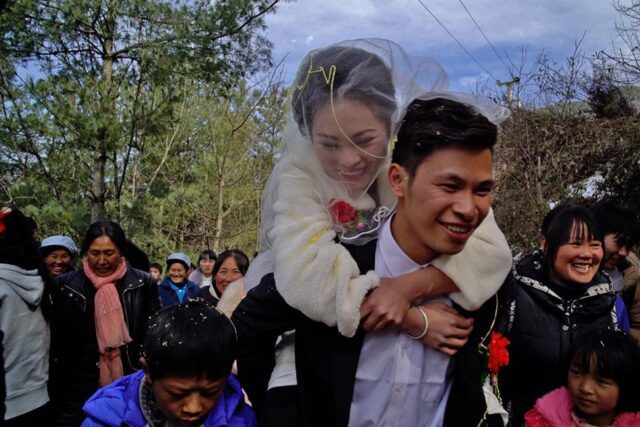
So yes, we see workers getting married and celebrating New Year in their home towns. But then they go back to their workshops, work from sunrise to way past sunset, sleep above their workplace, and hardly ever go out for even a meal or a drink. In previous episodes, we’ve seen other workers with a small kid running around among the noisy sewing machines while both parents continue to work the same long hours. Getting married and having children traditionally means entering a new phase of life – hence the accompanying rituals. But nothing seems to be fundamentally changing here. When one worker says, “As long as there’s work, there’s life!”, it doesn’t sound hopeful or uplifting. It just sounds depressing.
After the vibrant energy with which we met the young workers in Spring who, despite their long working hours and meagre wages, still found the time to flirt, argue, tease and make love, and the more hard-boiled energy of Hard Times, where the focus was more on navigating the challenges of uncertain wage negotiations, unreliable police intervention and unpredictable business situations, the more melancholy tone of Homecomingmeans that this 152-minute film can actually feel longer than its three-hour-plus predecessors. Long, uncut walks through the rural countryside back home have a different vibe when compared to the busy streets and buildings of Zhili’s textile district.
Seen as a stand-alone film, Homecoming is inevitably less gripping than Youths 1 and 2. Had all three parts been edited as a single film (running around nine or ten hours, omitting some of the recurring imagery necessary to make each episode stand on its own), as per the original intention, the trilogy would be nothing short of a masterpiece.
France/Luxembourg/Netherlands, 2024, 152 minutes
Director Wang Bing
Production Gladys Glover Films, House On Fire, CS Production
Producers Sonia Buchman, Vincent Wang, Mao Hui, Gilles Chanial
International sales Pyramide International
Cinematography Liu Xianhui, Song Yang, Ding Bihan, Shan Xiaohui, Maeda Yoshitaka, Wang Bing
Editing Dominique Auvray, Xu Bingyuan
Sound Ranko Paukovic