

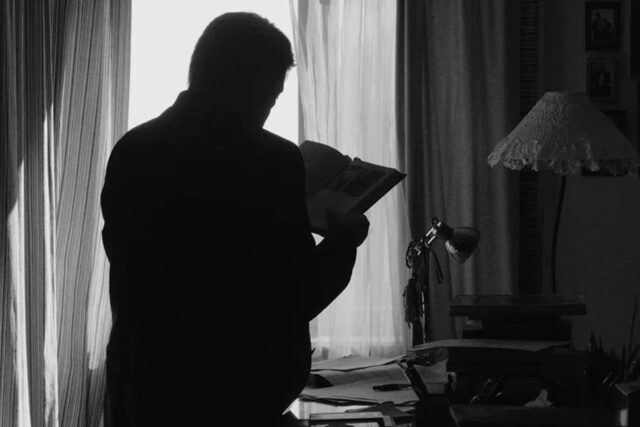
“Because I am alive!” Alexander Sokurov replies quietly to Business Doc Europe when asked what led him to embark on his monumental new, five-hour long archive-based documentary, Director’s Diary. In the film, sold by Films Boutique and a world premiere Out of Competition in Venice, the 74-year-old Russian director takes viewers on an epic but very personal journey through late Soviet history.
“I am able to think. I am able to observe,” the Golden Lion-winning director of modern-day classics including Mother and Son, Russian Ark, Moloch and Faust continues. “I understand that what is happening now started in the past.”
The project, Sokurov emphasises, was not made with any Russian state funding. An Italian-Russian co-production, it was produced instead through Sokurov’s own non-profit Example of Intonation support fund, and with Italian backing from Revolver (Paolo Maria Spina) and Bielle Re (Giuseppe Lepore).
Director’s Diary opens with its narrator writing by hand with an ink pen. “For years, I collected all sorts of material that caught my attention and I memorised what was happening far away,” he tells us.
We begin in 1957, just as the USSR decides to start construction of the Plesestk Cosmodrome, and increases the minimum wage and scholarships. The documentary interweaves footage from old films and newsreels with text on the screen describing events in Russia and abroad, everything from the resignation of Thatcher to the murder of Pasolini. Our epic journey into the heart of 20th Century darkness finally ends in 1990, just as Boris Yeltsin is elected Russian president amid much euphoria, and a year before the collapse of the Soviet Union.
Sokurov sees himself as a historian as well as a filmmaker. His answers are a little cryptic but he suggests that what is happening now, for example all the ongoing tension, war and social upheaval in former Soviet republics, had its roots in the events depicted in his documentary. In one part of the film, we see footage from the Malta Summit in 1989 where Mikhail Gorbachev and George Bush declare the end of the Cold War. Sokurov, though, circles a piece of text shown on screen which reads “USSR alarmed by NATO’s proximity.”
Some of the footage in the documentary seems to portray Soviet life in a positive and even nostalgic light. We see Russian people dancing and enjoying themselves; we watch happy factory workers extolling their lives, and we hear about Soviet achievements in science, industry and culture. However, the text that accompanies the images also always tells us about disasters, wars and abuses of human rights.
“It’s true there are people dancing and singing but people are not living for political issues. They’re living their own lives,” Sokurov draws a sharp distinction between the Soviet citizens and their leaders. “Have you ever seen a politician who is singing and dancing? They are never in a mood to sing and dance for happiness…”
Ask Sokurov about the situation currently in the Russian film industry and he gives a non-committal answer. He has had his run-ins with the authorities, and is clearly wary about what he can disclose. “It’s a very dangerous question for one who has to return to Russia…”
Unlike his fellow filmmaker and near contemporary, Nikita Mikhalkov, who won an Oscar for Burnt By The Sun, Sokurov is not close to the Putin regime. “I am not condemning them,” he says of Mikhalkov and his family and associates. “This is their life and they are convinced in what they do. Time, history, will show who was right, me or them. But I think it’s very bad when politics is intruding in artistic choices. The artist must stay on the side of art and culture, not of the regime or political issues…but the pressure of power is heavy in every country and so the artist is forced to close the border [with] the other side. It’s not only in Russia – if an artist in Western Europe proposes something against the political values, maybe he will have difficulties too.”
In today’s deeply polarised world, Sokurov adds, different perspectives are simply not allowed to co-exist, and there is therefore no dialogue. He is not talking just about Russia but about the lack of “ethics” in Europe too. Since he arrived in Venice, he has been watching European TV stations including the BBC and CNN, which are currently banned in Russia. “I see that there is just one point of view reported, just one,” he sighs with evident disappointment. “It is the same mood, the same opinion. I don’t see discussion.”
When asked about the ongoing attacks on Kyiv, he deflects the question, talking instead about old US wars in Iraq and Vietnam, or the bombing of Belgrade in the 1990s.
Director’s Diary is unusual in Sokurov’s work in that he is at its centre. “This is my first film in which my life is part of the narrative. I witnessed it, I saw these events happen,” he says of the characters and incidents portrayed. “As an example, for some years I was close to [President] Yeltsin, as a friend. He called me himself and asked me to meet him. Our friendship started from that first meeting. So I witnessed several events that happened in those years.”
Through all the years, Sokurov has kept his own notebook. In the documentary, he is trying “find some system” for describing what he observed over the last six decades. One constant is never-ending conflict. “Wars, wars,” Sokurov says of the history of violence in Europe, Russia and the US. Wars are easy to start, he suggests, but very hard to end.
Ask the Russian director if it still possible for him to make dramatic films on the scale of Moloch and The Sunand he replies in enigmatic fashion: “it depends on how my destiny will be considered in my motherland.”
Sokurov’s deep affinity for Russia is self-evident but so is passion for the foreign painters and writers whose work inspired him as a younger man.
“Maybe for my artistic roots, I am more an Italian filmmaker than a Russian one. This is because of the influence of the paintings, the cinema, the architecture – it is inside me,” he rhapsodises about Giotto, Leonardo Da Vinci and Dante’s The Divine Comedy. A bit of an anglophile, he describes himself as a strong admirer of Charles Dickens, George Bernard Shaw and British theatre in general. He’s fascinated, too, by Winston Churchill, (“I admire some parts of his character”) who features in his 2022 allegorical feature, Fairytale, which also depicted Stalin, Hitler and Mussolini – and was banned in Russia.
“It’s my life, they can’t take it away from me,” he says of the art and culture he grew up with.
His film ends ambiguously with the narrator laying down his pen having written one final entry in his diary: “happy are our loved ones, who have died before us…”
What will happen to the new documentary now is hard to predict, but there is already huge interest in it, Sokurov only finished the film a few days ago. However, his sales agent Films Boutique confirms that other festivals and buyers are tracking it closely as it is such an “important piece.”





