John Lennon once gave an interview in which he said that after The Beatles broke up and he decamped to New York, all he did was watch TV. That’s how he made sense of his new life with Yoko Ono in Greenwich Village in the early 1970s. This transformational period ended with the famous “One to One concert,” Lennon’s final full-length gig after The Beatles.
Prolific Scottish documentary maker Kevin Macdonald takes Lennon’s compulsive TV watching as the frame for his new film, One to One: John & Yoko.
Don’t expect voice-overs or intertitles to explain what is going on. Instead, we’re taken on a channel-hopping jaunt through an era when you might be watching horrific footage from the Vietnam war one moment and enjoying a chat show, sitcom or game show the next. (Macdonald steeped himself in US TV from the period to understand what his subjects were experiencing and quickly discovered “it is uncannily like what we are going through today politically and culturally.”)
The television would be on all the time in John & Yoko’s apartment. If they weren’t watching something seriously, they’d simply turn down the volume.
We’re put in Lennon’s frame of mind as he tries to figure out what his life should be post-Fab Four. We’re also given a sense of the abuse that Yoko endured from the media and fans who continued to blame her for splitting up The Beatles.
In telling their story, Macdonald was “just using what was in front of me, what was there in audio and archive.”
Thankfully, plenty of material survives. This ranges from some riveting concert footage to phone call recordings, snippets from John and Yoko’s own TV appearances and clips showing them with counter-culture activists like Jerry Rubin, poet Allen Ginsberg and Abbie Hoffman. Yoko and her assistant are also heard trying to procure flies to use in her latest conceptual art exhibit.
Some of the most vibrant 8mm material comes from films made by the late Jonas Mekas, the Lithuanian filmmaker and poet who became a Pied Piper-like figure in the bohemian New York art world of the period.
“My idea was not to overly structure it [the film]. It’s a bit like when a person dies, you go to their house and you find these shards of a life. What is left behind after somebody goes is a few photos, some video maybe, some letters. That’s obviously not the whole story of their lives but it is what is left there behind.”
The director is effectively challenging his audience to make up their own minds about John & Yoko. Most viewers will surely feel that the couple emerge in a very positive light: artistically adventurous, socially engaged, anti-materialist (despite their wealth), anti-war; desperate to engage the youth in politics but ultimately still smart enough to resist being drawn too deep into a protest movement that was becoming increasingly violent and macho. Lennon was teaching himself how to use his celebrity to “do something simple and decent that is going to change things.”
Macdonald spoke to Sean Lennon, John & Yoko’s son, by Zoom at the start of the project. “He just said to me ‘that sounds like an idea my mum will really love.’ Then, at the end, he watched the film and the first thing he said was…’wow, that’s heavy.’ I think it’s heavy because he’s spending time with his mother and father from a period before he was born. I don’t think he had listened [before] to any of those phone calls.”
Sean, though, was very happy with the way Macdonald caught his mother.
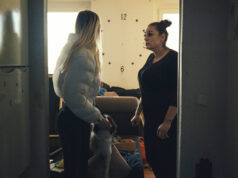
The director was working with Oscar-nominated production designer and set decorator Tatiana Macdonald (whose credits range from Billy Elliott to The Hours). She’s also his wife, the Yoko to his John. She designed the apartment, going to exhaustive lengths to make it look exactly as it would have done when Lennon and Ono were living there. (This was one of the only non-archive elements in the film).
The film includes poignant footage of an elderly Charlie Chaplin being accepted back into the US for his honorary Oscar after he had been forced to leave the country for many years because of allegations about his communist beliefs. Ironically, at the very moment Chaplin is returning to America, Lennon is being threatened with deportation.
One to One: John & Yoko is among the first projects to come through Macdonald’s joint venture with Plan B, the company run by, among others, Brad Pitt, Dede Gardner and Jeremy Kleiner.
The film is screening in Telluride immediately after its Venice premiere. Cinetic is handling world sales.
This is Macdonald’s third feature in the space of just over a year, following on from Klitschko: More Than a Fight which he made in Ukraine, and High & Low, has film about the brilliant but troubled designer John Galliano.
“I am taking a long break. I am going to loads of festivals, I’m going to be on the jury of a couple…and I am going to have a nice few months,” he explains why there isn’t anything new in the immediate pipeline.