

Back in 2023, Luke Lorentzen garnered the Best Director (Doc) prize at Sundance for A Still Small Voice, a film about an aspiring hospital chaplain who begins a year-long spiritual care residency during Covid at Manhattan’s Mount Sinai hospital.
“It really was an extraordinary experience, but it really beat me up and left me very drained, and I intentionally set a goal to have a lot of fun making my next film,” Lorentzen tells Business Doc Europe of his decision to head up the coast to Brooklin, Maine, a town of just over 800 inhabitants, to spend a year chronicling life within the local boatbuilding community.
“I grew up in Connecticut, just outside of New York City but I had a childhood love for Maine, and I really wanted to explore that in making the film,” Lorentzen adds. “It was a place where I wanted to spend more time and was curious to get to know even better, and the project came about really through a desire of wanting to make a film in my favourite place.”
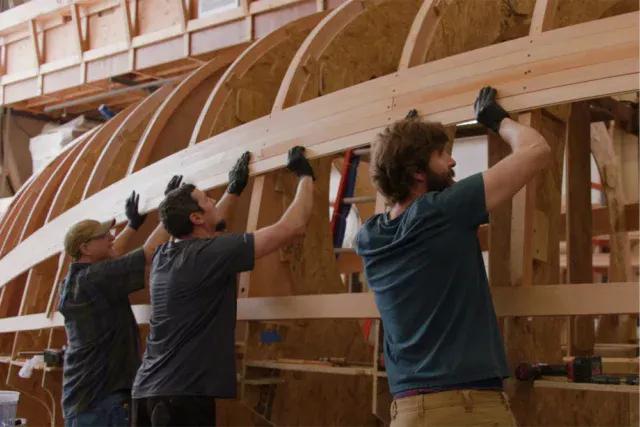
In the feature documentary, sold by MetFilm and which world-premieres in Venice, we meet some of the workers at the 60-strong Brooklin boatyard who, over four seasons, are tasked with building a 56-foot luxury sailboat. Key among these is kindly company boss Brian Larkin and new dad Trent, an immensely capable and skilled craftsman, but a little lacking in assertiveness. What we are offered over the course of 100 minutes is a sublime meditation on skill and competence and an immensely satisfying immersion into coastal life, before witnessing the eventual delivery of a masterly constructed sailing boat.
Is there conflict in the documentary? Yes, at times. One man is fired and pleads for his job, but the process is as painful for the bosses as it is for the employee. But the main conflict we see is at micro level. How can a seemingly impossible task, such as lowering the top half of a boat onto the hull, be performed so well, with every drill hole aligned and each join meeting flawlessly along the boat’s 56-foot length? We see planing, carpentry and wood-coaxing. Tile-laying and painting. Sanding, cleaning, spraying, polishing and slow transportation, and so much more. All of which can make for “great cinema and really fun to experience,” says Lorentzen, whose attention to detail rivals that of his subjects.
“I would show up and try to be really attentive and really curious to anything in the yard that revealed some sort of problem getting solved,” he adds. “Time passing, a group of people or a person figuring something out, as well as things that were just visually satisfying or mesmerising, or things that I couldn’t for whatever reason look away from. I knew I got a great scene when it checked one of those boxes.”
“It’s different from any other film I’ve made in that I didn’t set out for it to be a character-driven story,” he continues. “But I was also still really invested in the people that I was filming with, those being Trent and Brian, but also people you just meet once or for a brief moment.”
In cinematic terms, Lorentzen is something of a one-man-band, a production polymath, taking on (in the main) all directing, camera and editing responsibilities. “Really paying attention is a part of my craft that I’ve focused on getting better and better at for almost 15 years now,” he explains. “The ‘one-person film crew’ has a simplicity to it that I love. It minimizes all of the logistical and technical components of filmmaking and makes it a really relational process. It enables a type of intimate storytelling that I find thrilling. My job as a filmmaker is not to overthink or control things, but to be attuned to what’s right in front of me, with enough curiosity that the film slowly comes to life.”
Boatbuilders tells a masculine story, or at least is a film that is populated mainly by men. But this isn’t a story of about toxic masculinity, nor a reflection on what the modern male has become. Rather, it is a story of guys who take great satisfaction in the excellent work that they do, and the company that they keep.
“It’s something I noticed in my first week in the boatyard, just how kind everybody was to one another. And I think that type of masculinity is not something that I set out to explore. If anything, I was concerned that the film was too masculine and that there weren’t more women building the boat,” says Lorentzen.
“But I think it just emerged from the people, and how they treat one another and how they are men who are both very strong and very sensitive,” he adds. “By sensitive, I mean they care about the wood fitting perfectly and they also care about treating the people they work with kindly. Not to speak too generally, but they just have a spirit to them that I really enjoyed being with, and that felt different from the [male] ego or power or dominance that we often see in our culture.”
“They were genuinely interested in caring for one another and working as a collective group.”
Inevitably, we get to meet Graham, the guy who commissioned the boat’s construction. Yes, he is different in tone and style to the humble and modest boatyard folk, and seeing his rich friends at the launch offers further contrast to life in a small community. But, as Lorentzen points out, if it wasn’t for the likes of Graham, there would be no boatbuilding industry with all of its attendant skills and crafts, and sense of togetherness.
“People like Graham make these communities financially [viable]. He is, you know, paying for all of it,” the director adds to BDE. “I was definitely interested in the Brooklin boatyard as a place where people from vastly different places came together and had to work on one project together. This little town was in some ways symbolic both of both the divides and collaborations that I think we experience all around the United States, in terms of wealth and what that looks like, and what that means in terms of how we treat one another and how we think about our own lives, and where we fit.”
“I’m not coming to a project like this aiming to make something that’s critical of the people in it, but just to observe them warmly and show people what unfolds,” he adds. “I think for me, as a filmmaker, the starting point is always curiosity and empathy.”
Lorentzen is happy to concede that Venice, a city rich in maritime tradition, may just be the perfect place to world-premiere his film. “I sort of knew that conceptually, but I arrived here yesterday and I’ve just been on the ferries, and it’s amazing how many boats there are here. Millions. I think it’s a film that hopefully will bring together all the boat lovers of the world, but also reach beyond that and bring people into the experience of what it’s like to work together and build stuff and be a small collaborative community.”
“But I think what I personally love most about the film is how, on one hand, it’s a very simple, straightforward story of building a boat, but it does touch on a variety of deeper human questions that I feel are really timely, and really interesting to me as a filmmaker right now.”





