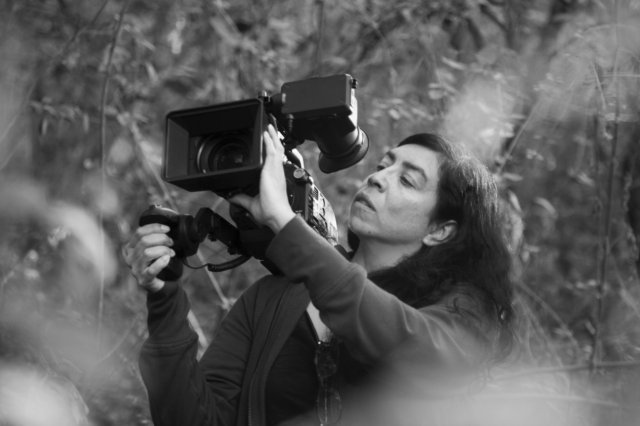
One of Latin-America’s most fêted docmakers, Mexican-Salvadorian director Tatiana Huezo will be participating in a masterclass at Visions du Réel 22 April, speaking live from Mexico City. She set aside time in advance to talk to Business Doc Europe about how working on her latest film, a fiction, compares to the doc experience.
In 2011 Huezo won Visions du Réel’s Grand Prix for Feature-length Doc with her debut El lugar más pequeño. A decade later she has recently completed her first fictional film, Noche de fuego (sold by The Match Factory who were also co-producers).
“I needed a new challenge in my path as a filmmaker,” the director tells BDE of why she decided, after all these years, to make a dramatic feature. She wrote and directed the film which is produced by Nicolas Celis (Roma) and Jim Stark. It has support from, among others, The Sundance Institute, the World Cinema Fund, and the Hubert Bals Fund.
Based on Jennifer Clement’s book ‘Prayers For The Stolen’, the film tells the story of three girls growing up in a rural mountain town scarred by violence and kidnappings.
“Actually, my documentaries have a certain narrative mechanism that is related to fiction,” the director notes. “It has always disturbed me when people make this difference between documentary and fiction.”
A film, she adds, is a film, “a work of cinema.” She has never been one of those who regards documentary as somehow “second-rate” compared to a narrative movie. Both forms have “the same kind of deep creative challenges.”
“I approached this film from my own knowledge of working with reality and working with real people,” Huezo continues. “The girls in this film are not actresses. Actually, it took me a year to find the six protagonists.”
Huezo auditioned over 800 girls before choosing the lead actors. She also researched the locations exhaustively, eventually choosing the mountain town which she wanted to shoot – and then going to live there while she finished the script.
“My approach came from my own documentary processes,” she underlines.
Nonetheless, Huezo acknowledges that she was a little startled when she walked onto the set of Noche de Fuego and realised just how many cast and crew members were waiting for her. “I had never been confronted [before] with fiction’s apparatus. All of a sudden, we were about 100 people in the middle of nowhere!”
And was it fun making a fiction movie? Huezo pauses before answering. “Wow! It was very, very hard and I actually suffered a lot,” she says. “Everything [went] so quick and everything was so costly.” She had prepared meticulously in advance but, even so, the stress levels were high. She had to be careful not to make any continuity errors – an issue that never affected her on her docs.
The most rewarding side was working with the young actresses and seeing their performances develop. “The screenplay was the starting point but I could also trigger other situations. That was something I know from documentary filmmaking. I really enjoyed this freedom that the producers allowed me to have.”
Huezo discussed her ideas about the main sets with her crew – Anna the protagonist’s house, the school and the beauty salon. She then looked on in amazement as the production designer and an army of technicians got to work. “When I stepped into Anna’s house, I realised they had built it so close to what I had imagined. That was something I had never experienced before.”
Inevitably, the roll-out of Noche De Fuego has been interrupted by the pandemic. It was supposed to premiere in early 2020. The producers decided that they didn’t want to show the film online but preferred to wait for another year, until physical festivals and distribution were possible again.
“That was terrible for me because making a film is like being pregnant!” she jokes. “I still haven’t been able to give birth yet.”
Huezo has a strong following among European critics, distributors and festival programmers. However, European audiences have sometimes struggled to believe that some of the darker stories she tells about the violence and exploitation in modern-day Mexico in documentaries like Tempestad can actually be true. The director remembers being told off by a spectator in Spain who berated her for showing such a bleak picture of Mexico which he knew to be “such a joyful, warm and hospitable country, with such great music and where you can eat so nicely.”
The director laughs at that spectator’s tourist eye view of the country. She was equally flabbergasted by a viewer in Abu Dhabi who asked how much the special effects cost in another of her documentaries, and how she created the forest scenes. (She had to explain politely that it was actually a real forest).
In Latin-America, by contrast, the audiences are much more intense. “These films, they tackle shared issues that relate to Latin America, all over, from top to bottom,” Huezo says of how viewers relate to her documentary depictions of violence and exploitation. They will often have suffered experiences close to those shown in her films. This can lead to some very emotional Q&As.
Yes, the lockdown has had some consolations for Huezo, who is developing a new feature doc called The Echo, about childhood in rural Mexico. After working very intensely, she was able finally to spend time at home. “That was something new. The pandemic forced me to stop and spend time with my husband and child…it brought my feet back to the ground and that was something I appreciated. I don’t want to leave anymore!”