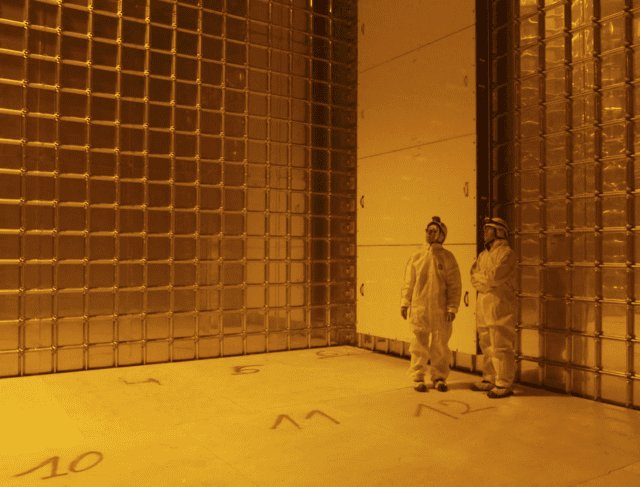
On paper there could be nothing more dull than a fly-on-the-wall documentary recording a series of meetings held as part of the Future Collider Study (FCC). But at these meetings some of the world’s top scientists are developing plans for an upgrade of the legendary Large Hadron Collider (LHC), the largest machine in the world, housed beneath the France-Switzerland border near Geneva, once it reaches the end of its lifespan.
The FCC Study – hosted by CERN, the European Organisation for Nuclear Research – is an international collaboration of more than 150 universities, research institutes and industrial partners to discuss the Future Circular Collider, a machine far larger than its predecessor.
Most of the discussions seen in Way Beyond were shot over two sessions of an independent International Advisory Committee (IAC), which evaluated the work of the FCC as the project was developed, with a four-volume Conceptual Design Report published in 2019.
The discussions are fascinating in their breadth and depth of debate, but also largely driven by a conviction that steps must be put in place to develop further the already ground-breaking work of the Large Hadron Collider. The levels of data coming from the machine is immense. As is said in the film: “Every single year, the LHC generates an amount of data equal to four stacks of DVDs…each one as high as the Mont Blanc.”
That said, “the future collider will produce data by the exabyte…one exabyte equals 1000 petabytes…that is about 326 Mont-Blanc stacks of DVDs,” we hear, before the wry admission that pretty soon no one will ever remember what a DVD looked like.
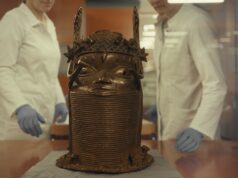
Julier shrewdly avoids dwelling too much on footage from meetings. Sure, watching scientists talk can be interesting, but she nimbly cuts in footage of the building of the original LHC; animation of what the new project could look like and white board footage of bewildering equations, and also makes judicious use of an evocative sound design and score.
There are gentle moments of humour as well – especially when scientists don VR headsets to experience what it would be like if there were an underground emergency – and also times when debate about practical realities must be considered in the face of scientific necessity. Just where the new FCC will be built under France and Switzerland is massively complex issue and there is debate on just how the build will impact communities, setting to one side the undoubted scientific advances of the project.
On a practical level the differences between the countries offer odd and very real challenges. For example there are differences in subterranean land law. In Switzerland individual ownership ends at 200 meters, while in France, ownership extends to 6,378 meters beneath the land’s surface.
Throughout the doc, there is still plenty of footage of exceptionally brilliant physicists from around the world talking about pushing boundaries and chat about striving to reach ‘collision boundaries of 100 TeV’ (whatever that is), but remarkably director Pauline Julier manages to keep things engagingly matter-of-fact while also playing on the massive logistical nightmare that is developing this billion dollar project.
Switzerland, 2021, 60mins
Dir/scr Pauline Julier
Production Close Up Films
International sales Sister Distribution
Producers Joelle Bertossa, Flavia Zanon
Cinematography Marion Neumann
Editors Orsola Valenti
Music ‘Arpeggios N4’ Marc Melia